Last updated 2026-07-23
TL;DR
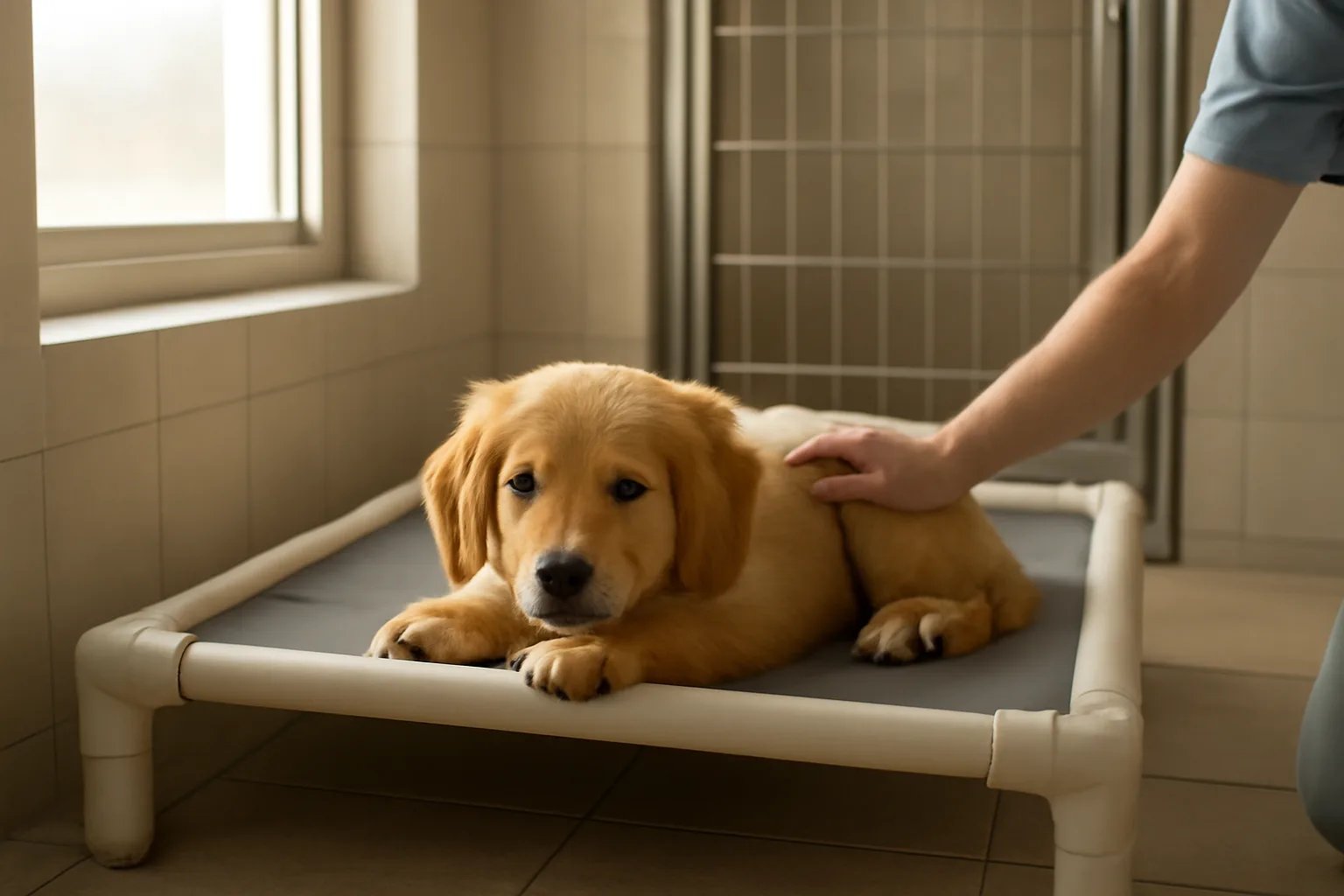
Puppy boarding near me typically costs $30-$85 per night depending on your city and the facility's amenities, with vaccination proof (rabies, DHPP, sometimes Bordetella) required almost everywhere. Before booking, confirm the facility carries a state or county kennel license, ask about puppy-specific supervision, and check vaccine and age minimums since many kennels won't take pups under 12-16 weeks.
How much does dog boarding cost?
Dog boarding for a puppy usually runs $30 to $85 per night in most U.S. metro areas, with rural facilities sometimes as low as $20 and upscale "pet hotels" in cities like New York or San Francisco topping $100 a night. Add-ons push the number higher fast: extra playtime, medication administration, grooming before pickup, and puppy-specific one-on-one attention are often billed separately, sometimes $10-$25 per service per day. There's no federal price-setting body for boarding rates, so what you pay depends entirely on local market rates and what the facility includes. A bare-bones kennel run might just mean a crate, two potty breaks, and food you provide. A daycare-style boarding suite might include webcams, a raised cot, structured playgroups, and a report card at pickup. Puppies specifically often cost more to board than adult dogs. Many facilities charge a premium (commonly 10-20% more) because puppies need more frequent bathroom breaks, closer supervision to prevent them from getting hurt in group play, and sometimes separate housing away from adult dogs until they're fully vaccinated. If a facility quotes you the exact same rate for a 10-week-old pup as a 5-year-old Lab, ask why. It might mean they're not adjusting supervision levels either. For comparison shopping, it helps to look at how dog boarding rates break down by region, and how they compare to dog hotels near me style upscale options versus basic kennels.
What should I check before booking puppy boarding near me?
Before you book, confirm four things: current license status, vaccine requirements, minimum age policy, and staff-to-puppy supervision ratio. Skipping this step is how people end up with a sick puppy or a facility that turns out to be operating without proper authorization. Start with licensing. Most states require commercial boarding kennels to hold a state license, a county license, or both, and some states (like California) leave kennel licensing almost entirely to city and county governments rather than the state itself. Ask directly: "What's your kennel license number, and which agency issued it?" A legitimate operator will have this answer memorized, not buried in a filing cabinet. Next, vaccines. Nearly every boarding facility requires proof of rabies vaccination, and most require DHPP (distemper, hepatitis, parainfluenza, parvovirus) and Bordetella (kennel cough) as well. Puppies under 16 weeks are often mid-series on their core vaccines, which is exactly why some facilities set a minimum age (commonly 12-16 weeks, sometimes higher) before they'll accept a puppy at all. If a facility doesn't ask you for vaccine records, that's a bad sign, not a convenience. Finally, ask how puppies are separated from adult dogs during play and rest. Parvovirus is a well-documented risk in group housing. Cornell University's Riney Canine Health Center, which studies canine infectious disease and shelter/kennel transmission risk, notes that parvovirus is highly resistant to disinfection and can persist in an environment for a long time, making unvaccinated or partially vaccinated puppies especially vulnerable in shared kennel spaces [1]. A facility that mixes an 11-week-old pup into an adult play group is taking a real risk with your dog's health, more than being friendly.
How do you register a dog?
Registering a dog usually means one of two different things: getting a local dog license (a legal requirement in many cities and counties) or registering the dog's pedigree with a breed registry like the AKC (a separate, optional process). They are not the same thing, and mixing them up causes a lot of confusion. For a local dog license, you typically go through your city or county clerk's office or animal control department. Requirements almost always include proof of current rabies vaccination and a fee, which commonly ranges from $10 to $25 a year for a spayed/neutered dog, sometimes more for an intact dog. Many counties charge a higher fee for unaltered dogs specifically to encourage spay/neuter compliance. Check your specific county's animal services or clerk's office page, since requirements and fees vary widely by jurisdiction and are set locally, not federally. For breed registry registration (AKC or similar), you're registering the dog's parentage and pedigree, not fulfilling a legal obligation. That process runs through the breed registry itself, typically requires the breeder to have already registered the litter, and costs vary by registry and litter size.
How do you get a dog license?
You get a dog license through your city or county government, not through a pet store or your vet's office (though your vet may help supply the rabies certificate you need). Most jurisdictions require the license annually or every 1-3 years, and nearly all require current rabies vaccination as a prerequisite. The typical process: get your dog's rabies shot from a licensed veterinarian, take the rabies certificate to your county clerk, animal control office, or the online portal if your county has one, pay the fee, and get a tag. Many counties, like Los Angeles County, run this entirely online now through their animal care and control department. Fees vary a lot by location and by whether the dog is spayed or neutered. Some counties charge $5-$15 for altered dogs and $30-$50 or more for intact dogs annually. Some cities also require a separate "kennel license" if you're housing multiple dogs at one address for boarding or breeding purposes, which is a different, business-facing license from the basic pet ownership tag. If you're operating a boarding facility rather than just owning a pet, don't assume your personal dog license covers you. It doesn't.
How do you get papers for a dog?
"Papers" almost always means AKC registration papers or documentation from another breed registry (like UKC), proving the dog's pedigree and parentage. If you bought a puppy from a registered breeder, the breeder typically gives you an AKC registration application at pickup, which you then complete and submit yourself, usually online, to finalize registration in your name. If you didn't get papers at purchase and you believe your dog is purebred, options are limited. You can try contacting the breeder directly to request the litter registration number. If the breeder is unresponsive or the litter was never registered, there's genuinely no reliable path to "get papers after the fact" for a dog with unknown or undocumented parentage. The AKC's own registration rules tie a dog's registration to litter records filed by the breeder of record, not to appearance or DNA results. DNA testing services (Embark, Wisdom Panel, etc.) can tell you breed composition and health markers, but that is not the same as AKC papers and won't get you registration status. If you just want proof of vaccination and ownership for boarding or travel purposes, that's a much simpler ask: your vet's records and your county dog license serve that function fine, no pedigree needed.
How to become a dog breeder
Becoming a dog breeder legally means clearing three separate layers: local zoning approval for keeping breeding dogs at your property, state licensing (required in many but not all states), and potentially a federal USDA license if you sell wholesale or cross certain thresholds. Start with zoning. Most residential zones cap the number of dogs allowed per household (commonly 3-5 adult dogs before you're classified as a "kennel" requiring a conditional use permit or special exception). Check your county zoning office before you do anything else, because a state breeding license won't protect you from a zoning violation notice. Next, check your state's animal welfare or agriculture department for breeder licensing requirements. States like Ohio, Pennsylvania, Missouri, Louisiana, and Iowa have well-known breeder-specific licensing laws with inspection requirements, kennel size and cleanliness standards, and reporting rules, but requirements vary a lot state to state, and some states have essentially no breeder-specific license at all beyond general animal welfare law. Then there's the federal layer. The USDA's Animal Welfare Act regulations, at 9 CFR Part 2, define who needs a federal license to deal in animals, and a separate provision, 9 CFR 2.1(a)(3)(iii), sets out the retail pet store exemption for people who sell animals face-to-face for pets. Under that framework, breeders who sell dogs sight-unseen (mail order, some online sales) and keep more than four breeding female dogs are generally required to hold a USDA license [2]. Breeders who sell only face-to-face, where the buyer physically visits the facility, are typically exempt from USDA licensing regardless of volume, under that same retail pet store exemption. If you're building out kennel space, cross-check your state's specific facility standards for square footage per dog, ventilation, and record-keeping. A kennel licensing packet covering both your state and county requirements up front saves you from redoing paperwork twice.
What's the difference between dog boarding, dog daycare, and a kennel license?
| Daycare | Daytime only, no overnight | Group size, county business license | Play area safety, staff ratios | |
|---|---|---|---|---|
| Boarding | Overnight stays | State/county kennel license | Housing, sanitation, fire exits | |
| Breeding kennel | N/A | State breeder license + possible USDA | Whelping area, vet records, dog counts | If you're comparing operating models, it's worth reading how pet boarding businesses differ operationally from doggy day care setups, since the staffing and space requirements aren't identical even though both often fall under the same local ordinance. |
Dog boarding means overnight stays. Dog daycare means daytime-only supervised play, no overnight component. A kennel license is the regulatory permit that typically covers both, plus breeding operations, depending on your state and county's definitions. This distinction matters because some jurisdictions license boarding and daycare completely separately, with different fee schedules and inspection standards. A facility that's licensed for daycare only but starts offering overnight boarding without updating its license is operating outside its permit, which can trigger fines or forced closure during an inspection. | Service type | Typical hours | Common licensing trigger | Typical inspection focus |
What vaccines does a puppy need before boarding?
Almost every boarding facility requires proof of rabies vaccination, and most also require the DHPP combination vaccine (distemper, hepatitis, parainfluenza, parvovirus) and Bordetella (kennel cough) at minimum. Some facilities also ask for canine influenza vaccination, especially in regions that have had recent outbreaks. The tricky part with puppies is timing. Cornell University's Riney Canine Health Center and veterinary immunology literature generally describe a puppy series given roughly every 3-4 weeks starting around 6-8 weeks of age, with the core series typically not finished until somewhere around 14-16 weeks old [1]. That means a lot of puppies simply aren't "fully vaccinated" by the time owners want to board them for a trip. This is exactly why so many boarding facilities set a hard minimum age (commonly 12, 14, or 16 weeks) rather than a vaccine checklist alone. Ask the facility directly what their cutoff is and whether they'll accept a puppy that's had at least one round of DHPP plus a vet's letter clearing them for group exposure. Some facilities offer separate puppy-only play areas specifically to reduce exposure risk for partially vaccinated pups, which is worth asking about by name.
How do I know if a boarding facility is actually licensed?
Ask for the license number and verify it directly with the issuing agency, don't just take the facility's word for it. Most state departments of agriculture or state veterinary boards maintain a searchable list of licensed kennels, and most county clerk or animal control offices can confirm a business license or kennel permit over the phone. Red flags to watch for: a facility that can't produce a license number on request, one that's vague about which agency licenses them, or one operating out of a residential zone with an unusually large number of dogs on-site without a visible conditional use permit posted (many counties require this to be displayed). None of these automatically mean the place is unsafe, but they mean you should ask more questions before you hand over your puppy. If you're the one opening a facility rather than searching for one, the same standards apply to you in reverse: your state agriculture department page and your county zoning office are the two authorities you need sign-off from, not a private inspection company or a general business license alone. Building a facility around a dog kennels licensing checklist from day one, covering both state and county requirements, is a lot cheaper than retrofitting after a failed inspection. That's the exact gap our $149 Kennel License & Zoning Packet at /license-packet-builder is built to close: a state-by-state, county-aware starting point for the paperwork, not a guarantee of approval and not a replacement for legal advice.
What questions should I ask a puppy boarding facility before I book?
Ask about staff-to-dog ratios, puppy separation from adult dogs, emergency vet protocol, and what happens if your puppy gets sick or injured during the stay. These four questions filter out most bad operators fast. A reasonable staff ratio for active supervised play is commonly cited around 1 staff member per 10-15 dogs during group play, though there's no single federal standard for this in boarding/daycare settings specifically. USDA staffing and space rules under the Animal Welfare Act regulations at 9 CFR Part 3, Subpart A apply to licensed breeding, dealing, and research facilities, not to commercial boarding or daycare operations, which fall under state and local rules instead [3]. Still, asking the facility what ratio they aim for tells you a lot about how seriously they take supervision. Ask specifically whether puppies are housed and played separately from adult dogs, and for how long that separation lasts. Ask what their emergency plan is: which vet clinic they use, whether it's on-site or a partner clinic nearby, and whether they'll call you immediately or make decisions on your behalf up to some dollar limit. Get this in writing if you can, more than a verbal answer at drop-off.
What does it cost to open a puppy boarding or daycare facility?
Startup costs for a small boarding/daycare facility typically range from $50,000 to $250,000+ depending on whether you're leasing or building, how much renovation the space needs, and local licensing fees. That's a wide range on purpose, because the two biggest variables (real estate and construction) are entirely local. Licensing itself is usually a small fraction of total startup cost, often just a few hundred dollars for state and county permits combined, but the process of getting zoning approval can take months and involves a public hearing in many counties. Budget time, more than money, for this step. A zoning board hearing that gets continued once or twice can add 60-90 days to your timeline easily. If you're crossing into breeding territory rather than pure boarding/daycare, factor in the possibility of USDA licensing fees and annual inspection compliance costs too, which are separate from your state and county fees. The dog boarding and dogtopia style franchise models handle a lot of this compliance centrally, which is part of why franchise fees run higher than independent startup costs, but independent operators can absolutely do it themselves with the right checklist.
Frequently asked questions
How much does dog boarding cost per night?
Most dog boarding runs $30 to $85 per night depending on your city, with rural kennels sometimes under $25 and upscale pet hotels in major metros exceeding $100. Puppies often cost 10-20% more than adult dogs due to closer supervision needs. Add-ons like medication, extra playtime, or grooming are usually billed separately.
How much is dog boarding for a week?
A week of boarding typically costs $200 to $500+ depending on nightly rate and add-ons, since most facilities charge per night rather than offering a flat weekly rate. Some kennels offer a modest multi-night discount (commonly 5-10% off) for stays of 5+ nights, but this isn't universal, so ask directly.
How do I register a dog with my city?
Registering a dog with your city usually means getting a local dog license through your city or county clerk's office or animal control department. You'll need proof of current rabies vaccination and to pay a small annual or multi-year fee, commonly $10-$25 for altered dogs. This is separate from AKC or breed registry registration.
How do you get papers for a dog after the fact?
If a puppy came without AKC papers, contact the original breeder to request the litter registration number, since papers are tied to breeder-filed litter records, not DNA or appearance. If the breeder is unreachable or never registered the litter, there's no reliable way to obtain official pedigree papers retroactively.
How do you get papers for my dog if I don't know the breeder?
Without breeder contact, you generally cannot obtain official AKC or breed registry papers, since registration requires litter records the breeder files. DNA testing services can tell you breed composition but won't produce registration papers. Your vet records and local dog license are sufficient for boarding, travel, and ownership proof.
How to get a dog license if I just moved?
Contact your new county or city's animal control or clerk's office directly, since dog licenses don't transfer automatically between jurisdictions. Bring proof of current rabies vaccination and any prior license or vet records. Most counties process this quickly, often same-day online or by mail, for a fee typically under $25.
How to become a dog breeder legally?
Check your county zoning rules first (most residential zones cap dogs per household before requiring a kennel permit), then check your state's animal welfare or agriculture department for breeder licensing. If you sell puppies sight-unseen and have more than four breeding females, USDA APHIS licensing may also apply under the Animal Welfare Act.
What vaccines does my puppy need before I can board them?
Most facilities require rabies, DHPP (distemper, hepatitis, parainfluenza, parvovirus), and Bordetella at minimum, sometimes canine influenza too. Puppies typically don't finish their core vaccine series until 14-16 weeks old, so many facilities set a minimum boarding age of 12-16 weeks rather than requiring full vaccination completion.
Is puppy boarding near me safe for an unvaccinated puppy?
Boarding an unvaccinated or partially vaccinated puppy carries real risk, especially parvovirus exposure, which can persist in kennel environments for a long time and resists routine disinfection. Most reputable facilities won't accept puppies under 12-16 weeks for exactly this reason. If you must board a young puppy, ask specifically about separate puppy-only areas and reduced group exposure.
Do I need a USDA license to sell puppies from home?
Not necessarily. If you sell puppies face-to-face, where buyers visit and see the animals before purchase, you're typically exempt from USDA licensing under the AWA's retail pet store exemption at 9 CFR 2.1(a)(3)(iii). USDA licensing generally applies to sight-unseen sales (mail order, some online sales) combined with more than four breeding females.
What's the difference between a dog license and dog registration papers?
A dog license is a legal requirement from your city or county proving vaccination and ownership, typically costing $10-$25 annually. Registration papers (AKC, UKC) are optional pedigree documentation proving parentage, arranged through the breeder at purchase. They serve completely different purposes and neither substitutes for the other.
How long does it take to get a kennel license for boarding or breeding?
Timelines vary widely by state and county, but expect 30-90 days minimum if a public zoning hearing is required, longer if the hearing gets continued. State licensing alone (without a zoning hearing) can sometimes be completed in a few weeks. Always confirm current timelines with your specific state agriculture department and county zoning office.
Sources
- Cornell University Riney Canine Health Center, canine parvovirus resources: Parvovirus is highly resistant to disinfection and can persist in the environment, creating risk for unvaccinated puppies in group boarding settings
- Animal Welfare Act regulations, 9 CFR Part 2 (licensing) and 9 CFR 2.1(a)(3)(iii) (retail pet store exemption): USDA licensing thresholds for breeders selling sight-unseen with more than four breeding females, and the retail pet store exemption for face-to-face sales
- 9 CFR 2.1, Animal Welfare Act regulations, requirement for license: Federal regulation setting out who must hold a USDA license to deal in animals under the Animal Welfare Act
- Animal Welfare Act regulations, 9 CFR Part 3, subpart A (dog and cat facility standards): USDA space and care standards under the AWA apply to licensed breeding, dealing, and research facilities, not to commercial boarding or daycare businesses
- USDA APHIS, Animal Welfare Act enforcement and licensing overview (Federal Register, Animal Welfare; Retail Pet Stores and Licensing, 2013 final rule): USDA APHIS Animal Care administers licensing for dealers, including certain wholesale and sight-unseen dog breeders, under the Animal Welfare Act