Last updated 2026-07-25
TL;DR
running a dog daycare legally means clearing three separate hurdles: a state or local kennel/animal facility license, county or city zoning approval (often a conditional use permit), and, if you also breed or sell dogs, possible USDA APHIS registration once you cross federal thresholds. Costs and rules vary hugely by state and county, so verify locally before you sign a lease.
what does it actually take to run a dog daycare, legally?
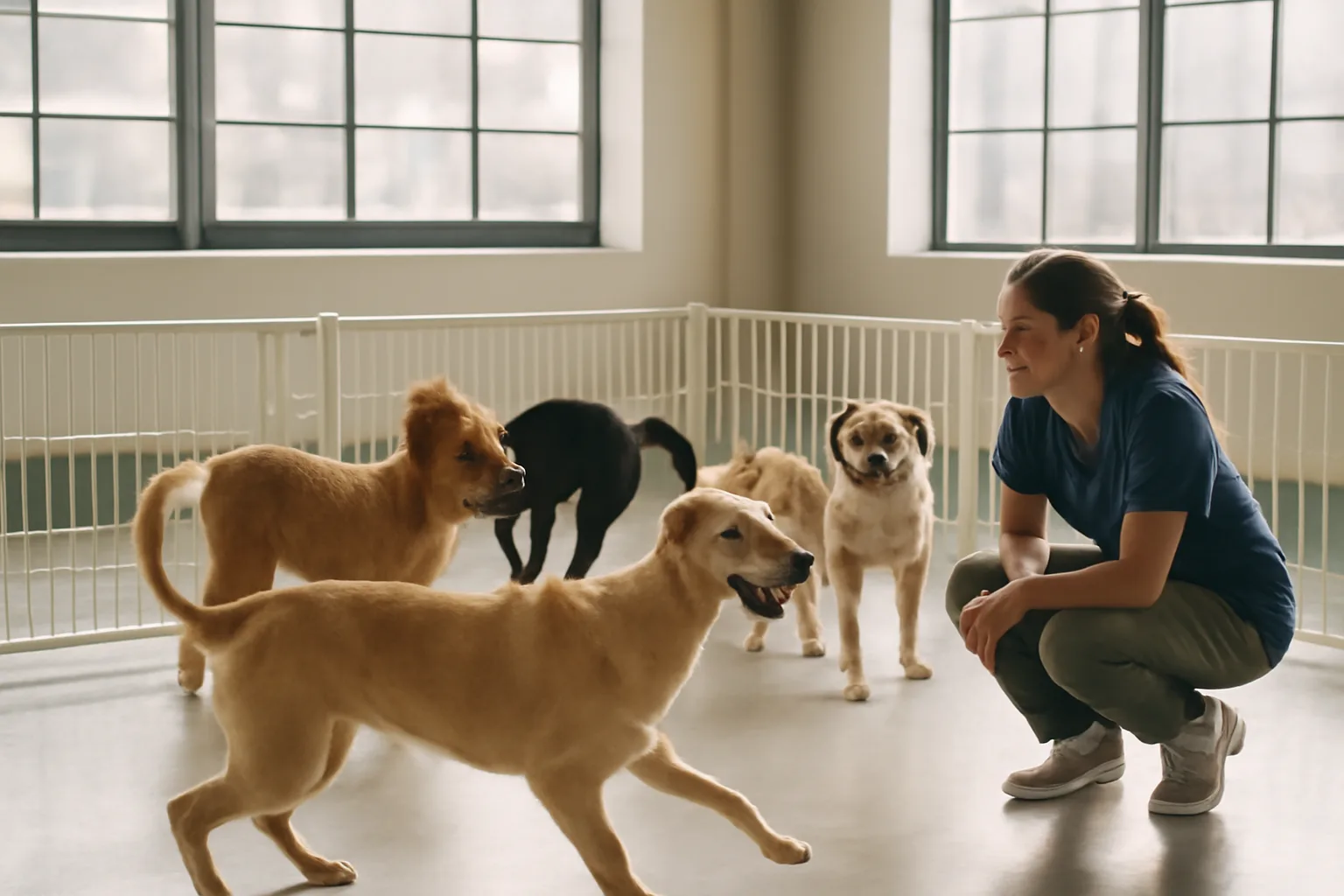
Three separate approval tracks stack on top of each other, and missing any one of them can shut you down after you've already signed a lease. The first is licensing: most states or counties require some kind of kennel, pet care facility, or animal boarding permit before you can legally house dogs that aren't yours, even for daycare hours only. The second is zoning: your city or county has to classify "animal daycare" or "kennel" as an allowed use in whatever zoning district your building sits in, and a lot of daycare operators find out the hard way that their retail-zoned strip mall unit needs a conditional use permit first. The third, which surprises people, is federal: if your daycare business also breeds and sells dogs (a lot of operators do both), you may cross a USDA Animal Welfare Act threshold that has nothing to do with your local license at all. Here's the part nobody tells you up front: these three systems don't talk to each other. Your state agriculture department doesn't check your zoning. Your county zoning office doesn't check whether USDA cares about your breeding sideline. You have to run down all three yourself, or hire someone who will. For dog boarding operators specifically, overnight stays often trigger stricter facility rules (fire egress, sprinkler requirements, staff-on-site overnight) that pure daycare-only operations can skip in some jurisdictions, so know which category you're actually applying under before you fill out any form.
do i need a state or county license to run a dog daycare?
In most states, yes, though the name of the license and the agency that issues it vary a lot. Some states run licensing through the department of agriculture (common for kennels and commercial breeders), others push it down to county health departments or county clerks, and some states have no state-level pet daycare license at all and leave it entirely to city or county ordinance. The honest answer is: check your specific state department of agriculture page and your county clerk's business license page, because there is no single federal daycare license. What IS federal and fairly uniform is the USDA Animal Welfare Act licensing threshold for breeders and dealers, which we cover below, but daycare-only operations (no breeding, no interstate sales) generally fall outside USDA's jurisdiction entirely. A practical way to find your requirement: search "[your state] department of agriculture kennel license" and separately "[your county] zoning kennel special use permit." If your state has an animal welfare or companion animal statute, it usually defines "kennel" broadly enough to sweep in daycare-only facilities that board zero dogs overnight, so don't assume daycare is exempt just because nobody sleeps there.
how do i get zoning approval for a dog daycare facility?
Zoning approval usually means proving to a planning department, and sometimes a public hearing board, that a commercial animal facility fits the neighborhood: noise, traffic, waste handling, hours of operation, and outdoor run placement all get scrutinized. Many jurisdictions classify kennels and animal daycares as a conditional use or special exception rather than a permitted-by-right use, meaning you need a hearing even in commercially zoned property. Start by pulling your zoning district designation from the county GIS parcel viewer, then call the planning office and ask directly: "is animal daycare a permitted use, conditional use, or prohibited use in this district?" Bring a site plan showing outdoor run fencing, sound buffering, parking counts (staff plus drop-off traffic), and waste disposal plan. Boards weigh noise complaints heavily, so a facility with sound-dampened play yards and a hard closing time for outdoor play tends to clear hearings faster than one that leaves that vague. If a hearing is required, expect the board to ask about hours, maximum dog capacity, and how you'll handle escaped or aggressive animals. Getting this wrong (or skipping the hearing because you assumed your commercial zoning covered it) is the single most common reason daycare operators get shut down after opening, not failed inspections. For a broader look at how different building types get evaluated, see dog kennels and pet boarding zoning treatment, since many counties zone daycare and boarding under the same kennel definition even when the actual service differs.
how much does dog boarding cost, and how does that compare to daycare pricing?
| Daycare (day only) | $25-$40/day | Group play, no overnight stay | |
|---|---|---|---|
| Standard boarding | $35-$75/night | Kennel run or shared space | |
| Luxury boarding suite | $75-$150+/night | Private room, webcam, premium care | |
| Multi-dog / same-family discount | 10-20% off | Common but not universal | When someone asks how much is dog boarding, the honest answer is "it depends on your city, whether it's a national chain like dogtopia or an independent operator, and what's included." Add-ons (grooming, medication administration, extra play sessions) typically add $10 to $30 per visit on top of the base rate. If you're pricing your own facility, call five to eight competitors within a 15-mile radius and build a range; undercutting the market rarely works long-term because dog owners associate rock-bottom pricing with lower supervision quality, fairly or not. |
Boarding and daycare are priced differently and it's worth knowing both if you're building a business plan, since most facilities offer both services. Daycare in the US commonly runs $25 to $40 per day per dog in most metro markets, while overnight boarding commonly runs $35 to $75 per night depending on region, with luxury "suite" boarding in major cities pushing past $100/night. These are market-rate observations, not government figures, since no federal agency tracks private boarding pricing. | Service type | Typical price range | Notes |
what facility standards do inspectors actually check?
Inspectors, whether state agriculture staff, county health inspectors, or local animal control, generally check the same core categories: sanitation and disease control, staff-to-dog supervision ratios, secure containment (double-gated entries, fencing height and condition), ventilation and temperature control, fire and emergency egress, and recordkeeping (vaccination records, incident logs). The federal Animal Welfare Act regulations, which apply to USDA-licensed breeders and dealers but are often used informally as a reference standard by state inspectors too, specify things like primary enclosure size formulas and sanitation frequency; the actual regulatory text is at 9 CFR Part 3, Subpart A [1]. Even if your daycare-only operation isn't USDA-licensed, expect your state or county inspector to ask similar questions: how often are runs sanitized, what's your isolation protocol for a dog that starts vomiting mid-day, how do you separate size or temperament groups. Staff-to-dog supervision ratio is the item that trips up the most first-time operators. There's no single national number; some states and some liability insurers recommend roughly 1 staff member per 10-15 dogs in active group play, but this is an industry guideline from insurers and trade groups, not a uniform law, so check whether your state has codified a ratio (a few have) before you build your staffing model around an assumed number.
how to become a dog breeder if my daycare also breeds dogs?
If your daycare operation also breeds dogs to sell, you need to separately check both your state's breeder licensing law and the federal USDA threshold, because these are two different systems that both might apply to you at once. At the federal level, USDA APHIS requires a Class A (breeder) or Class B (dealer) license once you meet certain conditions. The core federal trigger, per USDA's own guidance, is this: "If you have more than 4 breeding female dogs, cats, and/or small exotic or wild mammals and you sell any offspring... sight unseen (to another person for resale, for research, or as a pet) you are considered a dealer and must be licensed" [2]. There's also a well-known retail pet store exemption in the Animal Welfare Act: breeders who sell only face-to-face at their own premises to the buyer generally don't need a USDA license, but the moment you sell sight unseen (internet sales, shipping puppies, selling through a broker) that exemption disappears [2]. At the state level, many states layer their own commercial breeder license on top of federal rules, often triggered by a lower number of breeding females or by gross annual sales, and these thresholds vary widely by state, so check your specific state department of agriculture's animal welfare or commercial breeder statute page directly rather than assuming federal exemption covers you at the state level too.
how do you register a dog, and how is that different from a kennel license?
Registering an individual dog (usually a county dog license tied to rabies vaccination) is a completely different process from licensing your business as a kennel or daycare, and daycare operators need to understand both because you'll be handling other people's registered dogs all day. How to register a dog and how to get a dog license both typically mean the same thing at the county or city level: you bring proof of a current rabies vaccination to your county clerk, animal control office, or county treasurer, pay a small annual fee (commonly in the $10 to $25 range for altered dogs, often more for unaltered dogs in counties that price-incentivize spay/neuter), and get a tag. This is separate from any business license your daycare needs to operate, and it's the dog owner's responsibility, not yours, though a lot of daycares ask to see current tags and vaccination proof at intake as a liability safeguard, which is smart practice regardless of whether your state requires it. Some states also require kennels to hold a facility-level or "kennel" dog license that covers multiple dogs under one business registration rather than individual tags per dog, which is a different animal (so to speak) from a homeowner's single-dog license, so don't assume your business's kennel license substitutes for each visiting dog's individual county registration.
how do you get papers for a dog, and does a daycare need to care about this?
"Papers" almost always means breed registry documentation (AKC, UKC, or similar), not a government license, and it has nothing to do with your daycare's legal operating status. If a client asks how to get papers for a dog they're bringing to your facility, they mean registering the dog's pedigree with a breed registry, which is a private organization process, not a government one. To register a purebred puppy with the American Kennel Club, for example, the breeder typically completes an AKC litter registration application, and then individual puppy buyers complete individual registration using a form the breeder provides. There's no government agency involved in "papers" in this sense; it's entirely a private registry system, and a daycare operator has zero regulatory obligation tied to whether a dog has papers or not. Where this does matter for you: if you're the one breeding puppies alongside your daycare and asking how do I get papers for my dog for resale purposes, that's an AKC (or other registry) administrative process, completely separate from your USDA or state breeder license. You can hold a valid state breeder license and sell dogs with zero registry papers, and you can have full AKC papers with no state or federal license at all if you're under the thresholds. They don't substitute for each other.
what do usda aphis rules mean for a daycare that also sells puppies?
USDA APHIS licensing exists specifically to regulate breeders and dealers who sell animals wholesale or sight-unseen, not daycare or boarding operations by themselves. If your daycare's puppy sales stay under the federal threshold and stay face-to-face, you likely don't need a federal license at all, but you need to verify this against your specific sales pattern every year, since crossing four breeding females or starting internet sales changes your status immediately. APHIS itself frames the core question as whether you sell animals "sight unseen," and its published guidance states plainly that anyone meeting the breeding-female and sight-unseen-sale criteria "must be licensed" [2]. That same guidance also lays out current inspection and recordkeeping obligations for anyone who ends up licensed as a breeder or dealer. A practical checklist for a daycare-plus-breeding operation:
- Count your breeding females (not total dogs, just intact adult females used for breeding).
- Determine whether any puppy sales happen without the buyer meeting the dog and seller in person before the sale finalizes.
- If both the female count exceeds four and any sales are sight-unseen, contact APHIS's animal care licensing division directly before you take another litter to term.
- Separately check your state breeder statute, since state thresholds are often lower than the federal one and apply regardless of your USDA status.
how much does it cost to open a licensed dog daycare from scratch?
Costs split into three buckets and none of them are optional if you're doing this by the book: government fees (license, zoning application, inspection fees), buildout costs (fencing, drainage, ventilation, fire suppression if required), and ongoing compliance costs (annual license renewal, insurance, recordkeeping). Government fees are impossible to state as a single national number honestly, because state kennel license fees, county business license fees, and zoning conditional-use-permit application fees each vary by jurisdiction, sometimes by a factor of ten between neighboring counties. Rather than quoting a made-up average, budget a placeholder range and verify your specific county's fee schedule and your specific state agriculture department's kennel license fee page before finalizing a budget; both are usually posted as PDF fee schedules on the relevant.gov site. Buildout costs are more predictable in shape if not in dollar amount: expect fencing and secure double-gate entries, epoxy or sealed flooring for sanitation, HVAC sized for animal occupancy (more than human square footage), and in many jurisdictions a fire marshal sign-off if you're converting retail or warehouse space. This is where a lot of new operators get surprised, because the zoning approval and the building/fire code approval are two entirely separate reviews that both have to clear before you open, even after your kennel license is approved. If you want a structured way to pull together your state license requirement, your county zoning packet, and your facility standards checklist into one place before you walk into a zoning hearing, that's exactly the gap the $149 one-time Kennel License & Zoning Packet Builder is built to fill. It doesn't file anything for you or represent you at a hearing, but it organizes the state-by-state and county-by-county unknowns into a checklist you can actually work from.
what's the difference between a conditional use permit and a home-based daycare permit?
A conditional use permit (sometimes called a special exception) is required when your zoning district technically allows animal daycare but only after a public hearing confirms your specific site plan works; a home-based or "cottage" pet care permit is a separate, usually more restrictive, category for small-scale operations run out of a residence. Most counties cap home-based animal care operations at a small number of dogs (commonly single digits) and often prohibit any outdoor group play area visible from the property line, or restrict operating hours tightly to control noise complaints from neighbors. A commercial conditional use permit, by contrast, applies to standalone commercial buildings and generally allows higher capacity but demands a much more detailed site plan: parking counts, sound studies in some jurisdictions, and sometimes buffer landscaping requirements between your property and residential neighbors. If you're planning to scale past a handful of dogs, running under a home-based permit and hoping nobody notices your Instagram-advertised capacity is a real compliance risk; zoning enforcement often gets triggered by neighbor complaints, not proactive inspection, and "we grew faster than our permit" is not a defense at a code enforcement hearing.
how do i actually prepare for a zoning hearing for my daycare?
Preparation means treating the hearing like a presentation to skeptical neighbors, more than a form to file. Boards and commissions typically want a site plan, a traffic/parking analysis, a noise mitigation plan, and a clear statement of maximum capacity and hours, submitted well before the hearing date (many counties require packets 2 to 4 weeks in advance, so check your specific board's submission deadline). Bring answers to the questions board members almost always ask: how do you handle a dog fight or escape, what's your outdoor play cutoff time, how do you manage waste disposal, and how many parking spaces do you have relative to expected peak drop-off traffic. If your county publishes prior meeting minutes for kennel or animal facility conditional use applications (many do, through the county clerk or planning commission archive), read two or three; they tell you exactly what that specific board fixates on. For doggy day care applicants specifically, sound is usually the number one neighbor objection, so a concrete mitigation plan (indoor-only play after a set hour, sound-dampening fence material, staggered outdoor group sizes) tends to move a hearing along faster than vague reassurances. And don't skip getting your county zoning classification confirmed in writing before you sign a commercial lease; verbal assurances from a leasing agent about "the space being zoned for pets" are not the same as a planning department's written determination, and it's a very common way daycare startups lose their deposit.
Frequently asked questions
how much does dog boarding cost per night?
Standard overnight boarding commonly runs $35 to $75 per night in most US markets, with luxury private-suite boarding running $75 to $150 or more in major cities. Exact pricing depends heavily on region, facility type, and whether add-ons like grooming or medication administration are included. These are market observations, not government-set rates.
how much is dog boarding compared to daycare?
Daycare (day use, no overnight stay) typically costs $25 to $40 per day, while overnight boarding runs $35 to $75 per night on average nationally, sometimes higher in expensive metro markets. Daycare is cheaper per visit because it doesn't include overnight staffing and housing costs that boarding requires.
how do you register a dog with the county?
Bring proof of current rabies vaccination to your county clerk, treasurer, or animal control office, fill out a short application, and pay the annual fee, commonly $10 to $25 for altered dogs in many counties, sometimes higher for unaltered dogs. This is separate from any business or kennel license a daycare facility itself needs.
how do you get a dog license?
A dog license (as opposed to a business kennel license) is obtained from your county clerk, treasurer, or local animal control office, usually requiring proof of rabies vaccination and a small annual fee. Requirements and fees are set locally, so check your specific county government's animal control or clerk page for exact amounts and renewal timing.
how do you get papers for a dog?
"Papers" means breed registry documentation like AKC or UKC registration, a private process unrelated to any government license. The breeder typically files a litter registration with the registry, then individual puppy buyers complete their own registration using paperwork the breeder provides. It has no bearing on whether your facility needs a state or county kennel license.
how do i get papers for my dog if i already own it without them?
Contact the breed registry (AKC, UKC, etc.) directly; some allow individual registration if you can document the dog's parentage or, for AKC specifically, through limited alternative programs for dogs without full litter registration. Requirements vary by registry and by breed, so check the specific registry's current registration policy rather than assuming a universal process applies.
how to become a dog breeder legally?
Check your state department of agriculture's breeder licensing statute first, since state thresholds vary and are often lower than federal ones. Separately check USDA APHIS: if you keep more than 4 breeding females and sell any puppies sight unseen, federal licensing applies. Selling only face-to-face at your own premises may qualify for the retail exemption, but verify current terms with APHIS directly.
what is the usda threshold for dog breeders?
USDA APHIS guidance states that anyone with more than 4 breeding female dogs who sells offspring sight unseen (including online or shipped sales) is considered a dealer and must be licensed under the Animal Welfare Act. Face-to-face sales at your own premises may fall under the retail pet store exemption instead, but confirm current criteria with APHIS.
does a dog daycare need a usda license?
Generally no, USDA APHIS licensing targets breeders and dealers, not daycare or boarding operations that don't sell animals. If your daycare business also breeds and sells puppies and crosses the federal breeding-female or sight-unseen-sale thresholds, that side of the business may need USDA registration even though your daycare service itself doesn't.
does dog daycare need zoning approval separate from a business license?
Yes, almost always. A business license lets you legally operate a business; zoning approval confirms that specific use is allowed on that specific parcel. Many jurisdictions classify kennels or animal daycares as a conditional use requiring a public hearing even in commercially zoned buildings, so clearing one approval doesn't guarantee the other.
what staff-to-dog ratio do dog daycares need?
There's no single national law; industry and insurer guidelines commonly suggest roughly one staff member per 10 to 15 dogs during active group play, but this varies by state, by dog temperament mix, and by facility layout. A handful of states have codified specific ratios, so check your state's animal facility regulations before finalizing staffing plans.
can i run a dog daycare out of my house?
Sometimes, under a home-based or cottage pet care permit, but most counties cap the number of dogs allowed and restrict outdoor group play visibility and hours. Scaling past that cap without upgrading to a commercial conditional use permit is a common code enforcement trigger, usually reported by neighbors rather than caught proactively.
Sources
- eCFR, 9 CFR Part 3 Subpart A (Dogs): Federal facility standards for enclosure size and sanitation frequency that inspectors often reference
- USDA APHIS Animal Care, "Animal Welfare Act Licensing and Registration" (Federal Register, 9 CFR Part 2, dealer/exhibitor licensing definitions): Anyone with more than 4 breeding females who sells offspring sight unseen must be licensed as a dealer
- eCFR, 9 CFR Part 2, Subpart A (Licensing recordkeeping requirements): Current inspection and recordkeeping obligations apply to USDA Animal Welfare Act licensees
- U.S. Small Business Administration: Steps for registering a new business, including a dog daycare, at the state level
- eCFR: Facility standards for housing dogs under USDA Animal Welfare Act regulations relevant to inspections