Last updated 2026-07-25
TL;DR
Kansas doesn't issue one universal "kennel license." Commercial breeders, dealers, and some boarding/daycare operations register through the Kansas Department of Agriculture's Animal Facilities Inspection Program, plus separate city/county licensing and zoning approval. Breeders selling across state lines or above USDA thresholds also need a federal license from APHIS.
Does Kansas have a statewide kennel license?
Not in the way people usually mean it. Kansas regulates commercial animal facilities through the Kansas Pet Animal Act, K.S.A. 47-1701 et seq., administered by the Kansas Department of Agriculture's Animal Facilities Inspection Program [1]. That statute covers people who operate as an "animal breeder," "pet shop," "kennel," "cattery," "boarding/training kennel," or "animal dealer" for commercial purposes. If you're running a hobby kennel with a couple of dogs and no commercial sales, you likely fall outside state licensing, but your city or county almost certainly still wants you registered. The practical answer: expect two or three separate approvals stacked on top of each other. State license (if you meet the commercial threshold), county or city animal license/zoning permit, and possibly a federal USDA license if you sell dogs wholesale or across state lines. None of these offices talk to each other automatically, so missing one is common and it's the reason renovation projects stall mid-build. The Kansas Department of Agriculture's own licensing page lists the categories that need a state license: "animal breeder," "animal dealer," "boarding/training kennel," "pet shop," "public/private animal shelter," "hobby breeder," and "kennel/cattery operator" among others [2]. Boarding kennels and daycare facilities that board other people's pets for a fee are explicitly named, so if that's your business model, plan on state licensing from day one.
Who needs a Kansas Department of Agriculture kennel or cattery license?
Under K.S.A. 47-1701, a "kennel" is generally defined as a facility that houses dogs for boarding, breeding, training, or sale as a business [1]. If you board other people's dogs for money, breed and sell puppies commercially, or run a daycare that houses animals overnight, you're in scope. Purely daytime-only daycare with no overnight boarding and no breeding may fall into a gray area depending on how KDA classifies your specific operations, so it's worth calling the Animal Facilities Inspection Program directly before you assume you're exempt. The license categories KDA uses include animal breeder, animal dealer, boarding kennel, training kennel, pet shop, and public or private shelter [2]. Each category has its own fee schedule and inspection standard. Fees change periodically, so treat any number you see online as a guided estimate and confirm the current fee against KDA's own posted schedule before you budget for it. Inspections are the teeth of the program. KDA inspectors check housing, sanitation, ventilation, temperature control, food and water, and recordkeeping against the standards in the Kansas Pet Animal Act rules found in K.A.R. 9-18-1 through 9-18-25 (facility and care standards for licensed operations) [1]. New applicants typically get a pre-licensing inspection before the license is issued, not after.
How do I get a Kansas kennel license, step by step?
1. Confirm you actually need a state license. Call the KDA Animal Facilities Inspection Program and describe your operation honestly (boarding, daycare, breeding, sales volume). Get the category determination in writing if you can. 2. Check your county and city rules first, or at the same time. Zoning almost always has to clear before the state will finalize anything, and many Kansas counties (plus cities like Wichita, Topeka, Overland Park) run their own separate animal licensing or kennel permit process on top of the state one [3]. 3. Prepare your facility to meet K.A.R. 9-18 standards: enclosure size and construction, sanitation and waste disposal, ventilation and temperature control, separate isolation space for sick animals, and recordkeeping on each animal in your care [1]. 4. Submit your state application and fee to KDA, schedule the pre-licensing inspection, and correct any deficiencies the inspector flags. 5. Renew annually. Kansas commercial licenses under the Pet Animal Act are generally renewed each year, and a lapsed license means you're operating illegally, full stop. If you're building out a new facility or converting an existing building, do the zoning-hearing prep and the state paperwork in parallel, not sequentially. Waiting for one before starting the other is the single biggest reason projects miss their opening date. Our license-packet-builder approach exists mainly because operators keep discovering the state application and the county zoning packet ask for overlapping but not identical information, and redoing it twice wastes real time.
How much does dog boarding cost to license and operate?
Two different costs get confused here: what you pay to license the business, and what you charge customers to board their dog. On the licensing side, Kansas state fees for boarding/training kennels are set by KDA's fee schedule and can change, so check the current numbers directly on the department's licensing page rather than trusting a cached figure [2]. County or city kennel permits typically add another fee, often in the range of tens to a couple hundred dollars depending on the jurisdiction, plus possible per-animal or per-run inspection fees. On the consumer side, boarding rates vary widely by region and service level. Basic overnight boarding in most U.S. markets commonly runs somewhere between $25 and $75 per night for a standard kennel or suite, with upscale "dog hotel" suites, webcams, and extra playtime pushing well past $100 a night in some metro areas. Kansas rates tend to sit toward the lower-to-middle end of that national range compared to coastal metro pricing, though nobody publishes a definitive statewide average, so treat any specific number you see as a market estimate, not a regulated figure. If you're pricing out a new facility, look at what similar operators in your county actually charge before setting rates. Comparing dog boarding and pet boarding rate structures nearby, and checking what dog hotels near me style competitors charge for premium suites, gives you a realistic local range faster than any national average will.
How do I register a dog in Kansas?
Registering an individual pet dog is different from licensing a kennel business, and Kansas handles it at the city or county level, not the state. Most Kansas cities and counties require a dog license or rabies tag renewal annually, tied to proof of current rabies vaccination from a licensed veterinarian. Fees and rules vary by jurisdiction: Wichita, Topeka, Johnson County, and Sedgwick County each run their own pet licensing programs with their own fees and deadlines, so you'll need to check your specific city or county clerk / animal control office [3]. The typical process: get your dog vaccinated against rabies, bring the vaccination certificate to your city or county's designated office (often the health department, animal control, or treasurer's office), pay the license fee, and get a tag. Many jurisdictions require the tag to be worn on the dog's collar at all times and require annual renewal tied to the rabies vaccination schedule. If you're a boarding or daycare operator, this matters directly: many county boarding-facility rules require every dog on the premises to have current rabies vaccination and, in some jurisdictions, a current local dog license, before you can legally accept them. Build a check for both into your intake paperwork.
How do I get papers for my dog, and how is that different from a license?
"Papers" almost always means breed registration documents, like AKC (American Kennel Club) registration, not a government license. Registration with a breed club is a private, non-governmental process that documents a dog's pedigree and eligibility for breed-specific events and, in some cases, breeding recognition. It has nothing to do with your Kansas kennel license, your county dog license, or USDA registration. To register a purebred puppy with the AKC, the breeder typically completes an AKC litter registration application (using the sire and dam's registration numbers) and the buyer then receives an individual registration application to complete for their specific puppy. If you bought a dog without papers and want to register it, options are limited: AKC has a Purebred Alternative Listing (PAL) program for dogs that appear purebred but lack registration papers, though PAL dogs can't be shown in conformation and can't be bred for AKC-registered litters. There's no government office that issues breed papers; that's entirely a private registry function. Don't confuse any of this with your state or county licensing obligations. A dog can have full AKC papers and still need a rabies tag from the county and a kennel license from the state if you're breeding or boarding commercially.
How do I become a licensed dog breeder in Kansas?
Start by figuring out which threshold you're crossing, because Kansas and the federal government use different triggers. Under the Kansas Pet Animal Act, anyone operating as an "animal breeder" for commercial purposes needs a state license from KDA, with facility standards enforced under K.A.R. 9-18 [1] [1]. There isn't a bright-line "number of litters" test spelled out the way some states do; KDA determines commercial breeder status based on whether you're breeding and selling dogs as a business. Call the Animal Facilities Inspection Program to get a determination for your specific situation. Federally, the USDA's Animal and Plant Health Inspection Service (APHIS) requires a license under the Animal Welfare Act if you sell more than a certain number of dogs directly to the public sight-unseen (online, by phone, by mail) or if you sell wholesale to pet stores, brokers, or research facilities. As of the 2013 APHIS retail pet store rule, breeders who sell more than four female breeding dogs and sell any puppies sight-unseen (the buyer never physically sees the animal or the facility before purchase) generally need a USDA license, with exemptions for very small-scale hobby breeders [4]. The regulation defines a "retail pet store" exclusion in terms of in-person, face-to-face sales, and breeders who fall outside that exclusion and meet the sales thresholds must be licensed as dealers under 9 CFR 2.1 [5]. The exact exemption language is detailed, so check APHIS's own breeder licensing guidance before assuming you're covered or excluded. Here's the sequence that actually works: confirm your county zoning allows a breeding kennel at your address, get your Kansas state breeder license from KDA, and check APHIS thresholds every time your sales channel changes (adding online sales, adding a wholesale buyer, exceeding four breeding females). Crossing a threshold mid-year without noticing is one of the most common compliance failures breeders run into, because nobody's watching your sales channel for you but you.
What are the USDA (APHIS) thresholds every Kansas breeder should know?
The Animal Welfare Act and its regulations (7 U.S.C. 2131 et seq., 9 CFR Chapter I) require a federal license for anyone dealing in dogs commercially above certain thresholds [4] [5]. The core triggers most small Kansas breeders hit: - Selling sight-unseen: if buyers never see the dog or your facility in person before the sale (common with online/shipped puppy sales), you generally need a USDA license once you have more than four breeding females, per the 2013 retail pet store rule [4].
- Wholesale sales: selling puppies to a pet store, broker, or another dealer for resale generally requires a USDA dealer license regardless of scale, because that's not a retail transaction to the end owner.
- Research or exhibition sales: selling to labs, zoos, or exhibitors also triggers dealer licensing requirements under 9 CFR 2.1 [5]. The retail pet store exemption in 9 CFR 2.1 applies to breeders who sell animals only through direct, face-to-face transactions and who maintain four or fewer breeding female dogs, cats, or small exotic or wild mammals [4] [5]. Exceed either condition and you're expected to apply for a Class A (breeder) or Class B (dealer) license and submit to APHIS inspections. This stacks on top of, not instead of, your Kansas state breeder license. A Kansas breeder selling puppies nationwide through a website with six breeding females needs both the KDA state license and a federal USDA Class A license, plus whatever county zoning and kennel permit their location requires.
What county and city rules apply on top of state licensing?
Kansas is a home-rule state for many local matters, so counties and cities set their own zoning and permitting rules for kennels, and they vary a lot. Some counties treat any home-based operation with more than a handful of dogs as a "commercial kennel" requiring a conditional use permit or special use permit through the county planning and zoning office, regardless of what the state calls you [3]. Others fold kennel rules into general animal control ordinances administered by the county clerk or health department. Before you sign a lease or break ground, call your county's planning and zoning department directly and ask three things: is a kennel/boarding facility a permitted use, a conditional use, or prohibited at this address; is there a minimum lot size or setback from neighboring residences; and does the county cap the number of dogs allowed without a special permit. Get the answer in writing or note who you spoke with and when, because zoning determinations sometimes get revisited later and you want a record. If a zoning hearing is required, treat it like a real hearing, not a formality. Bring your KDA facility plan, noise mitigation plan, traffic/parking plan, and waste management plan. Neighbors show up to these hearings more often than new operators expect, and unaddressed noise or odor concerns are the most common reason boards table or deny kennel applications. This is exactly the kind of overlapping paperwork, state facility standards on one side and county zoning submission requirements on the other, that a combined license packet is built to organize, though you can absolutely assemble it yourself by working both offices' checklists in parallel.
How much does it cost overall to license a kennel or boarding facility in Kansas?
| KDA state kennel/breeder license | Kansas Dept. of Agriculture | Set by KDA fee schedule; check current page [2] |
|---|---|---|
| County/city kennel or zoning permit | County/city planning or clerk's office | Varies widely by jurisdiction [3] |
| USDA Class A/B license (if applicable) | APHIS | Set by APHIS fee schedule; check current page [4] |
| Facility upgrades to meet 9-18 standards | Your contractor/vendor | Highly variable, often the largest line item |
| Annual rabies tag/dog license per animal | County/city | Varies by jurisdiction [3] |
There's no single number, and anyone who gives you one flat figure is guessing or citing outdated information. Your total cost stacks across at least three sources: the Kansas state license fee (varies by category: breeder, boarding kennel, pet shop, dealer), a county or city kennel/zoning permit fee, and possibly a federal USDA license fee if you cross APHIS thresholds. State and county fee schedules change, so pull the current numbers directly from KDA's licensing fee page and your county's planning department before budgeting [2] [3]. Don't forget the indirect costs that dwarf the license fees for most new facilities: facility upgrades to meet K.A.R. 9-18 standards (fencing, drainage, ventilation, isolation space), a pre-licensing inspection that may require a re-inspection if you fail items the first time, and any structural work a zoning board requires as a condition of approval (sound barriers, parking lot resurfacing, screening landscaping). Budget for the inspection to catch something. It almost always does on a first pass. Table: rough cost categories to budget for (confirm exact figures with each office): | Cost category | Who charges it | Typical range (confirm locally) |
What happens during a Kansas kennel inspection?
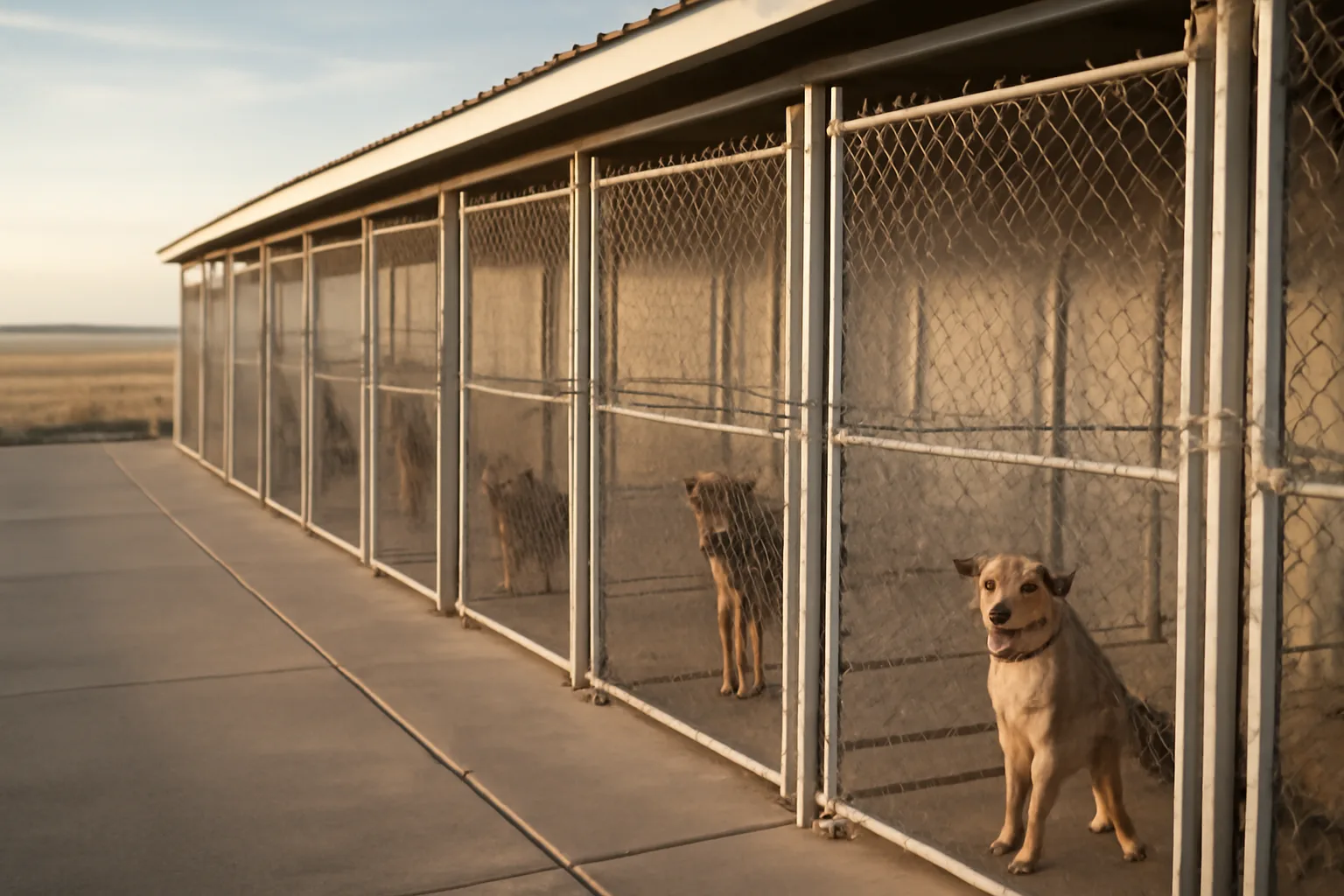
KDA inspectors evaluate your facility against the standards in K.A.R. 9-18, covering primary enclosure size and construction, sanitation and disease control, food and water, ventilation, temperature control, lighting, and recordkeeping for each animal (identification, acquisition, health records, disposition) [1]. Expect the inspector to walk every run and kennel space, check for standing water or waste buildup, verify your isolation area for sick animals is genuinely separate, and review your written records against the animals physically present. New applicants typically get a pre-licensing inspection, and licensed facilities get periodic unannounced inspections after that. If you fail items, you'll usually get a written list of deficiencies and a timeline to correct them before the license issues or renews. Recordkeeping failures (missing health records, no acquisition/disposition log) are a common and entirely avoidable reason facilities get dinged, since it costs nothing but attention to fix. If you also hold a USDA license, APHIS runs its own separate inspections under the Animal Welfare Act, and those two inspection regimes (state and federal) don't automatically share findings, so a clean state inspection doesn't guarantee a clean federal one, and vice versa.
State vs. federal vs. county: who regulates what?
| State (Kansas Dept. of Agriculture) | Commercial breeder/dealer/boarding kennel/pet shop licensing and facility standards | K.S.A. 47-1701 et seq. [1]; K.A.R. 9-18 [1] | |
|---|---|---|---|
| Federal (USDA APHIS) | Dealers/breeders selling sight-unseen above threshold or wholesale, under the Animal Welfare Act | 9 CFR Chapter I, Part 2 [5] | |
| County/City | Zoning, land use, individual dog licensing/rabies tags, local kennel permits | Varies; check your county planning office [3] | A single facility can owe paperwork to all three at once. A breeder in rural Kansas selling puppies online with six breeding females, for example, needs the KDA state breeder license, a USDA Class A license because of sight-unseen sales above four females, and a county conditional use permit if local zoning treats kennels as a special use. Missing any one of the three is still a violation, even if the other two are in perfect order. |
This is the part that confuses almost every new operator, so here's the plain breakdown: | Level | Regulates | Key citation |
Frequently asked questions
How much does dog boarding cost in Kansas?
Boarding rates in Kansas generally run in the same broad U.S. range as most mid-size markets, roughly $25 to $75 per night for standard kennel boarding, with premium suites and added services pushing higher. There's no state-set rate; it's market pricing. Check what nearby dog boarding and dog kennels facilities charge in your specific county for a realistic local number.
How do I register a dog in Kansas?
Dog registration (licensing) happens at the city or county level, not through the state. Get your dog's rabies vaccination current, then bring the vaccination certificate to your city or county's animal control, health department, or clerk's office to pay the license fee and get a tag. Requirements and fees differ by jurisdiction, so check your specific county's website.
How do you get papers for a dog?
"Papers" means breed registry documents like AKC registration, not a government license. Breeders register litters with the AKC using the sire and dam's registration numbers, then individual puppy buyers complete a separate registration form. There's no government office for breed papers; it's a private registry process entirely separate from your state kennel license or county dog license.
How can I get papers for my dog if I bought it without any?
Options are limited. The AKC's Purebred Alternative Listing (PAL) program lets dogs that appear purebred but lack documentation get listed for participation in many AKC activities, though PAL dogs can't be shown in conformation or produce AKC-registered litters. If the breeder never registered the litter at all, there may be no way to get full papers retroactively.
How do I become a dog breeder in Kansas?
Confirm your county zoning allows a breeding kennel at your address, then apply for a Kansas Department of Agriculture animal breeder license under the Pet Animal Act, meeting facility standards in K.A.R. 9-18. If you sell sight-unseen with more than four breeding females, or sell wholesale, you also need a USDA APHIS Class A or B license under the Animal Welfare Act.
How do I get a Kansas kennel license?
Contact KDA's Animal Facilities Inspection Program to confirm your license category (breeder, boarding kennel, pet shop, dealer), check your county zoning first, prepare your facility to meet K.A.R. 9-18 standards, and submit your state application and fee for a pre-licensing inspection. Renew annually. County or city permits are usually required separately.
Does Kansas require a kennel license for home-based dog boarding?
Likely yes, if you're paid to board other people's dogs, even from your home. Kansas's Pet Animal Act covers commercial boarding kennels regardless of whether the facility is a dedicated building or a portion of a residence. Check with KDA and your county zoning office; many counties treat home-based boarding as a conditional use requiring a special permit.
What is the difference between a kennel license and a dog license?
A kennel license authorizes a business (breeding, boarding, selling dogs commercially) and comes from the state (KDA) and often the county. A dog license is per-animal, tied to rabies vaccination, and issued by your city or county for any owned pet dog. Boarding facilities typically need both a facility kennel license and to verify each boarded dog has a current individual license.
How many dogs can I have before I need a USDA license in Kansas?
The federal trigger isn't purely a dog count; it's about sales method. Under the 2013 APHIS retail pet store rule, breeders with more than four breeding females who sell any puppies sight-unseen (buyer never sees the dog or facility in person first) generally need a USDA Class A license. Wholesale sales to pet stores or brokers require licensing regardless of breeding female count.
Do I need a Kansas state license if I only board dogs occasionally as a side hustle?
Possibly still yes. Kansas's Pet Animal Act licensing threshold is based on whether you're operating commercially, not full-time versus part-time status. If you're charging money to board dogs regularly, even occasionally, call KDA's Animal Facilities Inspection Program to get a category determination rather than assuming a low volume exempts you.
How long does it take to get a kennel license approved in Kansas?
Timelines vary by county zoning backlog and how quickly your facility passes the KDA pre-licensing inspection. Budget several weeks to a few months when zoning approval, facility upgrades, and inspection scheduling are all needed, especially if a public zoning hearing is required. Applying to state and county simultaneously, rather than sequentially, meaningfully shortens the real-world timeline.
Can I lose my Kansas kennel license?
Yes. KDA can suspend or revoke a Pet Animal Act license for repeated facility standard violations, failed re-inspections, or failure to maintain required records, and USDA can take separate enforcement action (including civil penalties) for Animal Welfare Act violations if you also hold a federal license. Both agencies conduct unannounced follow-up inspections after citing deficiencies.
Sources
- Kansas Legislature, Kansas Pet Animal Act: Kansas Pet Animal Act definitions and commercial licensing requirement for kennels, breeders, dealers, and boarding/training kennels
- Kansas Department of Agriculture, Animal Facilities Inspection Program licensing: License categories (breeder, dealer, boarding/training kennel, pet shop, shelter) and fee schedule administered by KDA
- Sedgwick County, KS Code of Ordinances, Chapter on Animal Control: County zoning and ordinance offices set their own kennel permitting and land-use rules separate from state licensing
- USDA APHIS, "Amendments to the Animal Welfare Act Regulations, Retail Pet Stores" (final rule), 78 Fed. Reg. 57227 (Sept. 18, 2013): 2013 rule requiring USDA license for breeders selling sight-unseen with more than four breeding females
- Code of Federal Regulations, 9 CFR 2.1 (Requirements and application for a license): Federal dealer/breeder licensing requirements under the Animal Welfare Act, including the retail pet store exemption and wholesale sales triggering licensure