Last updated 2026-07-25
TL;DR
Getting a kennel license means three separate approvals in most places: local zoning sign-off, a state or county kennel/pet-dealer license, and possibly a USDA APHIS license if you sell dogs sight unseen across state lines or breed above the federal threshold. Expect $25 to $500+ in state fees, a facility inspection, and a zoning hearing that can take months.
what does "kennel license" actually mean, and who needs one?
A kennel license is usually a state or county permit that lets you house multiple dogs (boarding, daycare, breeding, or rescue) at one address. It's separate from a business license and separate from zoning approval, though you'll need all three working together before you can legally open. Most states define a "kennel" by number of dogs, not by activity. New York, for example, treats any place that houses, breeds, boards, or trains more than three dogs as a "kennel" subject to licensing under state Agriculture and Markets Law [1]. Other states set the threshold at four, five, or ten dogs, and some don't regulate kennels at the state level at all, leaving it entirely to county or city rules. If you're boarding other people's pets, running daycare, or breeding and selling puppies, you almost certainly need something. The question is which agency, not whether you need a license at all. Skipping this step is the single most common reason facilities get shut down mid-lease, not because the business failed, but because nobody checked zoning before signing.
how do I know which license applies to my business (boarding, daycare, or breeding)?
Boarding kennels, daycare facilities, and breeding operations often fall under different rules even in the same state, because the risk profile and the regulating agency differ. Boarding and daycare are usually regulated at the county or city level as a commercial kennel or animal facility, tied to zoning and a health/safety inspection. Breeding operations that sell puppies commercial can trigger both a state pet dealer/breeder license and, if you cross certain thresholds, a federal USDA license. The federal trigger is specific: under the Animal Welfare Act regulations, a "retail pet store" exemption does not apply to breeders who sell dogs "sight unseen" (the buyer never physically meets the animal before purchase), and anyone maintaining more than four female dogs for breeding who sells this way generally must hold a USDA Class A dealer (breeder) license under 9 CFR 2.1 [2]. Retail pet stores and hobby breeders who sell in person, buyer meets seller, meets dog, are typically exempt. So: boarding/daycare operator, start with your dog boarding county zoning and kennel license. Breeder crossing state lines or selling online, add USDA to your list.
how to get a kennel license, step by step
The order matters. Doing this out of sequence (signing a lease before checking zoning, for instance) is how people lose deposits. 1. Check zoning first, before you sign a lease or buy property. Call the county or city zoning office and ask if a commercial kennel, boarding facility, or animal daycare is a permitted use, a conditional use, or not allowed at all in that parcel's zone. Conditional use usually means a public hearing. 2. Confirm the state-level license requirement and threshold. Search "[your state] department of agriculture kennel license" or "pet dealer license." Pennsylvania, for instance, requires a kennel license for anyone keeping 26 or more dogs over six months old, with license classes and fees set by the state's Dog Law statute, 3 Pa. Cons. Stat. Chapter 45 [3]. 3. Prepare your facility to meet physical standards, run size, ventilation, sanitation, fencing, fire safety. These are usually spelled out in state code or county ordinance, and an inspector will check them before issuing anything. 4. Apply for the state or county license, pay the fee, and schedule your inspection. 5. If you cross the USDA threshold, apply for an APHIS license separately, it has its own facility standards under 9 CFR Part 3 [4]. 6. Get your business license and any required local health permit. Budget real time for this. A conditional use hearing alone can add two to six months depending on your county's meeting schedule and whether neighbors object.
how much does dog boarding cost (and how does that relate to licensing fees)?
These are two different numbers, and people mix them up. "How much does dog boarding cost" usually means what a pet owner pays per night, while your kennel license fee is what you pay the state or county to operate. For pet owners, boarding typically runs $25 to $85 per night for a standard kennel or home-boarding stay, with upscale "dog hotel" suites running higher in major metro areas; these are market rates, not government figures, and vary widely by region and season. If you're pricing your own facility, check three to five competitors in dog hotels near me searches for your specific market rather than relying on national averages. For operators, the kennel license fee itself is much smaller: often $10 to $50 per year at the county level for a basic kennel permit, and $50 to $500+ at the state level depending on how many dogs you house and whether you're classified as a commercial breeder or kennel. Pennsylvania's kennel license fees, for example, scale by class and number of dogs under its Dog Law statute, from smaller kennel classes up through commercial kennels housing 26 or more dogs [3]. Always check your specific state schedule since these numbers shift with legislation.
how to register a dog vs. how to get a kennel license
These are not the same process, and conflating them causes real confusion for new operators and pet owners alike. Registering a dog (sometimes called dog licensing) is a per-animal requirement, usually at the county or city level, tied to rabies vaccination. You bring proof of rabies vaccination to the county clerk or animal control office, pay a small fee (commonly $10 to $25 a year, less for spayed/neutered dogs in many counties), and get a tag. This is required of any dog owner, more than kennel operators. A kennel license is a business-level permit that lets you house multiple dogs at one location. If you're boarding dogs, each dog that comes through your door should already be individually registered/licensed by its owner in most jurisdictions, that's the owner's responsibility, not yours, though a good boarding contract asks for proof of registration and vaccination at drop-off anyway. If you're opening a boarding or daycare facility, don't confuse "I need to register my own dog" with "I need a kennel license." You may need to do both: register your own personal dogs individually, and separately license your facility as a kennel.
how do you get papers for a dog (AKC registration vs. state license)?
"Papers" almost always means breed registry paperwork, not a government license, and this trips up a lot of new breeders. AKC registration (or registration with another breed club) documents a dog's pedigree and parentage; it has nothing to do with your state kennel license or USDA license. To register a litter with the American Kennel Club, both parents typically need to be AKC-registered already, and you submit a litter registration application with the AKC, not with any government agency. If you're asking "how do I get papers for my dog" because you bought a puppy without them, the honest answer is: you generally can't create AKC papers after the fact unless the breeder registers the litter and transfers ownership paperwork to you. Some breed registries offer alternative or "pet-only" registration options, but requirements vary by organization. If you're asking as a breeder, "how to get papers for my dog" so you can sell registered puppies, you need to register the sire and dam with the registry of your choice first, then register each litter. This is a private, non-governmental process. It runs in parallel with, and is entirely separate from, your state breeder/kennel license and any USDA license obligation.
how to become a dog breeder legally
Legally becoming a dog breeder means clearing three possible layers: local zoning, state licensing, and federal USDA licensing, in that order of how likely you are to trip on them. First, check zoning. Many residential zones cap the number of dogs allowed on a property (often three to five) before it's considered a kennel use requiring a conditional use permit or rezoning. This is the step most backyard breeders skip and the one that gets neighbors calling code enforcement. Second, check your state's breeder or pet dealer license threshold. States vary hugely here. Pennsylvania, for one, regulates at 26+ dogs under its Dog Law statute [3]. Others have separate "commercial breeder" statutes with lower thresholds, ten or more intact females is a common trigger in several states. There isn't one national number, you have to check your specific state department of agriculture page. Third, check the federal USDA threshold. If you keep more than four breeding females and sell puppies sight unseen (shipped, sold online, or through a broker without the buyer meeting the dog in person), you likely need an APHIS Class A (breeder) license, and your facility must meet the space, sanitation, and veterinary care standards in 9 CFR Part 3 [4]. Under 9 CFR 2.1, breeders who sell only in person, buyer meets the puppy face to face before the sale, are generally exempt from federal licensing regardless of how many females they have [2]. Fourth, plan your facility to actual code, not guesswork: whelping area sanitation, primary enclosure size formulas tied to dog size (the APHIS formula in 9 CFR 3.6 is roughly the dog's length plus 6 inches, squared, for minimum square footage) [4], temperature control, and record-keeping on every breeding female. For a dog kennels build-out, get these numbers from the actual regulation, not from what a neighbor's kennel looks like.
how to get a dog license (the pet-owner version)
Getting a dog license as a pet owner is usually a quick, low-cost process at the county or city level, separate from anything a business owner deals with. Step one is proof of current rabies vaccination from a licensed vet. Step two is bringing that proof, plus your dog's basic info (breed, age, sex, spay/neuter status), to your county clerk, treasurer's office, or local animal control, either in person or often online now in larger counties. Step three is paying the fee, commonly $10 to $25 annually, with many counties offering a discount for spayed or neutered dogs and sometimes a lifetime tag option for a higher one-time fee. Renewal is usually annual or triennial depending on your rabies vaccine schedule. Late renewal often triggers a penalty fee, so most counties send a renewal notice by mail. If you're a boarding or daycare operator, requiring proof of current dog license and rabies vaccination at intake protects you if a dog bites another dog or a staff member, it's a paperwork habit worth building into your intake form even if you're not required to enforce it.
what facility standards will inspectors check before I get licensed?
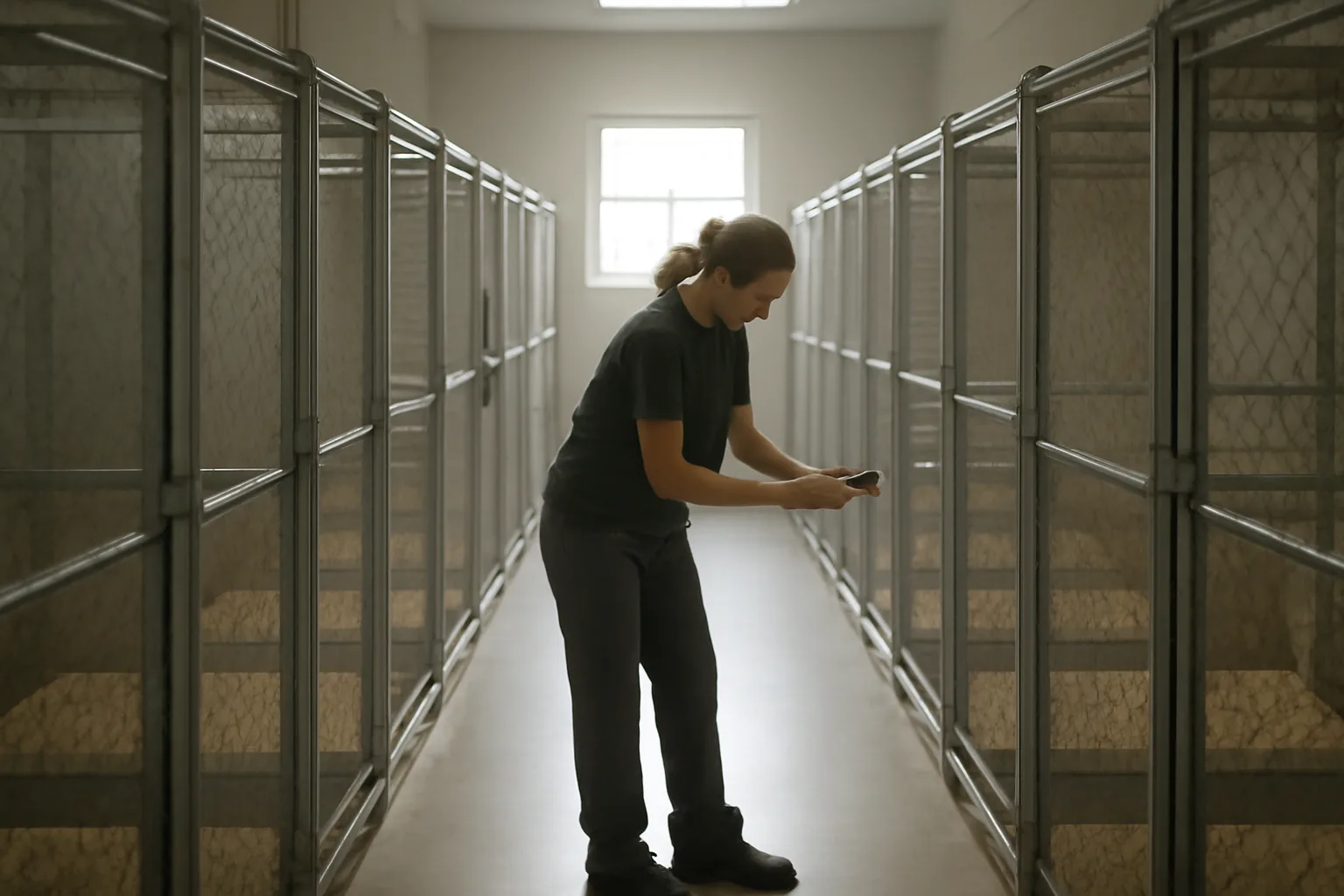
Inspectors check physical space, sanitation systems, and safety, not your business plan. Expect a checklist-based walkthrough, not a conversation. Common items across states include: minimum primary enclosure size (often tied to the dog's size, with formulas like the APHIS standard in 9 CFR 3.6 requiring floor space equal to the dog's length plus 6 inches, squared, per dog, with additional space if housed in groups) [4], adequate ventilation and temperature control (9 CFR 3.2 and 3.3 require ambient temperature not fall below 50°F for more than four hours or exceed 85°F for more than four hours for dogs not acclimated) [4], a functioning drainage and waste-disposal system, secure double-gated entry to prevent escapes, fire extinguishers and a written emergency plan, and separate isolation space for sick animals. Expect the inspector to also check your recordkeeping: vaccination records for resident and boarded animals, a log of any bites or injuries, and (for breeders) a health and breeding record for every female. USDA-licensed facilities are subject to unannounced inspections under 9 CFR 2.126 during the licensing process and periodically after [4]. State and county inspections vary in frequency from annual to complaint-driven only. If you're building out a new space, get the actual code sections in writing before you frame a single wall.
how do zoning hearings work if my property isn't automatically approved?
If your property is zoned residential or if commercial kennels are a conditional use rather than a permitted one, you'll likely need a public hearing before your county planning commission or zoning board of appeals. The typical sequence: submit a conditional use permit (CUP) or special exception application with a site plan, pay a filing fee (often $200 to $2,000+ depending on the county and project size), get a scheduled public hearing date, and mail/post notice to neighboring property owners within a set radius (commonly 200 to 500 feet, set by local ordinance). At the hearing, you present your plan, address noise and odor mitigation, parking, and hours of operation, and the board votes, sometimes with conditions attached (capped dog counts, sound barriers, restricted outdoor hours). This is where good preparation pays for itself. Boards care about noise complaints and traffic more than almost anything else. Bring a real noise mitigation plan (sound-buffering fencing, limited outdoor group sizes, indoor-only overnight hours) and a parking plan, and you dramatically improve your odds versus showing up with just a floor plan. Because every county's ordinance, hearing process, and fee schedule is different, and because rules change, we built a $149 one-time Kennel License & Zoning Packet that organizes the documents, checklists, and application language operators typically need to prepare for their specific county's process. It's not legal representation and it doesn't guarantee approval, no service honestly can, but it saves you from re-learning your county's paperwork requirements from scratch.
what does it cost overall to get fully licensed?
| County dog registration (per dog) | $10 to $25/year | Owner-level, not business-level [general county practice] | |
|---|---|---|---|
| County kennel/business license | $25 to $150/year | Varies widely by jurisdiction | |
| State kennel or breeder license | $10 to $500+/year | Scales by dog count/class, e.g. Pennsylvania [3] | |
| Zoning conditional use permit filing fee | $200 to $2,000+ one-time | Set by county planning department | |
| USDA APHIS Class A/B license | Tiered annual fee based on gross sales | Set by APHIS fee schedule under 9 CFR 2.6 [4] | |
| Facility build-out to code | Highly variable | Fencing, drainage, HVAC, isolation space | The honest range for a small-to-mid boarding or breeding operation clearing every layer (county, state, zoning, and possibly USDA) runs from a few hundred dollars for a simple, already-zoned commercial property up to several thousand for a conditional use hearing plus facility retrofits. Don't assume the government fee is the expensive part, it's usually the build-out and the hearing process that cost real money and real time. |
Total cost depends heavily on your state, county, and business size, but here's a realistic range breakdown based on the fee structures cited above. | Cost item | Typical range | Notes |
Frequently asked questions
How much does dog boarding cost for pet owners?
Dog boarding typically runs $25 to $85 per night depending on region, facility type, and dog size, with upscale suites in major metro areas costing more. These are market rates set by individual businesses, not government fees, so check local competitors directly for accurate pricing in your area.
How do I register a dog?
Bring proof of current rabies vaccination to your county clerk, treasurer's office, or animal control, provide basic dog info, and pay the license fee, commonly $10 to $25 a year. Many counties now allow online registration and offer discounts for spayed or neutered dogs.
How do you get papers for a dog?
"Papers" means breed registry documentation like AKC registration, not a government license. Both parent dogs generally need existing registration with the registry, and the breeder submits a litter registration application. You typically can't add papers after purchase unless the original breeder registers the litter.
How to become a dog breeder legally?
Check local zoning for dog-count limits first, then your state's breeder/kennel license threshold (varies by state, no single national number), then confirm whether you cross the federal USDA threshold of more than four breeding females plus sight-unseen sales, which requires an APHIS license under 9 CFR Part 3.
How to get a dog license as a pet owner?
Get proof of current rabies vaccination from your vet, then apply through your county clerk or local animal control office, in person or online. Fees commonly run $10 to $25 annually, often less for spayed or neutered dogs, with renewal required yearly or every few years.
How to get papers for my dog if I bought it without any?
In most cases you can't create registry papers retroactively unless the breeder who bred the litter registers it with a breed club and transfers ownership documentation to you. Contact the breeder first. Some registries offer limited or alternative registration paths, but options vary by organization.
What's the difference between a kennel license and a business license?
A kennel license specifically authorizes housing multiple dogs at one address and comes with facility and sanitation standards. A business license is a general municipal requirement to operate any commercial enterprise. Most kennel operators need both, plus zoning approval, as separate steps.
Do I need a USDA license to breed and sell puppies?
Only if you have more than four female dogs used for breeding and you sell puppies sight unseen (online, by phone, or shipped without the buyer meeting the dog first). Breeders who sell only in person to buyers who meet the puppy are generally exempt, per 9 CFR 2.1.
How long does it take to get a kennel license?
A straightforward state or county kennel license with no zoning issues can take a few weeks. If your property needs a conditional use permit or zoning hearing, add two to six months depending on your county's meeting schedule and whether neighbors raise objections.
What is the AWA threshold for USDA breeder licensing?
Under 9 CFR 2.1, breeders with more than four breeding females who sell dogs sight unseen generally must obtain an APHIS Class A license. Retail sellers and breeders who sell only face to face are typically exempt regardless of how many dogs they keep.
Can I board dogs in my home without a kennel license?
It depends entirely on your local zoning and county ordinance. Some counties exempt small-scale home boarding of a few dogs; others require a home occupation permit or full kennel license once you take in dogs for pay. Always check your specific county zoning office before starting.
What happens at a kennel license inspection?
An inspector checks primary enclosure sizes, ventilation and temperature control, sanitation and drainage, secure fencing and double-gated entry, fire safety equipment, and recordkeeping like vaccination logs. USDA-licensed facilities get unannounced inspections under 9 CFR 2.126 during initial licensing and periodically after.
Sources
- New York State Senate, Agriculture and Markets Law Section 108: New York defines a kennel as a place housing, boarding, or breeding more than three dogs, subject to state licensing
- Electronic Code of Federal Regulations, 9 CFR 2.1 (Requirements and application): USDA licenses breeders with more than four breeding females who sell dogs sight unseen; in-person sellers are generally exempt
- Pennsylvania General Assembly, Dog Law, 3 Pa. Cons. Stat. Chapter 45: Pennsylvania requires kennel licensing with fee classes scaling by number of dogs, including a 26+ dog commercial kennel class
- Electronic Code of Federal Regulations, 9 CFR Part 3 Animal Welfare Standards: Federal facility standards specify enclosure size formulas, temperature limits, and inspection requirements for licensed animal facilities
- Electronic Code of Federal Regulations, 9 CFR 2.126 (Access and inspection of records and property): USDA-licensed facilities are subject to unannounced inspections during licensing and periodically afterward