Last updated 2026-07-25
TL;DR
Dogtopia North Austin is a franchised daycare and boarding facility; exact rates aren't published and change with promotions, but comparable Austin-area daycare runs about $35-$45/day and boarding about $45-$65/night. Texas has no statewide kennel license for boarding-only facilities; regulation happens mostly at the city or county level through Austin/Travis County zoning and health rules.
What is Dogtopia North Austin and what does it offer?
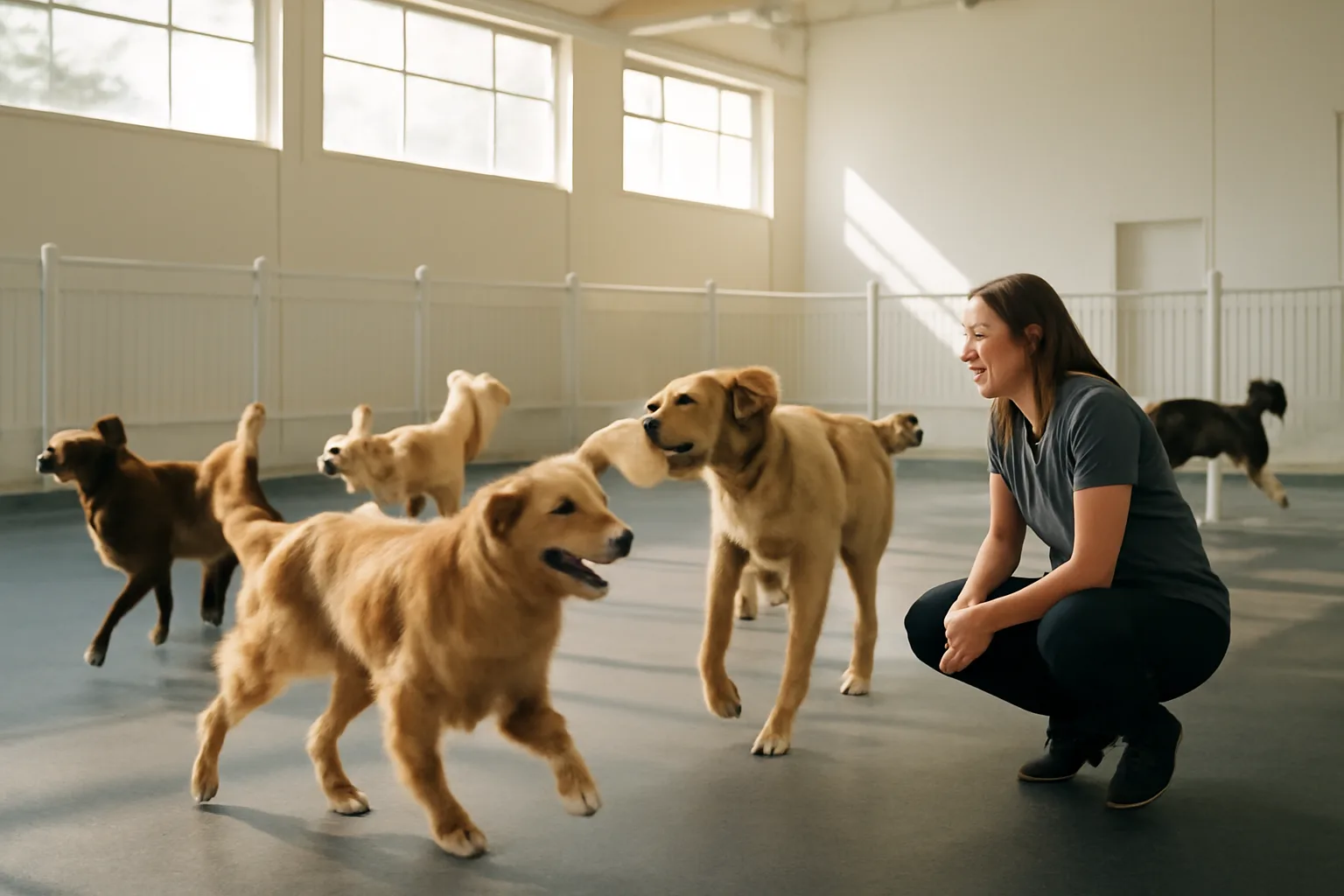
Dogtopia North Austin is a location of the Dogtopia franchise chain, which operates dog daycare, boarding, and spa services at facilities across the U.S. and Canada. Dogtopia is a private franchise brand, not a government-licensed category of its own; each location still has to meet whatever city, county, and state rules apply to commercial animal boarding in its specific location. Like other Dogtopia locations, the North Austin franchise generally offers open-play daycare (dogs grouped by size and temperament), overnight boarding, and add-on services like bathing or nail trims. Specific hours, pricing, and enrollment requirements (proof of vaccination, temperament evaluation) are set by the individual franchisee, so they can vary from what you'd find at a different Dogtopia in, say, Dallas or Round Rock. If you're comparing it to other options, it helps to look at the broader categories first. Dog boarding, pet boarding, and doggy day care all cover the general landscape of what these businesses do and how they're regulated, separate from any one brand.
How much does dog boarding cost in Austin, and at a place like Dogtopia?
| Daycare (single day) | $35-$45 | Often cheaper with monthly packages | |
|---|---|---|---|
| Boarding (overnight) | $45-$65/night | Private suite costs more than shared | |
| Add-on bath/grooming | $20-$50 | Priced per service, varies by dog size | |
| Multi-dog / holiday surcharge | +10-30% | Common around major holidays | These are market observations, not a quote from any specific business. Always confirm current pricing directly. |
National averages for overnight dog boarding run about $40-$85 per night depending on the market and whether the dog gets a private suite versus a shared kennel run, according to cost surveys tracked by industry groups like the International Boarding & Pet Services Association. Daycare (no overnight stay) tends to run cheaper, often $25-$45 per day in mid-size metro markets. Austin specifically sits in that mid-to-upper range because of cost of living and demand. Franchise daycare/boarding operators in the Austin area commonly price full-day daycare somewhere around $35-$45 and overnight boarding around $45-$65 per night, though these numbers move with fuel costs, staffing, and seasonal demand (holiday weeks often carry a surcharge). Dogtopia specifically doesn't publish national list pricing; each franchise location sets its own rates, and they change with promotions and membership packages (many locations sell monthly daycare packages that lower the per-day cost if you go often). The honest answer if you're asking "how much is dog boarding" at this specific location: call and ask, or check the location's booking page directly. There's no reliable public rate sheet, and anything printed here would go stale fast. What you can rely on is the general range above as a sanity check against a quote. | Service type | Typical Austin-area range (2024-2025) | Notes |
Do facilities like Dogtopia need a state kennel license in Texas?
Texas doesn't run a single statewide "kennel license" the way some states do. Instead, boarding and daycare facilities in Texas are regulated mainly through two channels: local city/county ordinances (zoning, health permits, sometimes a local animal care license) and, if the facility also breeds or sells dogs commercially, the Texas Department of Licensing and Regulation's Animal Breeder program under the Texas Occupations Code Chapter 802 (the Dog and Cat Breeders Act). A pure boarding/daycare operation, no breeding, generally doesn't fall under Chapter 802 at all, since that law covers people who keep breeding female dogs, not boarding operators. That's why a place like Dogtopia North Austin is licensed and inspected mostly at the city/county level, through Austin/Travis County health and zoning departments, rather than through a state kennel license. What you actually need to check locally: Austin and Travis County both maintain zoning codes that classify "kennel" or "animal boarding" uses, often requiring a conditional use permit or specific zoning district before you can operate. The city's Development Services Department and the Travis County Development Services office are the two places to confirm requirements for a specific address. Because rules differ block to block depending on zoning district, there's no universal fee or permit name to quote here; you'd pull the specific zoning classification for the property in question. For a broader look at how state-level kennel licensing works outside Texas (some states, like Ohio and Pennsylvania, run their own state kennel license programs), see dog kennels.
How do you register a dog, and is that the same as getting a license?
Registering a dog and licensing a dog are usually two different things, and people mix them up constantly. Registration (with the AKC or another breed registry) has nothing to do with government law; it just establishes a paper record of a dog's parentage and breed for pedigree purposes. Licensing a dog is a local government requirement, usually tied to rabies vaccination, and it's about public health and animal control, not pedigree. Most counties and cities require a dog license renewed annually or every 1-3 years, usually costing somewhere between $10 and $30 for an intact dog and less for a spayed/neutered one (some jurisdictions waive the fee entirely for altered pets or senior citizens). The license typically requires proof of a current rabies vaccination, which is why animal control offices tie the two together. Travis County and the City of Austin both require rabies vaccination and dog registration under local rabies control rules; specifics on fees and renewal periods are set locally and change periodically, so check the current fee schedule directly with Austin Animal Center or Travis County's animal control office rather than relying on an old number. This is the honest, boring truth about local licensing: it's cheap, it's usually online or at the vet's office, and the fee schedules move often enough that any number printed in an article risks being wrong within a year.
How to get papers for a dog (AKC registration and pedigree documents)
"Papers" for a dog almost always means AKC registration or a similar breed-registry pedigree document, not a government license. If your dog came from a breeder who registered the litter with the American Kennel Club, you get an AKC registration application from the breeder, which you then complete and submit (with a fee, currently in the range of $25-$35 for individual dog registration, though the AKC updates its fee schedule and litter registration involves separate costs) to receive an official AKC registration certificate. If you didn't get papers at the time of purchase, you generally can't manufacture them after the fact. The AKC requires that both parents be individually registered and that the breeder file litter registration paperwork; there's no retroactive path to "getting papers" for a dog whose parents were never registered, aside from the AKC's limited Purebred Alternative Listing / PAL program, which lets an unregistered purebred-looking dog compete in some AKC events without conferring full registration or breeding rights. So if you're asking "how do you get a dog papers" after adopting a rescue or buying from someone without documentation: for most practical purposes, you can't, unless you can trace and verify both parents' AKC registration and get the breeder or previous owner to cooperate with paperwork. A DNA breed test (like Embark or Wisdom Panel) can tell you likely breed composition, but that's not the same as registration papers and won't make a dog eligible for AKC conformation shows.
How to become a dog breeder, and what thresholds trigger licensing?
Becoming a legal, licensed dog breeder in the U.S. involves two layers that often get confused: federal USDA/APHIS licensing (which kicks in at certain commercial thresholds) and state or local breeder licensing (which varies enormously by state). Federally, the USDA's Animal Welfare Act requires a license for anyone who breeds and sells more than a certain number of dogs directly to the public sight-unseen, or who sells to brokers/pet stores/research facilities, unless they qualify for an exemption. Under 9 CFR 2.1, a person who owns or maintains four or fewer breeding female dogs and sells only offspring born and raised on their own premises may qualify for the retail pet store exemption from federal licensing, but that changes if the operator has more breeding females or sells wholesale or sight-unseen [1]. The Animal Welfare Act regulations at 9 CFR Part 2 lay out separate Class A (breeder) and Class B (dealer/broker) license categories depending on the business model. At the state level, Texas requires a license under the Dog and Cat Breeders Act (Texas Occupations Code Chapter 802) for anyone who keeps 11 or more intact female dogs for breeding purposes and sells more than a certain number of puppies; the statute sets the threshold at maintaining 11 or more adult intact female dogs and cats combined for breeding purposes [2]. Below that threshold, Texas generally doesn't require a state breeder license, though city or county rules can still apply. Practically, becoming a breeder means: pick your state's threshold and confirm whether you cross it, register with the Texas Department of Licensing and Regulation if you do (application, facility inspection, and an annual fee set by TDLR rule), keep vaccination and health records for every litter, and separately check whether you need a USDA license if you plan to sell wholesale, sight-unseen, or through brokers rather than exclusively face-to-face retail. For details on breeder-specific compliance work, see dogtopia, which covers the boarding/daycare comparison angle, though breeders specifically should focus on the USDA and TDLR sources above rather than boarding-industry guidance.
How to get a dog license (the local government kind)
Getting a dog license is a local government process, done through your city or county animal control office, not through AKC or any national registry. The general steps: get your dog's rabies vaccination from a licensed veterinarian, bring or upload proof of that vaccination (usually a rabies certificate showing vaccine type, date, and expiration), pay the local license fee, and receive a tag or license number, sometimes with a physical tag for the collar. In most jurisdictions, spayed/neutered dogs get a lower license fee than intact dogs, sometimes half the price or less, as an incentive tied to local animal control policy. Fees, renewal cycles (annual versus multi-year), and whether the license is even required at all (some rural counties skip it) differ so much by city and county that there's no single national number worth quoting; check your specific city or county animal control page directly. For Austin/Travis County residents specifically, the license and rabies-tag process runs through Austin Animal Center; check their current fee schedule before assuming any number, since these fees get revisited periodically by city council or commissioners court action.
What zoning and facility rules should a boarding or daycare operator expect near Austin?
If you're opening a facility like Dogtopia North Austin rather than just visiting one, zoning is usually the first real hurdle, not licensing. Most cities and counties classify commercial dog boarding/daycare as a specific land use (often called "kennel," "animal boarding," or "animal care facility" in the zoning code), and that use is only allowed by-right in certain zoning districts; in others, it requires a conditional use permit, special exception, or variance, which usually means a public hearing in front of a planning commission or board of adjustment. Before signing a lease, pull the zoning designation for the specific parcel from the city or county's zoning map. Austin's zoning is managed by the City of Austin's Development Services Department; unincorporated Travis County properties go through Travis County's development services process instead, since city and county zoning are separate systems. Ask specifically whether "animal boarding" or "kennel" use is permitted by-right, permitted conditionally, or not permitted at that address. This single question saves more time and money than anything else in the process. Beyond zoning, expect health and safety inspection requirements around ventilation, drainage/sanitation, noise (some ordinances set decibel limits or require sound buffering near residential zones), fire code compliance for occupancy, and sometimes a separate local business license or health permit layered on top of the zoning approval. None of this is uniform: a facility in unincorporated Travis County can face a completely different checklist than one inside Austin's city limits two miles away. This is where a lot of new operators get tripped up, not because the rules are secret, but because they're scattered across three or four different offices (city zoning, county zoning, health department, fire marshal) with no single combined checklist. A structured packet that walks through zoning classification, facility standards, and state-specific thresholds side by side (like the $149 one-time Kennel License & Zoning Packet) can save the back-and-forth of chasing four separate offices, though it's still on the operator to confirm final requirements with each local authority since nobody can guarantee approval and rules change.
How does USDA/APHIS licensing intersect with boarding and daycare businesses?
Most pure boarding and daycare operations, no breeding or wholesale dog sales, don't need a USDA/APHIS license at all. The Animal Welfare Act's licensing requirement targets breeders, dealers, exhibitors, and certain research facilities; a facility that only boards and plays with dogs owned by other people generally isn't a "dealer" under the Act. Where it gets relevant: if a boarding/daycare operator also breeds dogs on the side, or sells puppies from the same property, APHIS licensing thresholds kick in based on the breeding female count and sales method described above. Under the Animal Welfare Act regulations, a person who buys or sells animals, negotiates the purchase or sale of animals, or acts as a broker, and does so beyond the retail-exemption thresholds, must hold a USDA license as a dealer [1]. If that's the case, the facility now needs to think about USDA inspection standards for primary enclosures, spacing, and recordkeeping on top of whatever local boarding rules apply, which is a meaningfully bigger compliance lift. For comparison shopping between boarding, daycare, and hotel-style options as a pet owner (not an operator), dog hotels near me covers how those categories differ in practice.
Dogtopia North Austin vs. independent local boarding: what actually differs?
| Zoning/licensing requirements | Same local rules apply | Same local rules apply | |
|---|---|---|---|
| Pricing structure | Often membership/package based | Often pay-per-night | |
| Play style | Open-play group daycare common | Varies widely, some offer private runs only | |
| Consistency across locations | High (corporate standards) | Varies by owner | If you're deciding between the two as a pet owner, ask both types of facility the same questions: staff-to-dog ratios during play groups, what happens in a medical emergency, vaccination requirements, and whether dogs are grouped by size/temperament. Those answers matter more than the brand name on the sign. |
Franchise locations like Dogtopia North Austin generally offer more standardized daycare structure (webcams, app-based booking, branded play groups) and consistent operating procedures across locations, since franchisees follow a corporate playbook. Independent local kennels and boarding facilities vary a lot more: some are excellent with decades of experience, others are informal operations run out of someone's property with minimal infrastructure. Neither model is inherently better regulated. Both a franchise location and an independent kennel in the Austin area answer to the same local zoning and health rules; the franchise brand itself doesn't grant any special licensing status or exemption. The practical differences buyers notice are more about service style (open-play daycare vs. individual runs), price structure (membership packages vs. pay-per-stay), and consistency of staffing training, not regulatory category. | Factor | Franchise (e.g., Dogtopia) | Independent kennel |
Frequently asked questions
How much does dog boarding cost at Dogtopia North Austin specifically?
Dogtopia doesn't publish a fixed national rate, and this specific location sets its own pricing that changes with promotions. Comparable Austin-area daycare/boarding runs about $35-$45/day for daycare and $45-$65/night for boarding; call the location directly or check its booking page for the current quote.
How do you register a dog with the AKC?
If the litter was AKC-registered by the breeder, you complete the individual dog registration application the breeder provides, pay the current fee (roughly $25-$35 per dog), and submit it to the AKC. Without a registered litter behind it, there's no way to newly register a dog for full AKC purposes.
How do you get a dog license from the city or county?
Get proof of current rabies vaccination from a vet, then submit that along with the local license fee to your city or county animal control office (in Austin/Travis County, that's Austin Animal Center). Fees and renewal periods vary by jurisdiction, so check the current schedule locally rather than assuming a number.
How do you get papers for a dog that didn't come with any?
In most cases you can't create AKC papers retroactively; registration requires both parents to be individually AKC-registered and the breeder to have filed litter paperwork. A DNA breed test can estimate breed composition but doesn't count as registration papers or make the dog show-eligible.
How do you become a licensed dog breeder in Texas?
If you keep 11 or more intact adult female dogs/cats combined for breeding, Texas requires a license under the Dog and Cat Breeders Act, Texas Occupations Code Chapter 802, through the Texas Department of Licensing and Regulation. Below that threshold, state licensing typically isn't required, but local rules can still apply.
When does a breeder need a USDA/APHIS license instead of just a state one?
USDA/APHIS licensing applies when a breeder sells wholesale, sells sight-unseen (like online direct-to-buyer shipping), or sells to brokers/pet stores, beyond the retail-exemption thresholds tied to breeding female count under 9 CFR 2.1. Purely face-to-face retail sales from a small operation often fall under the exemption; check the current federal thresholds before assuming you're exempt.
Is a dog boarding facility required to have a USDA license?
No, generally not. Pure boarding and daycare operations that don't breed or sell dogs aren't classified as dealers under the Animal Welfare Act, so USDA/APHIS licensing typically doesn't apply. Local city/county zoning, health, and business licensing rules are what actually govern a boarding facility.
What zoning classification do daycare and boarding facilities need?
Most cities zone dog boarding/daycare as "kennel" or "animal care facility" use, allowed by-right in some districts and only by conditional use permit in others. Check the zoning map for the specific parcel through the city or county's development services department before signing a lease, since this varies block to block.
Does AKC registration count as a legal dog license?
No. AKC registration is a private pedigree record with no legal standing; it doesn't satisfy any city or county's rabies/licensing requirement. You still need a separate local dog license through your city or county animal control office, tied to proof of rabies vaccination.
How much does it cost to register a litter of puppies with the AKC?
AKC litter registration fees and individual dog registration fees change periodically; check the AKC's current fee page directly rather than relying on an old figure, since fees for litter registration, individual registration, and late fees are all listed separately and update from time to time.
Do you need a kennel license to run a home-based dog boarding business?
It depends entirely on local zoning and any city/county animal-related ordinances, not on a statewide rule in most states. Some jurisdictions allow small-scale home boarding with no permit, others require a conditional use permit or home occupation permit; check with your specific city or county zoning office before starting.
What's the difference between a dog license and dog registration?
A dog license is a government requirement (usually annual, tied to rabies vaccination) issued by a city or county animal control office for public health tracking. Dog registration (AKC or similar) is a private pedigree record with no legal requirement behind it and no bearing on local licensing compliance.
Sources
- 9 CFR Part 2, Subpart A (Animal Welfare Act licensing requirements): Thresholds and criteria for when a breeder/dealer needs a USDA license, including the retail pet store exemption and dealer licensing categories.
- Texas Occupations Code, Chapter 802 (Dog and Cat Breeders Act): Texas state breeder licensing threshold of 11 or more intact adult female dogs/cats maintained for breeding purposes.
- City of Austin Code of Ordinances, Title 25 (Land Development Code): City of Austin zoning classifications and process for commercial animal-related land uses.
- Travis County, Transportation and Natural Resources / Development Services: Unincorporated Travis County development and zoning review process separate from City of Austin zoning.
- Austin, Texas Code of Ordinances, Chapter 3-4 (Animal Regulation): Local dog licensing and rabies vaccination requirements administered under Austin's animal regulation ordinance.