Last updated 2026-07-24
TL;DR
Dogtopia Eau Claire is a franchised dog daycare and boarding facility in Eau Claire, Wisconsin; exact rates vary by location and aren't published nationally, but comparable Dogtopia daycare runs about $35-$45/day and boarding often runs $50-$75/night. Wisconsin requires a rabies vaccination and county dog license every year (Wis. Stat. 174.05), separate from any facility license the daycare itself holds.
What is Dogtopia Eau Claire and what does it offer?
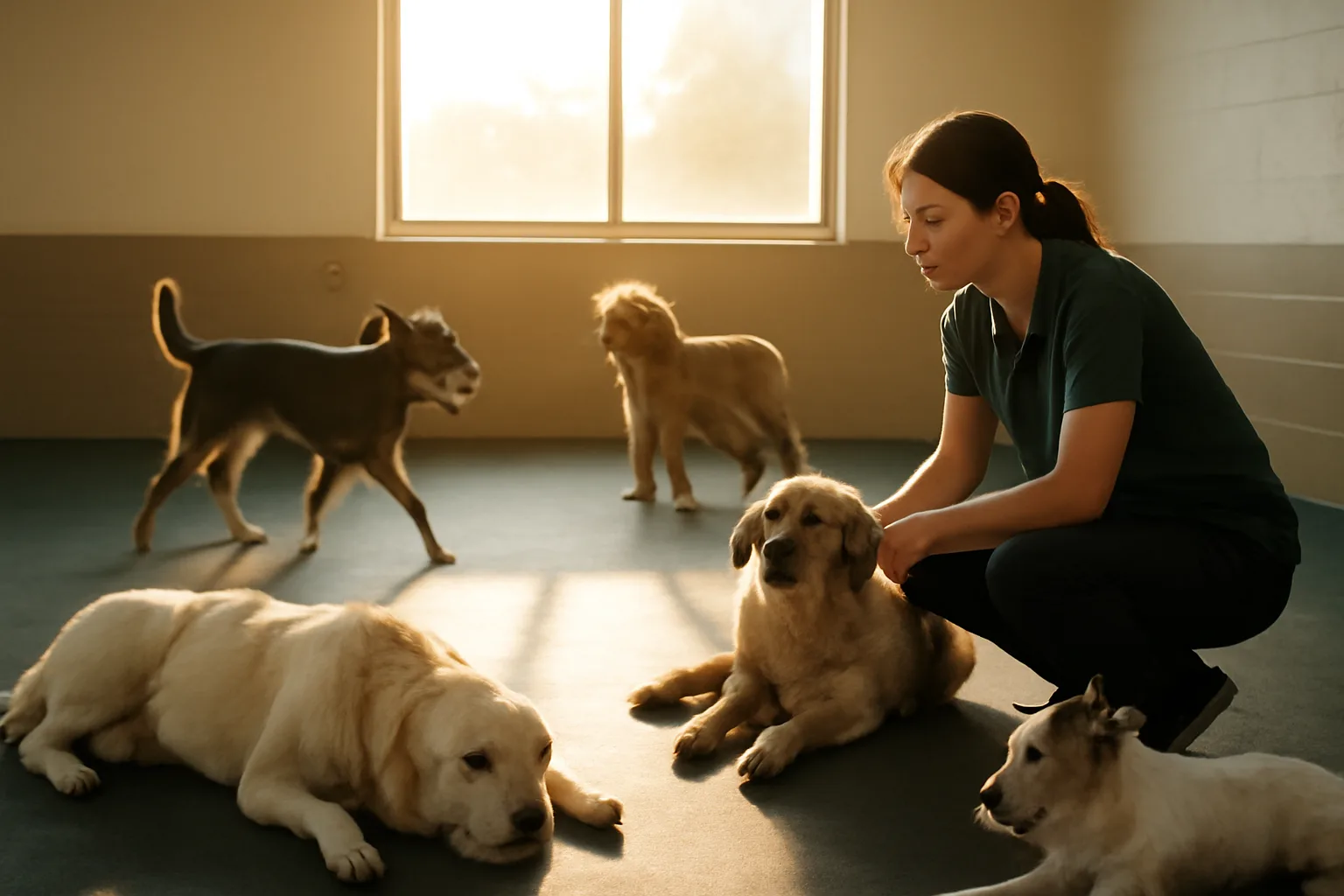
Dogtopia is a national franchise chain of dog daycare, boarding, and spa facilities, and the Eau Claire, Wisconsin location operates under that franchise model with local ownership handling day-to-day operations. Like other Dogtopia locations, it typically offers daycare (open play in supervised rooms grouped by size and temperament), overnight boarding, and add-on services like baths, nail trims, and enrichment activities. Franchise locations set their own prices, staffing, and hours within brand guidelines, so what you see advertised for Dogtopia locations in Texas or Florida won't necessarily match Eau Claire's rates. If you're comparing options, it helps to also look at independent dog boarding operators and dog hotels near me style searches, since franchise and independent pricing structures differ quite a bit. For pet owners, the practical takeaway is simple: call the specific location for current rates, membership options, and vaccination requirements before you book. For anyone building or operating a competing facility, Dogtopia's model is a useful benchmark for what a well-run mid-size daycare and boarding operation looks like from a service standpoint.
How much does dog boarding cost?
| Basic kennel (rural/budget) | $20-$35 | |
|---|---|---|
| Standard commercial boarding | $35-$55 | |
| Franchise suite boarding (e.g., Dogtopia-style) | $50-$75 | |
| Luxury/boutique boarding | $75-$150+ | If you're pricing out a new facility, look at pet boarding rate structures in your specific county before settling on numbers, because local competition matters more than national averages. |
Dog boarding costs vary a lot by region, facility type, and season, but a workable national range for standard overnight boarding at a commercial kennel or daycare-boarding combo is roughly $35 to $85 per night, with upscale 'suite' style boarding at franchises like Dogtopia often landing between $50 and $75 per night depending on market. Rural, no-frills kennels can run as low as $20-$30/night, while luxury boutique boarding in major metros can exceed $100/night. There's no federal or state price-setting for boarding rates; it's pure market pricing. Wisconsin doesn't publish boarding rate data at the state level, and neither does USDA, since routine boarding of personally owned pets generally falls outside APHIS licensing (more on that below). Multi-dog discounts, holiday surcharges (often 10-20% extra around major holidays), and membership/daycare bundles are common ways operators structure pricing. Here's a rough comparison table based on typical market segments (these are general industry ranges, not Eau Claire specific figures, since no government source tracks private boarding prices): | Facility type | Typical nightly rate |
How much is dog daycare, and how is it different from boarding?
Dog daycare is daytime-only supervised play, typically priced per day rather than per night, and generally runs $20-$45 per day at most U.S. facilities, with Dogtopia-brand locations commonly in the $30-$45 range for a single day depending on market and whether the owner buys a punch card or membership. Boarding, by contrast, includes overnight stays and usually costs more per 24-hour period because it includes overnight staffing or monitoring. Many facilities, including doggy day care operators nationwide, sell package deals: a 10-day punch card might knock 15-20% off the per-day rate compared to drop-in pricing. Monthly unlimited memberships are common at franchise daycare chains and can make sense for owners bringing a dog in 3+ times a week. One thing that surprises new pet owners: most legitimate daycare and boarding facilities require proof of current vaccinations (rabies, DHPP/distemper combo, and often bordetella for kennel cough) before the first visit. This isn't just a business policy; many states and counties tie facility licensing requirements to documented vaccination protocols for boarded animals.
How do I register a dog in Wisconsin (and does it matter for daycare)?
Registering a dog in Wisconsin means getting a county dog license, which state law requires annually for every dog five months or older. Under Wisconsin Statute 174.05, "the owner of a dog shall annually... obtain a dog license" from the county (or municipality where applicable), and the license requires proof of current rabies vaccination [1]. To register, you generally bring proof of rabies vaccination to your county clerk's office (or the municipal clerk if your city issues its own tags) and pay the license fee, which varies by county and by whether the dog is spayed/neutered. Eau Claire County residents register through the Eau Claire County Clerk's office; fees differ for altered vs. unaltered dogs, and many counties charge a late fee if you miss the annual renewal window (check your county clerk page directly since fees change) [2]. Daycare and boarding facilities don't replace this requirement. Some facilities will ask for your county license number or at least a note that the dog is currently licensed, since it's one more piece of evidence the dog is vaccinated and accounted for. But a daycare membership card is not a substitute for county registration, and vice versa; they're two separate paperwork trails.
How do I get a dog license, step by step?
Getting a dog license in most states follows a similar pattern: get the rabies vaccine from a licensed vet, get the vaccination certificate, then bring that certificate (plus proof of spay/neuter if applicable, for a lower fee) to your county or city licensing office along with payment. In Wisconsin specifically, county clerks issue dog licenses under Wis. Stat. 174.05, and the statute requires rabies vaccination as a prerequisite: "No dog license may be granted unless the owner presents evidence that the dog has a current rabies vaccination" (paraphrased from the statutory framework; check your county clerk's exact intake requirements) [1]. Some Wisconsin counties allow online or mail-in renewal once you've registered once in person. Missing the deadline usually triggers a late fee, and in some counties, dogs found unlicensed can result in a citation. This is a low-stakes but real legal requirement, separate from anything a boarding or daycare facility asks for at check-in.
How do you get papers for a dog, and what does that actually mean?
"Papers for a dog" almost always means AKC (American Kennel Club) registration papers or a similar purebred registry's paperwork, and this is completely separate from a county dog license. AKC registration establishes a dog's pedigree and eligibility for conformation shows, not a legal permit to own the dog. To get AKC papers for a puppy, you (or the breeder) typically need the litter registered with AKC first. If you bought a puppy from an AKC-registered litter, the breeder should provide an AKC Registration Application (sometimes called a 'blue slip' historically, now often done online) at the time of sale. You fill it out, pay the AKC registration fee, and submit it to formally register that individual puppy in your name. If you already own an adult dog without papers (bought without documentation, adopted, or a rescue), you generally cannot retroactively get full AKC papers unless you can establish verified purebred parentage through the breeder or DNA-based parentage verification programs AKC offers in limited circumstances. There's no way to manufacture papers after the fact if the breeder never registered the litter; that's one reason buying from an unregistered 'papers available later' seller is risky.
How can I get papers for my dog if I don't have the breeder's info?
If you don't have breeder contact information, getting full AKC-style papers after the fact is very difficult and often not possible. AKC registration depends on documented parentage from a registered litter; without that paper trail, there's no retroactive registration path for most owners. What you can realistically do: some registries (AKC included, in narrow cases) allow DNA parentage verification if you can identify and test the sire and dam, but this requires access to those specific dogs, more than a general breed guess. For mixed breed or unknown-parentage dogs, some owners instead register with less formal registries that don't require verified pedigree (these carry far less weight and aren't equivalent to AKC papers). If your goal is just proof of ownership and vaccination status rather than pedigree documentation, a county dog license and your vet's vaccination records accomplish that legitimate purpose without needing 'papers' in the AKC sense at all. Many people conflate the two, but a family pet with no papers is still a completely legal dog to own, board, and license.
How do you become a dog breeder legally?
Becoming a legal dog breeder means clearing three separate layers of rules: local zoning/animal control ordinances, state breeder licensing (if your state has one), and potentially federal USDA licensing if you sell wholesale or exceed certain thresholds. First, check your county zoning for kennel or breeding restrictions; many counties cap the number of intact adult dogs allowed on residential property without a kennel license. Second, check your state's animal or agriculture department; Wisconsin, for example, requires a license from the Department of Agriculture, Trade and Consumer Protection (DATCP) for anyone who sells 25 or more dogs in a year or keeps 3 or more breeding females for sale purposes, under Wisconsin's Dog Breeder license statute (Wis. Stat. 173.41 and related administrative code ATCP 16) [3]. Third, check USDA APHIS thresholds: if you sell puppies wholesale (to pet stores, brokers, or research) rather than directly retail to the end buyer, and you keep more than four breeding females, you likely need a USDA Class A (breeder) license under the Animal Welfare Act [4]. USDA's own guidance states that "Class 'A' licensees are breeders who sell puppies or other animals they've bred and raised on their own premises, to the public" for wholesale-type transactions and certain retail scenarios, and the agency has specific exemptions for small-scale, direct retail sellers [4]. The exact retail exemption thresholds have shifted with rule changes over the years, so check the current APHIS licensing page rather than relying on older blog posts. Breeders also typically need a state sales tax permit if selling as a business, and many states require health certificates from a licensed vet for each puppy sold. If you're building a real breeding operation rather than an occasional hobby litter, budget time for all three layers; skipping the state or federal piece because you only checked local zoning is the most common compliance gap breeders run into.
What's the difference between a kennel license and a breeder license?
A kennel license typically covers the facility itself (boarding, daycare, or housing multiple dogs at one location), while a breeder license specifically covers the business of producing and selling puppies. Some states fold both into one licensing category; others separate them entirely. Wisconsin's DATCP, for instance, licenses both boarding/daycare facilities and dog breeders, but under related-but-distinct rules within the state's animal welfare statutes; a facility that only boards other people's dogs doesn't need a breeder license, and a breeder who doesn't board outside dogs doesn't need a boarding facility license [3]. If you plan to do both (breed and board), you may need to satisfy both sets of requirements plus county zoning approval for a kennel use. This is exactly the kind of overlap that trips people up when opening a facility. Local zoning boards often want to see state licensing paperwork before granting a conditional use permit, and state agencies sometimes ask for proof of zoning compliance before issuing a license, so the order you pursue these in matters. If you're comparing your own state and county's process against a big brand's operation, it's worth reading how established chains like dogtopia structure their multi-location licensing, since franchise legal teams have already worked out state-by-state compliance patterns that solo operators have to figure out from scratch.
Do dog boarding and daycare facilities need a USDA license?
Most standalone dog boarding and daycare facilities that only care for personally owned pets (not breeding, not wholesale sales) do not need a USDA APHIS license, because routine boarding of pets isn't regulated under the federal Animal Welfare Act in the same way commercial breeding and dealing are. USDA licensing under the AWA mainly targets breeders, dealers, exhibitors, and research facilities [4]. However, states and counties absolutely do regulate boarding and daycare facilities, usually through the state department of agriculture (or health department, in some states) plus a county or city zoning/business license requirement. Wisconsin requires a license for commercial dog operations under DATCP's animal welfare rules, and Eau Claire County zoning would separately govern whether a given property can operate as a commercial kennel at all [3]. Check your specific county's zoning office for conditional use permit requirements before signing a lease for a boarding facility site. The compliance stack for a facility like Dogtopia Eau Claire, or any competitor opening nearby, generally looks like: county zoning approval for the physical location, state facility license (DATCP in Wisconsin), local business license/occupancy permit, and possibly a separate fire/safety inspection depending on the municipality. None of these are optional shortcuts; skipping county zoning is the single most common reason a facility gets shut down or denied occupancy after already spending money on buildout.
What should I check before opening a facility like this?
Before signing a lease or buying property for a dog boarding, daycare, or breeding operation, confirm four things in this order: county zoning allows kennel/commercial animal use at that address, the state agriculture department's licensing requirements for your facility type and size, any USDA APHIS threshold that applies if you're breeding or selling wholesale, and local building/fire code requirements for animal facilities (ventilation, drainage, fencing). Zoning is usually the first filter and the one people underestimate. Many counties require a conditional use permit or special exception for a commercial kennel in areas not already zoned commercial/agricultural, and that process can take weeks to months with a public hearing. Get your zoning question answered in writing from the county planning office before you commit to a lease. This is genuinely the part where a lot of new operators get stuck: pulling together the zoning packet, state license application, and facility standards documentation into one coherent submission. A Kennel License & Zoning Packet built for your state and county can save real time here; it's a $149 one-time tool to help organize the paperwork, not a substitute for a local attorney or zoning consultant, and it doesn't represent you before any board. Nothing beats an actual phone call to your county zoning office and state agriculture department to confirm current fees and forms, since both change more often than people expect.
How does Eau Claire County zoning treat kennels and dog daycare?
Eau Claire County, like most Wisconsin counties, regulates kennels and commercial animal facilities through its zoning ordinance, typically requiring a conditional use permit in residential or agricultural districts and allowing kennel use as a permitted use only in specific commercial or industrial zones. The exact zoning classification and permit process depends on the parcel's current zoning district, so anyone opening a facility (Dogtopia franchisee or independent operator) needs to check with the Eau Claire County Planning and Zoning office or the City of Eau Claire's zoning department if the property is within city limits, since city and county rules differ [5]. A franchise like Dogtopia typically handles this zoning research as part of its site selection process before signing a lease, which is one advantage of the franchise model over building solo. Independent operators need to do this legwork themselves or hire local help. If you're scouting a location in or near Eau Claire, call the zoning office directly and ask specifically: 'Is commercial kennel/dog daycare a permitted use or a conditional use at this address, and what's the approval timeline?' Get the answer in writing or by email if possible, since verbal answers from a front desk aren't always the final word from the actual zoning board.
Frequently asked questions
How much does dog boarding cost at a typical facility?
Standard commercial dog boarding runs roughly $35-$85 per night depending on region and facility type. Basic rural kennels can be as low as $20-$30/night, while franchise suite-style boarding (like Dogtopia-brand locations) often falls between $50 and $75/night. Luxury boutique boarding in major cities can exceed $100/night. There's no government-set rate; it's pure local market pricing, so calling the specific facility is the only way to get an exact number.
How much is dog daycare per day?
Dog daycare typically costs $20-$45 per day at most U.S. facilities, with franchise locations often in the $30-$45 range. Punch cards (10 days at a time) usually discount the per-day rate 15-20% compared to drop-in pricing, and monthly unlimited memberships are common at chains for owners who bring their dog in multiple times a week.
How do I register a dog in my county?
Get your dog's rabies vaccination from a licensed vet, then bring the vaccination certificate to your county (or city) clerk's office to apply for an annual dog license. Wisconsin law (Wis. Stat. 174.05) requires this for all dogs five months and older, and most states have a similar county-level licensing requirement tied to rabies vaccination proof.
How do you get a dog license?
Bring proof of current rabies vaccination to your county or municipal clerk's office and pay the licensing fee, which is usually lower for spayed/neutered dogs. Renewal is typically annual. Wisconsin's statute (174.05) makes this mandatory statewide, and most counties charge a late fee if you miss the renewal deadline, so check your county clerk's specific page for current fees and dates.
How do you get papers for a dog?
AKC-style 'papers' come from the breeder registering the litter with AKC and providing you a registration application at the time of sale, which you then submit and pay to finalize in your name. Papers only exist if the litter was registered originally; there's generally no way to create pedigree papers retroactively for a dog whose breeder never registered it.
How can I get papers for my dog if I bought it without any documentation?
If the breeder never registered the litter and you don't have contact info to track down parentage, full AKC-style papers usually aren't obtainable after the fact. Limited DNA parentage verification exists in some cases but requires identifying and testing the actual sire and dam. For most owners, a county dog license and vet vaccination records serve the practical legal purpose instead.
How do you become a dog breeder legally?
Check county zoning for kennel/breeding restrictions first, then your state agriculture department's breeder licensing rules (Wisconsin requires a DATCP license for those selling 25+ dogs/year or keeping 3+ breeding females for sale, under Wis. Stat. 173.41), and finally USDA APHIS thresholds if you sell wholesale or keep more than four breeding females. All three layers can apply at once.
Do I need a USDA license to breed dogs?
You likely need a USDA APHIS Class A breeder license if you sell puppies wholesale (to pet stores, brokers, or via certain online/retail arrangements) and keep more than four breeding females, per the federal Animal Welfare Act. Small-scale breeders selling directly retail to buyers who see the puppy in person before purchase are often exempt, but exemption details have changed over time, so check APHIS's current licensing page.
What is Dogtopia Eau Claire and what services does it offer?
Dogtopia Eau Claire is a franchise location of the national Dogtopia dog daycare and boarding chain, offering supervised daycare, overnight boarding, and add-on spa services like baths and nail trims. Exact pricing, hours, and vaccination requirements are set locally, so calling or checking the specific location directly is the only way to confirm current rates.
Does a boarding facility need the same license as a breeder?
No. A kennel/boarding facility license typically covers housing other people's dogs temporarily, while a breeder license covers producing and selling puppies. Some states combine these under one agency (Wisconsin's DATCP handles both, under separate rules), but a facility doing only boarding doesn't need breeder licensing, and vice versa, unless it does both.
How does zoning affect opening a dog daycare or kennel?
Most counties require a conditional use permit or special exception to run a commercial kennel or dog daycare in residential or agricultural zones, and only allow it as a permitted use in specific commercial/industrial districts. Always confirm zoning status with the county (or city) planning office in writing before signing a lease, since the approval process can take weeks to months with a public hearing.
What's the difference between a dog license and AKC registration papers?
A dog license is a legal requirement issued by your county or city, tied to rabies vaccination, and required annually regardless of breed. AKC registration papers document pedigree and purebred status for shows or breeding purposes and are entirely optional and unrelated to legal ownership. You can legally own, board, and license a dog with zero AKC papers.
Sources
- Wisconsin State Legislature, Wis. Stat. 174.05: Wisconsin requires annual dog licensing tied to rabies vaccination proof
- Eau Claire County Clerk, Dog Licensing: Eau Claire County residents register dogs through the county clerk's office
- Wisconsin DATCP, Dog Breeder and Seller License requirements: Wisconsin requires a DATCP license for breeders selling 25+ dogs annually or keeping 3+ breeding females
- USDA APHIS, Animal Welfare Act Licensing: USDA Class A breeder licenses apply to those who sell animals they bred and raised, under the Animal Welfare Act
- Eau Claire County, Zoning and Planning: Eau Claire County zoning governs conditional use permits for commercial kennel operations