Last updated 2026-07-24
TL;DR
Animal day care (dog daycare/boarding) typically costs $25 to $65 a day or $40 to $85 a night, depending on region and services. Operators need a state or county kennel license, local zoning approval, and sometimes a USDA license if breeding crosses wholesale thresholds. Dog owners register pets through county animal control, and breeders get papers through AKC or a similar registry, not the government.
What is animal day care and how is it different from boarding?
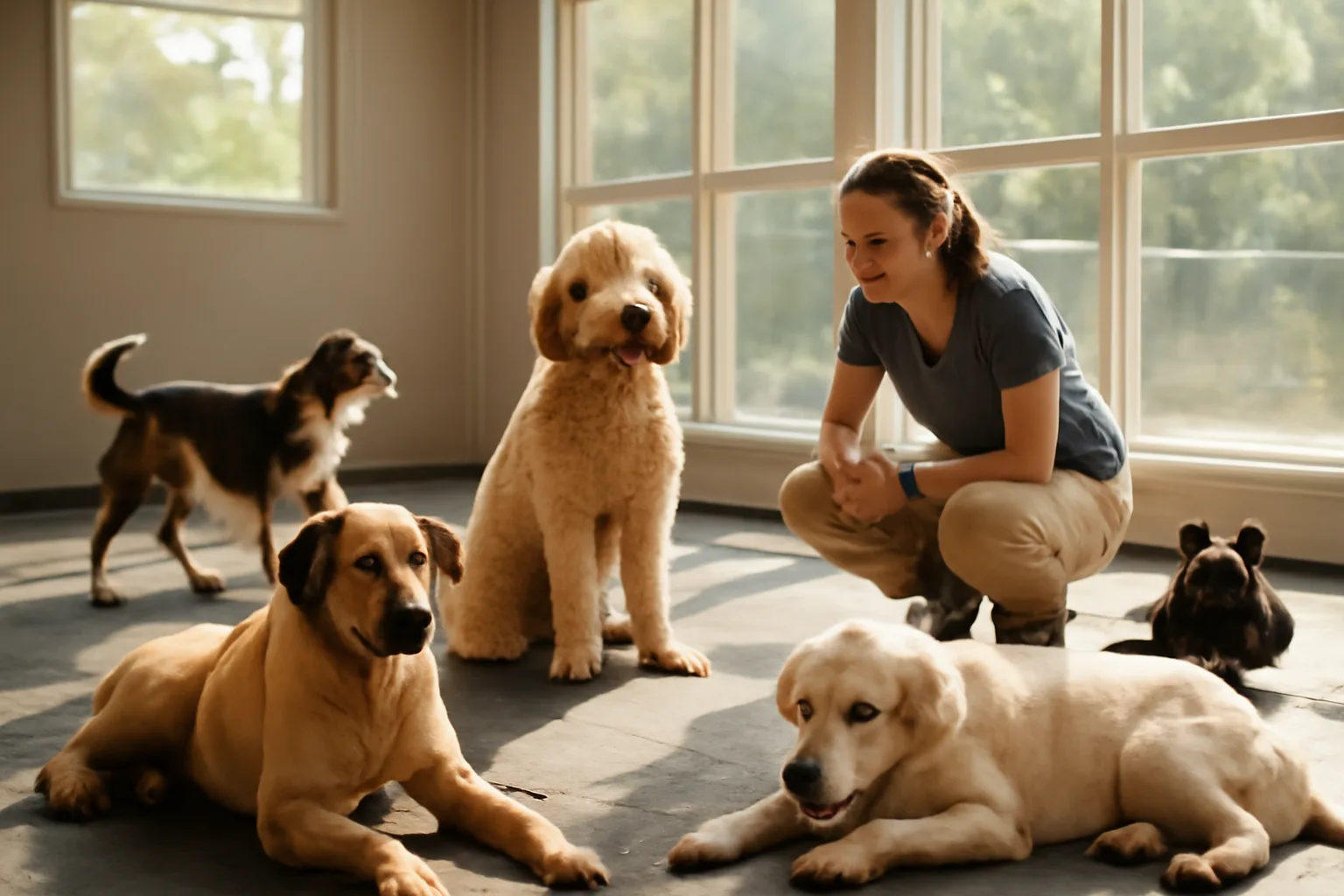
Animal day care, usually called dog daycare, is supervised group or individual care for pets during the day, with owners picking their animal up the same evening. Boarding is overnight care, sometimes for a night, sometimes for weeks. Most facilities offer both, and many states lump them into one regulatory category called a "kennel" or "animal boarding facility" regardless of whether the dog goes home at 6pm or stays a month. The distinction matters for licensing because some counties charge different fees or apply different facility standards to day-use-only operations versus overnight kennels. A daycare-only building might not need the same outdoor exercise yard ratios or nighttime staffing rules that a full boarding kennel needs. Always check with your county zoning office and state department of agriculture before assuming your business fits neatly into one bucket [1]. If you're comparing service models before you build out a facility, it helps to look at how dog boarding and doggy day care operations differ in staffing ratios, square footage needs, and typical local ordinance language.
How much does dog boarding cost?
Dog boarding generally runs $40 to $85 per night at a standard kennel or boarding facility, with upscale "dog hotel" suites running higher, sometimes $75 to $120 a night in major metro areas. Daycare-only rates are lower, typically $25 to $45 per day, since there's no overnight staffing or lodging involved. Pricing swings hard based on region, add-on services, and facility type. A basic run-of-the-mill kennel in a rural county might charge $25 a night. A boutique daycare-and-boarding combo in a coastal city can easily hit $90 to $150 a night once you add grooming, extra walks, or webcam access. There's no national database that tracks this consistently. Costs quoted by individual businesses and franchise operators (like Dogtopia) are the most reliable real-world benchmarks, since no federal agency publishes average boarding rates. For operators, the pricing question isn't just what to charge customers. It's whether your local fee structure (kennel license fees, inspection fees, zoning application costs) makes a given market viable. Some counties charge under $100 a year for a kennel permit. Others charge several hundred, plus a per-animal fee. Always get the current fee schedule from your county clerk or state agriculture department before building a pricing model.
How much is dog boarding for extended stays or multiple pets?
Extended boarding (a week or more) usually comes with a modest per-night discount, often 10% to 20% off standard rates, since the facility doesn't have to manage new intake and discharge paperwork daily. Multi-pet households often get a sibling discount too, commonly $10 to $20 off the second dog's nightly rate when they share a run. There's no regulatory reason extended stays cost less. It's purely a business decision facilities make to reward predictable, lower-friction bookings. If you're pricing your own facility, decide early whether you want to build in loyalty or bulk discounts, since it affects your revenue forecasting more than most new operators expect. A facility that's 90% full of long-term boarders has very different cash flow and staffing needs than one doing a lot of one-night bookings. Compare pricing tiers across facility types before settling on your rate card. Reviewing pet boarding rate structures and dog hotels near me listings in your target market gives you a realistic local benchmark faster than guessing.
How do you register a dog?
You register a dog through your city or county's animal control office or licensing division, not through a national database. Most jurisdictions require dog registration (often called a "dog license") annually or every one to three years, and proof of current rabies vaccination is almost always required before the license is issued. The process usually looks like this: get your dog's rabies vaccination from a licensed vet, take the vaccination certificate to your county or city clerk (or submit it online where available), pay the registration fee, and get a tag. Fees typically range from $10 to $25 a year for spayed/neutered dogs and $20 to $50 for intact dogs in jurisdictions that charge more for unaltered animals, though exact numbers vary widely by county and you should confirm current rates locally. Dog registration is a consumer-facing requirement, separate from a kennel or business license. If you're running a boarding or daycare facility, your customers still need their own dogs individually registered per local law, and you may be required to verify current rabies and registration status at intake as part of your facility's operating conditions. Ohio's statewide licensing law, administered by county auditors, is a good example of how this works at the state and county level together [2].
How to get a dog license
Getting a dog license is nearly the same process as registering a dog, and in most places the terms are used interchangeably. Contact your county or city clerk's office (or the local animal control agency), bring proof of rabies vaccination and, in many places, proof of spay/neuter status, pay the license fee, and receive a tag or certificate. Some states require dog licenses statewide with county-level administration. Ohio is a well-known example: under the Ohio Revised Code, every county auditor's office issues dog licenses, and state law sets the licensing framework counties must follow [2]. Other states leave licensing entirely to individual cities or counties, so requirements can differ from one town to the next even within the same state. Always check both your state department of agriculture and your specific county or city clerk, since either level might have its own rule. If you operate a kennel, daycare, or boarding facility, this is a different license from your business kennel permit. Don't confuse the individual dog license your customers need with the commercial kennel license your facility needs from the county zoning and licensing offices.
How do you get a dog papers?
"Papers" for a dog almost always means registration with a breed registry like the American Kennel Club (AKC), not a government document. To get AKC papers, both parent dogs need to be individually AKC registered, the breeder submits a litter registration application after the puppies are born, and each puppy then gets its own registration certificate. There is no government agency that issues dog pedigree papers. This trips people up constantly. If you bought a puppy and the seller says "the papers are coming," that means AKC (or another registry like United Kennel Club) paperwork, and it depends entirely on the parents already being registered with that same organization. A dog with no registered parents cannot retroactively get AKC papers just because someone fills out a form. Breeders who plan to sell puppies with papers need to register their own breeding dogs first, keep accurate whelping records, and submit litter applications promptly, typically within a set window after the litter is whelped. AKC litter registration deadlines and fees are published on their site and change periodically, so check current requirements directly.
How do you register a dog with a breed registry?
Registering a dog with AKC or a similar registry requires that the dog's parents are already registered, or, less commonly, that the dog qualifies under a limited registration path (like AKC's Purebred Alternative Listing for unregistered purebreds meeting certain conditions). You submit an application, pay a fee (commonly in the $25 to $40 range per dog through AKC, though fees change and should be verified on their site), and receive a registration certificate. This is completely separate from government dog licensing. A dog can be AKC registered and still need a local government dog license to be legal in its county. Conversely, plenty of dogs have a valid government license and zero breed registry papers, and that's fine unless you're planning to show, breed, or sell as purebred with documentation. If you're breeding dogs commercially, understand that breed registry paperwork and USDA/state breeder licensing are entirely different systems run by entirely different organizations, and passing one doesn't satisfy the other.
How to become a dog breeder
Becoming a legal dog breeder means clearing three separate hurdles depending on your scale: local zoning approval for a breeding kennel, state breeder licensing (required in many states above a certain number of litters or dogs), and potentially a USDA license if you sell dogs wholesale or exceed federal thresholds. Under the Animal Welfare Act (7 U.S.C. 2131 et seq.) and its implementing regulations at 9 CFR Part 1, anyone who sells dogs wholesale, meaning not in person, sight-unseen, to a buyer, and who has more than four breeding females, generally needs a USDA license as a "dealer," administered by USDA APHIS [3]. If you sell puppies only in person, direct to the buyer, at your own home or facility, you're generally exempt from USDA dealer licensing under the "retail pet store" exemption defined in 9 CFR 1.1, even at higher volumes, though this exemption has specific conditions worth reading carefully [3]. Many states layer their own commercial breeder license on top of this, often triggered at a lower threshold than USDA's, sometimes as few as three or more breeding females or a set number of litters per year. States like Missouri, Ohio, Pennsylvania, and Virginia all have their own commercial breeder statutes with different thresholds, inspection schedules, and facility standards, so check your specific state department of agriculture before assuming USDA exemption means you're fully compliant. Zoning is the piece breeders forget most often. Even a small home-based breeding operation can run into county zoning rules about the number of dogs allowed on residential property, noise ordinances, or requirements for a conditional use permit if you're breeding at any commercial scale. This is exactly the kind of overlapping requirement that trips up new breeders: they get state and USDA paperwork sorted and then get shut down by a county zoning complaint. A packet like our $149 Kennel License & Zoning Packet is built to help you organize state, county, and zoning requirements into one filing set before you submit anything, though we're not a law firm and can't represent you before a zoning board.
What USDA thresholds apply to breeders and boarding facilities?
| Retail breeder (in-person sales only) | Generally exempt | Any volume, if sold in person | |
|---|---|---|---|
| Wholesale/online breeder | Class A or B license required | Sight-unseen sales, more than 4 breeding females [3] | |
| Boarding kennel / daycare | No USDA license required | N/A, state/county regulated only | |
| Research or exhibition dog supplier | Class B license required | Selling for research or exhibition | Source: 9 CFR Part 1 and Part 2, Animal Welfare Act regulations [3] |
USDA APHIS licensing under the Animal Welfare Act applies to breeders who sell dogs wholesale (not directly to the end buyer in person) and who have more than four breeding females, selling offspring for resale, research, or exhibition, among other trigger conditions [3]. The exact regulatory language, at 9 CFR Part 1 and Part 2, is detailed and has specific carve-outs, so read the current regulatory text directly rather than relying on a rule of thumb. Here's the core distinction the regulation draws: a "retail pet store," as defined at 9 CFR 1.1, is a place where animals are sold at retail for pet purposes to the buyer in person, and breeders who sell puppies this way are typically exempt from dealer licensing, regardless of how many litters they produce a year [3]. Breeders who sell through pet stores, online sight-unseen, or through brokers generally are not exempt and need a USDA Class A (breeder) or Class B (dealer) license depending on their role. Boarding kennels and daycare facilities are generally not covered by USDA licensing at all, since the Animal Welfare Act's licensing structure, per 7 U.S.C. 2133, is aimed at dealers, exhibitors, and research facilities, not commercial pet care businesses. Your boarding or daycare facility's primary regulatory burden is state and local, not federal. | Activity | Federal (USDA APHIS) requirement | Typical trigger |
How do you get a kennel license for a boarding or daycare facility?
Getting a kennel license for a boarding or daycare business typically means clearing three separate approvals: local zoning (confirming your property is zoned for a commercial animal facility, or getting a conditional use permit if it isn't), a county or state kennel/business license application with facility inspection, and any state-specific animal facility standards compliance (ventilation, sanitation, fire safety, staff-to-animal ratios where applicable). Start with your county zoning office. Zoning is almost always the first blocker, not the last. A property that's zoned agricultural or commercial might allow a kennel outright; a residential property almost never will without a variance or conditional use permit, and getting one can take months and a public hearing. Contact your county zoning department directly, since this is entirely locally controlled and there's no federal or even consistent statewide standard. Next, check your state department of agriculture (or equivalent, sometimes it's the state veterinarian's office or department of health) for a state-level kennel or animal facility license, which some states require in addition to, not instead of, your county permit. Facility inspections typically check things like adequate ventilation, sanitation protocols, secure fencing, fire suppression access, and sometimes specific square-footage-per-animal minimums. Budget real time for this. Between zoning hearings, facility buildout to meet inspection standards, and license processing, expect the full approval timeline to run anywhere from two to six months in a straightforward case, longer if you need a zoning variance or public hearing. If you're comparing the full range of facility types before you commit to a building, dog kennels as a category cover everything from small home-based operations to large commercial boarding campuses, and the licensing burden scales with your intended capacity.
What should you check with your county zoning office before opening?
Before signing a lease or buying property for a boarding or daycare facility, call your county zoning office and ask directly whether commercial animal boarding or daycare is a permitted use, a conditional use, or prohibited on that specific parcel. Zoning designations (residential, agricultural, commercial, industrial) vary block by block, and the same business type can be welcomed on one lot and rejected on the lot next door. Ask specifically about noise ordinances, since barking complaints are the single most common source of zoning enforcement action against kennels and daycares. Ask about setback requirements from property lines and neighboring residences, parking minimums for staff and customers, and whether a public hearing or neighbor notification is required for your permit type. If your parcel isn't zoned for it, you'll likely need a conditional use permit or variance, which usually means a public hearing where neighbors can object. This is the step that kills or delays more animal care businesses than any facility standard or license fee. Budget for the possibility of a contested hearing, and get your application packet (site plan, noise mitigation plan, traffic plan) as complete as possible before you file, since incomplete applications are the most common reason for delay or denial at the local level.
How much does a kennel or breeder license actually cost?
License and permit costs vary enormously by state and county, and there is no national fee schedule, so treat any number here as a guided range to confirm locally, not a quote. County kennel or business licenses commonly run somewhere between $50 and $500 annually depending on facility size and animal capacity. State-level commercial breeder or kennel licenses, where required, often run higher, sometimes $200 to $750 or more annually, especially in states with tiered fee structures based on the number of dogs or litters. Zoning application fees (for a conditional use permit or variance) are typically separate and can run from under $200 in small rural counties to over $1,500 in larger urban or suburban jurisdictions, sometimes with additional public notice and hearing costs on top. Add attorney or consultant costs if you use them for a contested hearing. Inspection fees, where charged separately from the license fee itself, are usually modest ($50 to $150 per visit) but recur annually or biannually depending on your state's inspection schedule. The honest total for getting a mid-size boarding or daycare facility fully licensed and zoned, all-in, commonly lands somewhere in the low thousands of dollars once you count zoning, state license, county license, and any required facility upgrades, though a simple case in a business-friendly county can cost far less.
Frequently asked questions
How much does dog boarding cost per night?
Standard dog boarding runs $40 to $85 per night at most kennels, with upscale dog hotels charging $75 to $150 in major metro areas. Daycare-only rates are lower, typically $25 to $45 a day. Prices vary heavily by region and add-on services, so check current local listings for an accurate quote in your area.
How do I register my dog with the city or county?
Bring proof of current rabies vaccination to your county or city clerk's office or animal control agency, pay the registration fee (commonly $10 to $50 depending on spay/neuter status and your jurisdiction), and you'll receive a tag or license certificate. Renewal is usually required annually or every few years, depending on local rules.
How do you get a dog license?
Contact your county or city clerk's office or local animal control agency, provide proof of rabies vaccination, pay the licensing fee, and receive a tag. Some states, like Ohio, require statewide licensing administered at the county level. Requirements and fees differ by jurisdiction, so confirm with your specific county before assuming a neighboring county's rules apply.
How do you get papers for a dog?
"Papers" means registration with a breed registry like the AKC, not a government document. Both parent dogs must already be AKC registered, and the breeder submits a litter registration application after whelping. There is no way to retroactively get AKC papers for a dog whose parents were never registered.
How can I get papers for my dog if I don't know the breeder?
If the original breeder never registered the litter with AKC or a similar registry, you generally cannot get standard papers after the fact. Some registries offer limited or alternative listing paths for unregistered purebreds meeting specific conditions (like AKC's Purebred Alternative Listing), but this doesn't apply to mixed-breed dogs and has its own eligibility rules.
How to become a dog breeder legally?
Check three layers: county zoning approval for a breeding kennel, state commercial breeder licensing (many states require it above a certain number of females or litters), and USDA licensing if you sell wholesale or sight-unseen above federal thresholds. In-person retail sales are generally USDA-exempt regardless of volume, under the retail pet store exemption at 9 CFR 1.1.
What USDA license do dog breeders need?
Breeders who sell dogs wholesale, sight-unseen, or through brokers, and who have more than four breeding females, generally need a USDA Class A or Class B license under the Animal Welfare Act and its regulations at 9 CFR Part 2. Breeders selling only in person directly to buyers are typically exempt as a retail pet store, regardless of sales volume.
Do boarding kennels and dog daycares need a USDA license?
No. USDA APHIS licensing under the Animal Welfare Act targets breeders, dealers, exhibitors, and research animal suppliers, not commercial pet boarding or daycare businesses. Boarding and daycare facilities are regulated at the state and county level instead, through kennel licenses, zoning approval, and state facility standards.
How long does it take to get a kennel license approved?
A straightforward application with no zoning conflict typically takes two to six months once you count county zoning review, state license processing, and facility inspection. Cases requiring a conditional use permit or public hearing can take longer, sometimes six months to over a year, depending on your county's hearing schedule and any neighbor objections.
What does a kennel license cost?
County kennel or business licenses commonly run $50 to $500 a year. State commercial breeder or kennel licenses, where required, often run $200 to $750 or more annually. Zoning application fees for a variance or conditional use permit range from under $200 in rural counties to over $1,500 in larger jurisdictions. Always confirm current fees locally.
Is a dog license the same as AKC registration?
No. A dog license is a local government requirement proving vaccination and ownership, issued by your county or city. AKC registration (or papers) is a private breed registry record proving pedigree, issued by the American Kennel Club. A dog can have one, both, or neither, and they serve completely different purposes.
Can I open a dog daycare in a residential zone?
Usually not without a conditional use permit or variance, and even then approval isn't guaranteed. Most residential zoning codes don't permit commercial animal facilities outright. Contact your county zoning office directly to ask whether your specific parcel allows it as a conditional use, and expect a public hearing if it does.
Sources
- USDA APHIS, Animal Welfare Act (7 U.S.C. 2131-2159) overview and scope: Federal animal welfare licensing structure and scope
- Ohio Revised Code Section 955.01, dog licensing statute: Ohio requires statewide dog licensing administered through county auditors
- 9 CFR Part 1, Animal Welfare Act regulations, definitions including retail pet store exemption: USDA dealer licensing thresholds and the in-person retail sale exemption
- 9 CFR Part 2, Animal Welfare Act regulations, licensing requirements: Class A and Class B license requirements and breeding female thresholds
- Electronic Code of Federal Regulations (eCFR): USDA animal welfare standards under 9 CFR Part 3 set specific housing, space, and care requirements applicable to licensed boarding and breeding facilities.
- Ohio Revised Code: Ohio law specifies licensing requirements and fees for kennels housing multiple dogs within the state.
- U.S. Small Business Administration: Businesses such as boarding or daycare facilities must check local zoning and obtain applicable state and local licenses before opening.