Last updated 2026-07-24
TL;DR
Dogtopia Fort Collins is a franchised daycare and boarding facility; exact rates aren't published and vary by service, so call the location directly. Boarding nationally runs roughly $35 to $85+ a night. Registering or licensing a dog is a city/county matter (usually $10 to $30/year), separate from breed "papers," which come from a registry like the AKC based on a litter application.
What is Dogtopia Fort Collins and what services does it offer?
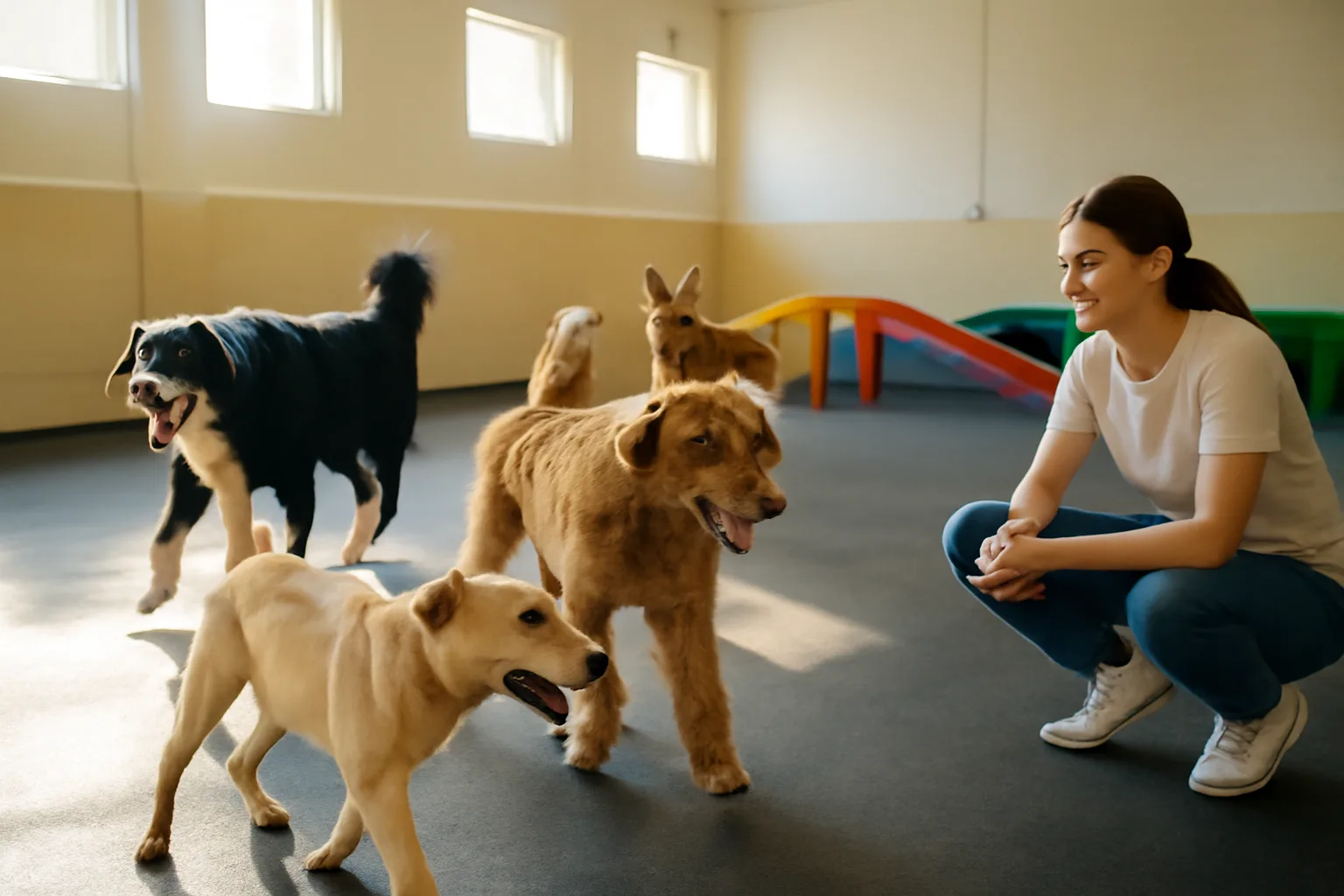
Dogtopia is a national franchise chain of dog daycare and boarding facilities, and the Fort Collins location operates under that franchise model like the rest of the company's roughly 250+ locations across the US and Canada. That means daycare, boarding, and sometimes spa services (baths, nail trims), all run inside a facility built around open-play rooms rather than individual runs. Franchised daycare chains like this typically require a temperament test or trial day before a new dog is admitted to group play. That's not a Fort Collins quirk, it's standard practice across the industry because operators carry real liability if a dog fight breaks out in an open playroom. If you're calling around, ask specifically whether the location requires proof of vaccination (rabies, DHPP, and often bordetella) before the first visit. Almost all of them do. If you're comparing this facility to other boarding options in Fort Collins or elsewhere, it helps to understand the difference between a franchised daycare-style operation and a traditional kennel with individual runs. We break that down in our dog boarding guide and our dog kennels explainer, which covers facility layout standards that inspectors actually check.
How much does dog boarding cost at Dogtopia Fort Collins?
Franchise locations set their own prices, and Dogtopia doesn't publish a national rate card, so the honest answer is: call the Fort Collins location or check their online booking portal for current pricing. That's true of almost every Dogtopia location; rates vary by city, by season, and by whether you're booking daycare, overnight boarding, or a package of visits. What we can tell you is the national range. Boarding at a professional kennel or daycare-style facility in the US commonly runs $35 to $85 per night for a standard dog, with luxury "suite" options at daycare chains sometimes pushing past $75 to $100 a night depending on the market. Colorado's Front Range (Fort Collins, Denver, Boulder) tends to sit in the middle-to-upper part of that range because of higher facility rents and labor costs compared to more rural parts of the state. Daycare (a single day, no overnight) is usually cheaper, often $25 to $45 a day at chain facilities, though multi-visit packages can bring the per-day cost down meaningfully. If a facility quotes you a number well outside these ranges, ask what's included. Some quotes bundle in playtime supervision ratios, webcam access, or specialty feeding, and some don't. For a broader comparison of what boarding costs across formats (in-home boarding, traditional kennels, franchise daycare chains), see our pet boarding breakdown and our Dogtopia overview covering the franchise model nationally.
How is dog boarding priced, and why does it vary so much?
Three things drive the price swing you'll see between a $35-a-night kennel and an $85-a-night daycare suite: staffing ratio, real estate cost, and add-on services. A facility that keeps a low dog-to-staff ratio in open play (some states and industry groups recommend something in the range of 1 staff member per 10 to 15 dogs, though this isn't federally mandated for daycare-only operations) costs more to run than one that simply crates dogs individually with periodic checks. Location matters too. A facility in a strip mall in a mid-size Colorado city pays different rent than one in a converted rural barn an hour outside town, and that gets passed through to the boarding rate. Finally, add-ons stack up fast: bath before pickup, extra feeding of a specific brand, medication administration, extended play sessions. None of these are scams, they're real labor, but they explain why two facilities quoting "$50/night" can land very differently on your final bill.
How do you register a dog?
"Registering" a dog usually means one of two very different things, and mixing them up causes a lot of confusion. The first is a city or county dog license, a legal requirement in many municipalities tied to rabies vaccination and animal control. The second is breed registration with an organization like the American Kennel Club (AKC), which has nothing to do with government law and everything to do with pedigree documentation. For the legal registration (a dog license), you typically go through your city clerk's office, county treasurer, or local animal control agency. Larimer County and the City of Fort Collins, like most Colorado municipalities, tie licensing to proof of current rabies vaccination administered by a licensed veterinarian. Requirements and fees are set locally, not by the state, so the exact process depends on whether you live inside city limits or unincorporated Larimer County. Check your specific city or county's animal services page directly, because ordinances change and this article can't guarantee current fee amounts. For AKC-style registration, you register a litter (if you're the breeder) or an individual dog through the AKC's registration system, which requires the breeder to have registered the litter first and issued you an individual registration application at the time of sale [1].
How do you get a dog license, and what does it cost?
A dog license is issued by your local city or county government, not the state of Colorado and not the federal government. It's proof that your dog is vaccinated against rabies and, in many jurisdictions, it funds local animal control operations. The typical process: get your dog vaccinated for rabies by a licensed vet, bring (or upload) that rabies certificate to your city or county's licensing office or online portal, pay the fee, and receive a tag. Many jurisdictions offer a discount for spayed/neutered animals and charge more for intact dogs, partly as a population-control incentive. Fees vary enormously by city and county, commonly landing somewhere between $10 and $30 a year for altered pets in many US municipalities, with intact-animal fees sometimes double or triple that. Because Fort Collins and Larimer County set their own fee schedules and can change them, don't rely on any number you find online, including this one, without confirming on the current official city or county page. If you let a license lapse, most jurisdictions charge a late fee or a higher renewal rate, so it's worth calendaring the renewal date rather than waiting for a mailed reminder that may or may not come.
How do you get papers for a dog?
"Papers" almost always means registration with a breed registry, most commonly the American Kennel Club in the US. This is a private organization, not a government body, and it has nothing to do with your city dog license. Here's how it actually works: when a breeder whelps a litter from two AKC-registered parents, the breeder registers the litter with the AKC. Each puppy then gets an individual registration application, which the breeder gives to the buyer at the time of sale [1]. The buyer completes that application (choosing the dog's registered name) and submits it to the AKC to get the dog's own individual "papers," officially called an AKC registration certificate. If you bought a puppy and weren't given a registration application, the honest first move is to go back to the breeder and ask for it. If the breeder can't or won't provide one, and you were told the puppy was "AKC registered," that's worth pushing on. There is no way for a buyer to retroactively create AKC papers for a dog with no registered parentage; the AKC's process depends on the litter being registered by the breeder in the first place. Mixed-breed dogs, or purebred dogs from unregistered parents, cannot get AKC papers, though some owners register mixed breeds with alternative registries or enroll them in AKC Canine Partners for event participation without a pedigree [1].
How do you get papers for your dog if you don't know the breeder?
If you got your dog from a shelter, rescue, or an unknown source, standard breed-registry papers are usually not available, because the AKC registration chain starts with the breeder registering the litter. No amount of paperwork after the fact substitutes for that missing link. What you can do: a DNA breed test (Embark, Wisdom Panel, and similar services) tells you the likely breed mix, which is useful for vet care and curiosity but carries no legal or registry weight. Some alternative registries will register a dog based on appearance or DNA results without full pedigree documentation, but these aren't recognized the same way AKC papers are, and they don't carry the same value if you ever intend to breed or show the dog. If your goal is eligibility for AKC companion events (obedience, agility, rally) rather than conformation showing or breeding, the AKC Canine Partners program specifically exists for dogs without full registration, including mixed breeds and rescues [1]. That's often the more realistic path if "getting papers" is really about wanting to compete or participate, not about proving pedigree.
How do you become a dog breeder?
Becoming a breeder legally involves layers that stack on top of each other: local zoning, possibly a state kennel or breeder license, and, if you cross certain thresholds, a federal USDA license. None of these are optional just because breeding is "a hobby." Start with zoning. Most residential zones limit how many dogs you can keep on a property, and running a breeding operation, even a small one, can trigger a home-occupation permit requirement or an outright ban depending on the zone. Check with your specific city or county planning/zoning office before you plan a litter. Next is state law. Many states require a commercial breeder license once you exceed a certain number of intact females or litters per year; thresholds and definitions differ significantly state to state, so check your state department of agriculture's animal welfare or pet dealer licensing page directly. Federally, the trigger is the Animal Welfare Act, enforced by USDA APHIS. If you breed dogs for wholesale sale (meaning you sell to a pet store, broker, or, generally, sight-unseen to the buyer) and you have more than 4 breeding females, you generally need a USDA "Class A" dealer license, per the Animal Welfare Act regulations at 9 CFR Part 1 [2]. Breeders who sell directly to buyers who see the puppy or the parents in person before purchase are typically exempt under the "retail pet store" exemption in the Animal Welfare Act regulations, but that exemption has specific conditions and does not cover every direct-sale scenario, particularly online sales sight-unseen [3]. If you're building toward this as a business rather than an occasional litter, our how to become a dog breeder resources and the county zoning guide are the next stops, and our tools help you assemble the zoning and licensing packet before you file anything.
What's the difference between a dog license, dog registration, and breed papers?
| Dog license | City/county government | Legal compliance, rabies proof, animal control funding | ~$10 to $30/year (varies by jurisdiction) | |
|---|---|---|---|---|
| AKC registration ("papers") | American Kennel Club (private) | Pedigree documentation, eligibility for AKC events/breeding records | Litter fee + individual dog registration fee, both set by AKC [1] | |
| USDA breeder license | USDA APHIS (federal) | Required for certain wholesale/commercial breeders under the Animal Welfare Act | License fee tiered by annual gross sales [2] | |
| State breeder/kennel license | State department of agriculture | State-level oversight of commercial breeding or boarding operations | Varies by state, often tiered by number of animals | A dog can have a city license and no AKC papers (most pets), AKC papers and no need for a USDA license (a hobby breeder selling one litter a year, in-person, to local families), or all three (a commercial breeder shipping puppies to buyers across state lines). They're independent systems that happen to all apply to the same dog. |
This trips up a lot of new dog owners, so here's the plain breakdown: | Term | Issued by | Purpose | Typical cost |
What should a boarding or daycare operator know before opening near Fort Collins?
If you're the one opening a facility, more than boarding your dog at one, the checklist looks different from anything above. You're dealing with commercial zoning approval, a possible conditional use permit if the property isn't already zoned for a kennel or animal care business, state licensing if Colorado requires it for your business type and scale, and local health/noise ordinances that specifically target kennels. Larimer County and the City of Fort Collins each maintain their own zoning code and planning department, and "kennel" or "animal boarding" is very often defined and restricted separately from a standard pet store or vet clinic in municipal zoning codes. Before you sign a lease, get the zoning classification for that specific parcel confirmed in writing by the planning department, more than verbally from a leasing agent. Colorado's Pet Animal Care Facilities Act (PACFA), administered by the Colorado Department of Agriculture, licenses certain pet care facilities, including boarding kennels and daycares, at the state level; requirements and fee schedules are set by the state and updated periodically, so check the current PACFA rules directly on the Colorado Department of Agriculture's site before assuming your facility type is or isn't covered . This is genuinely one of the more complicated permitting stacks a small business owner takes on, because you're coordinating a zoning hearing, a state license application, and often a fire/building inspection all at once, on different timelines from different agencies. A kennel license and zoning packet built for your specific state and county (we sell one for $149 as a one-time purchase at /license-packet-builder) can save you from re-filing when an inspector or hearing officer flags something you didn't know was required, but it's not a substitute for actually reading your local code or, for anything contested, talking to a local land-use attorney.
Where do you check current fees and rules before you file anything?
Don't trust any number in an article, including this one, as your final answer for a fee or a zoning requirement. Fees and thresholds change, and local jurisdictions update them without much fanfare. For Fort Collins/Larimer County specifics: check the City of Fort Collins municipal code and the Larimer County government site directly for current dog licensing fees and kennel zoning rules. For state-level pet facility licensing in Colorado, go to the Colorado Department of Agriculture's PACFA program page . For federal breeder thresholds, go straight to the Animal Welfare Act regulations at 9 CFR Part 1 [2]. Calling the actual office is often faster than searching, especially for zoning questions, because zoning staff can tell you the classification for your exact parcel in a five-minute phone call, something no website search will do reliably.
Frequently asked questions
How much does dog boarding cost?
Nationally, boarding runs about $35 to $85 per night at a professional kennel or daycare-style facility, with premium suites sometimes exceeding $100/night in higher-cost markets. Rates depend on the region, the facility type, and add-ons like baths or medication administration. Always confirm current pricing directly with the specific facility, since chains don't publish uniform national rates.
How much is dog boarding at a franchise like Dogtopia?
Franchise locations, including Dogtopia, set their own local pricing rather than following a company-wide rate card, so costs vary by city. Call the specific location or check its online booking system for current daycare and overnight boarding rates before assuming a number found elsewhere online is accurate.
How do you register a dog?
It depends what you mean. For a legal city/county dog license, contact your local animal control or clerk's office and provide proof of rabies vaccination. For breed registry "papers," the breeder registers the litter with the AKC and gives you an individual registration application at the time of sale.
How do you get a dog license?
Get your dog's rabies vaccination current through a licensed vet, then apply through your city or county's animal licensing office (often online) with the vaccination certificate. Pay the fee, which commonly runs $10 to $30/year for altered pets in many US jurisdictions, and confirm the current amount on your local government's site.
How do you get papers for a dog?
Papers come from a breed registry like the AKC, based on the breeder registering the litter and issuing you an individual registration application at sale. Without that chain, standard papers usually aren't obtainable after the fact; a DNA test can identify likely breed but carries no registry standing.
How can I get papers for my dog if I don't have the breeder's info?
If the litter was never AKC-registered, or you don't know the breeder, formal papers generally aren't available. A DNA breed test (Embark, Wisdom Panel) gives you likely ancestry for informational purposes. If you want to compete in AKC events, look into AKC Canine Partners, which allows mixed-breed and unregistered dogs to participate.
How do you become a dog breeder legally?
Check local zoning first, since many residential zones restrict or ban commercial breeding operations. Then check your state department of agriculture for any state kennel/breeder license threshold. If you sell wholesale or sight-unseen and keep more than 4 breeding females, you likely need a USDA APHIS Class A dealer license under the Animal Welfare Act.
What's the USDA threshold for needing a breeder license?
Under the Animal Welfare Act, breeders who sell dogs wholesale (to pet stores, brokers, or sight-unseen to buyers) and keep more than 4 breeding females generally need a USDA Class A dealer license. Breeders selling directly to buyers who see the dog or facility in person before purchase are typically exempt, subject to specific conditions in the regulation.
Is an AKC registration the same as a dog license?
No. An AKC registration is a private pedigree record from the American Kennel Club, unrelated to any government requirement. A dog license is issued by your city or county, tied to rabies vaccination, and required by local ordinance in many jurisdictions regardless of whether the dog is purebred, mixed, or registered anywhere.
Does Colorado require a state license for dog boarding or daycare facilities?
Colorado's Pet Animal Care Facilities Act (PACFA), run by the Colorado Department of Agriculture, licenses many pet care facility types including boarding and daycare operations. Exact requirements, exemptions, and fees are set by the state and can change, so confirm current rules on the Colorado Department of Agriculture's PACFA page before assuming your facility is covered or exempt.
Do I need a zoning permit to run a dog daycare in Fort Collins?
Very likely, since most municipal zoning codes classify kennels, boarding, and daycare facilities separately from general retail or office use, often requiring a conditional use permit. Confirm the zoning classification for your exact parcel directly with the City of Fort Collins or Larimer County planning department before signing a lease.
Can you register a mixed-breed dog with the AKC?
Not through standard AKC pedigree registration, which requires registered purebred parentage. However, the AKC Canine Partners program lets mixed-breed and otherwise unregistered dogs enroll for participation in many AKC companion events like obedience, agility, and rally, without pedigree documentation.
Sources
- eCFR, Title 9 Animal Welfare Act regulations, Part 1 (definitions, dealer and retail pet store): USDA Class A dealer license threshold applies to breeders with more than 4 breeding females selling wholesale, per Animal Welfare Act regulations
- City of Fort Collins, Municipal Code (animal licensing provisions): Dog licensing is governed by local municipal code rather than state law in Fort Collins
- Colorado Department of Agriculture, Pet Animal Care Facilities Act (PACFA) program: Colorado licenses boarding and daycare facilities under the PACFA program administered by the state Department of Agriculture
- Larimer County Humane Society / Larimer County: Process and fees for licensing a dog in Larimer County, which includes Fort Collins
- Colorado Department of Agriculture: Forms and fee schedules boarding/daycare operators must file under PACFA before opening a facility
- Electronic Code of Federal Regulations: Federal regulations on licensing requirements for animal facilities under the Animal Welfare Act