Last updated 2026-07-24
TL;DR
Dogtopia Sandy Springs is a franchised daycare and boarding facility in the Atlanta metro; daycare typically runs $35-45/day and boarding $55-75/night, though you should call for current rates. This article also covers how dog boarding pricing works nationally, how to register a dog and get a license, and how to get a dog's papers or become a breeder under Georgia and USDA rules.
What is Dogtopia Sandy Springs and what does it offer?
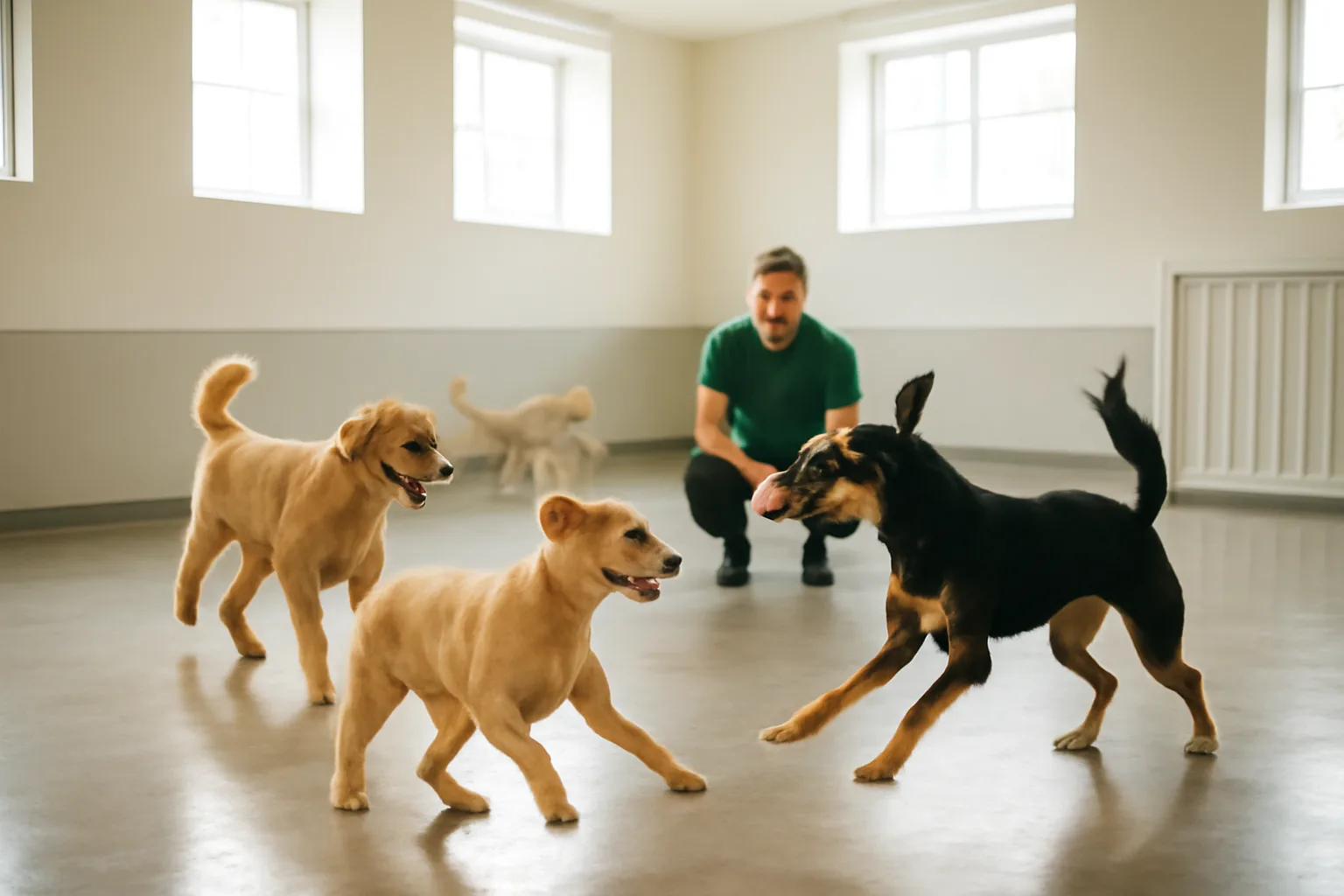
Dogtopia is a national franchise chain of dog daycare and boarding centers, and the Sandy Springs location is one of dozens of Georgia franchises operating under that brand. Like other Dogtopia locations, it typically offers open-play daycare, overnight boarding, spa services (baths, nail trims), and sometimes training add-ons. The physical layout usually includes webcam-monitored play rooms sorted by dog size and temperament. Franchise locations set their own prices and hours within brand guidelines, so the exact rate card at the Sandy Springs location can differ from a Dogtopia in, say, Marietta or Alpharetta. If you're comparing options in the metro Atlanta area, the smartest move is to call the specific location or check its website for the current published rate sheet, since franchise pricing changes more often than corporate marketing pages get updated. For readers researching this location because they're evaluating the broader boarding and daycare market (maybe you're opening a competing facility, or just want to understand what a corporate-backed daycare chain charges), it helps to see Dogtopia's model against the general pet boarding landscape and against independent dog boarding operators.
How much does dog boarding cost?
| Home-based sitter (Rover-style) | $25-45 | Lower overhead, variable supervision quality | |
|---|---|---|---|
| Independent kennel (traditional runs) | $30-55 | Often no daycare-style play included | |
| Cage-free / suite boarding | $45-75 | Includes Dogtopia-style franchise pricing | |
| Luxury pet hotel | $75-150+ | Private suites, webcams, extended play | These are general market ranges, not quotes for any specific business; always confirm directly with the facility. If you're building out your own facility and want to see how pricing maps to dog hotels near me style searches, understanding this spread helps you position your rate card competitively. |
Dog boarding in the US generally runs $30 to $85 per night depending on the region, the size of the dog, and whether the facility is a franchise, an independent kennel, or an in-home sitter through a platform like Rover. Metro Atlanta boarding, including franchise locations like Dogtopia, tends to land in the $45-75/night range for standard boarding, with add-ons (extra playtime, medication administration, grooming) pushing totals higher. Home-based boarding through sitter marketplaces is usually cheaper, often $25-45/night, because sitters don't carry the overhead of a commercial facility (rent, staff payroll, HVAC for climate-controlled kennel runs). Traditional kennels without daycare-style play tend to sit in the middle, often $30-55/night. A few cost drivers matter more than people expect. Facilities with 24/7 staff supervision charge more than ones with just daytime staff and a night check. Cage-free or suite-style boarding (no traditional kennel runs) commands a premium, often $10-20/night more than standard runs. And large or giant breed dogs sometimes cost more per night because they need bigger enclosures and more staff attention during group play. Here's a rough comparison of what boarding options cost nationally: | Boarding type | Typical nightly rate | Notes |
How do you register a dog?
Registering a dog usually means one of two different things, and people often conflate them: municipal dog licensing (a legal requirement in most counties) and breed registration with a kennel club like the AKC (optional, and unrelated to any government requirement). For legal registration, you go through your county or city, not a national database. In Georgia, for example, Fulton County (where Sandy Springs sits) requires rabies vaccination and, in many municipalities, a corresponding dog license or tag tied to that vaccination record. The exact registration process (online portal, in-person at animal control, through your vet) varies by county, so check your specific county's animal control or clerk's office page. If you mean registering a purebred dog's pedigree, that's a separate process through a registry like the American Kennel Club, done using either a litter registration application (breeder-initiated) or an individual dog registration if the litter was already registered. Neither of these registries is a government requirement; they're private organizations that track pedigree lineage for showing, breeding, and sport purposes.
How do you get a dog license?
Getting a dog license is a county or city-level process, almost always tied to proof of current rabies vaccination. Most jurisdictions require you to license a dog within 30 days of acquiring it or once it reaches a certain age (commonly 4 months), and licenses are usually renewed annually or every 1-3 years depending on the jurisdiction. The general steps look like this almost everywhere: get your dog vaccinated against rabies by a licensed veterinarian, bring or submit proof of that vaccination (the rabies certificate) to your county or city animal control office, pay the license fee, and receive a tag to attach to your dog's collar. Fees typically range from $10 to $25 for spayed/neutered dogs and $30 to $75 for intact dogs, with the higher intact-dog fee used in many counties as a soft incentive toward spay/neuter. Some counties offer online registration portals now, others still require an in-person visit or mail-in form. Because Sandy Springs is in Fulton County, Georgia, residents there should check Fulton County's own animal services requirements directly rather than assume a fee or process from another state; county rules genuinely differ this much. There is no single national dog license; the license is always local.
How do you get papers for a dog?
"Papers" almost always means AKC (or another breed registry's) pedigree documentation proving a dog's lineage, not a legal requirement of any kind. You cannot get papers for a dog that wasn't born from a litter registered with that organization; papers are backward-looking documentation of ancestry, not something a government agency issues after the fact. If your dog's parents were both AKC-registered and the breeder registered the litter, you get papers by having the breeder complete an AKC Dog Registration Application (sometimes called a "blue slip") at the time of the sale or shortly after. The buyer then submits that application, along with the fee, to the AKC to receive an individual registration certificate in the dog's name. The AKC describes registration as recording "a dog for the purpose of expressing his or her identity within a purebred registry," and that registry only works if the litter itself was registered. If your dog doesn't have a paper trail (a shelter dog, a mixed breed, or a purebred whose breeder never registered the litter), there is no way to retroactively get AKC papers. Some registries (like the AKC's Purebred Alternative Listing, PAL) allow spayed/neutered purebred dogs without papers to get a limited registration for sport participation, but that's not the same as full pedigree papers and doesn't establish lineage. If you're the breeder side of this question rather than the buyer, see the breeder section below; registering litters is a process you set up before puppies are ever sold, not something you retrofit later.
How do you become a dog breeder?
Becoming a legal dog breeder in the US means clearing three separate layers of rules: federal (USDA) thresholds if you sell wholesale or sell many dogs sight-unseen, state licensing if your state regulates breeders directly, and local zoning that determines whether you can even keep breeding-numbers of dogs on your property. At the federal level, the USDA's Animal Welfare Act requires a license if you sell more than a small number of dogs per year without the buyer meeting the dog or the parent in person. Specifically, USDA regulations exempt retail pet stores and hobby breeders who sell directly to the public, but the exemption has limits tied to number of breeding females and whether sales happen face-to-face. The Animal Welfare Act's implementing regulations, at 9 CFR Part 1, define who qualifies as a "dealer" subject to licensing, and APHIS (the USDA's Animal and Plant Health Inspection Service) is the agency that issues and enforces those licenses. At the state level, some states (California, for example, under its commercial dog and cat breeder rules) require separate state breeder registration or licensing on top of any federal requirement, while other states have no dog-specific breeder statute at all and rely on general animal welfare law plus local zoning. Georgia regulates commercial breeders and pet dealers under the Georgia Department of Agriculture's Animal Protection Act program, which covers kennels and breeding operations above certain thresholds; check the Department of Agriculture's current licensing page for the exact numeric thresholds and fee schedule, since these get updated periodically. At the local level, zoning is often the part new breeders skip and then get burned by. A property zoned residential may cap the number of adult dogs allowed on-site (commonly 3-5 in many suburban counties) regardless of what state or federal law allows, and a breeding operation exceeding that cap needs a conditional use permit or a variance, which means a hearing in front of a zoning board. This is the layer people most often get wrong, because state licensing rules say nothing about whether your specific parcel is zoned for it. Practically, becoming a breeder means: pick your breed and confirm health-testing protocols for that breed through a resource like the Orthopedic Foundation for Animals, register with your state's breeder program if one exists, check zoning before you exceed your county's dog-count limit, and register with USDA APHIS if your sales volume or sales method crosses the dealer threshold under 9 CFR Part 1.1.
What are the USDA thresholds that require an APHIS breeder license?
The USDA requires an Animal Welfare Act license from a dog breeder or dealer who doesn't qualify for the retail pet store exemption, and the line is drawn mainly around how sales happen, more than how many puppies are sold. Under the regulations at 9 CFR 1.1, a person who sells animals sight-unseen (online, through a broker, or shipped without the buyer physically visiting) generally needs a license once they exceed a small number of breeding females, commonly cited as more than 4 breeding females kept for the purpose of selling their offspring for use as pets, though you should confirm the current exact figure and any exemption carve-outs on APHIS's own licensing guidance page, since Congress and USDA have adjusted these thresholds over the years (notably via the 2013 "retail pet store" rule change that closed a loophole for online sellers). Breeders who sell every puppy through in-person, face-to-face transactions where the buyer sees the animal and the facility before buying are generally covered by the retail pet store exemption and don't need a USDA license, regardless of how many litters they produce. That's the single biggest factor: face-to-face sales versus remote sales. APHIS itself describes its Animal Care program's purpose as ensuring "the humane care and treatment of animals" covered under the Act, and licensed breeders are subject to unannounced inspections, recordkeeping requirements, and facility standards spelled out in 9 CFR Part 3 (housing, sanitation, veterinary care). If you're building a boarding or daycare facility rather than a breeding operation, USDA licensing usually doesn't apply to you at all; that's a state and county licensing question instead, covered in our dog kennels guide.
How does county zoning affect a daycare or boarding facility like Dogtopia?
Zoning is usually the first real obstacle for anyone opening a facility, franchise or independent, and it's handled entirely at the county or city level, never by a state or federal agency. Fulton County and the City of Sandy Springs (which has its own municipal zoning code separate from unincorporated Fulton County) each maintain their own zoning ordinances that determine which commercial districts allow kennel, animal boarding, or "animal care facility" uses outright versus which require a conditional use permit and a public hearing. Commercial daycare and boarding operations, including franchise locations, almost always need to confirm the specific commercial zoning district (often something like C-1, C-2, or a specific commercial overlay) permits "animal boarding" or "kennel" as a use, and many municipalities also layer on noise ordinance compliance, outdoor run setback requirements from residential property lines, and sometimes a cap on total dog capacity tied to the size of the building. If you're evaluating a location for your own facility rather than researching an existing one, budget real time for this step. Zoning hearings can take anywhere from 30 to 90+ days depending on the county's hearing calendar, and a facility that looks perfect on paper can get denied at the hearing stage if neighbors object to noise or traffic. This is exactly the kind of research a $149 Kennel License & Zoning Packet is built to organize: pulling together your jurisdiction's specific zoning code section, application forms, and a checklist of what the board typically wants to see, before you walk into a hearing.
What facility standards apply to boarding and daycare operations?
Facility standards for commercial boarding and daycare come from a layered mix of state animal welfare law, county health and building codes, and (for USDA-licensed breeders only) federal facility rules under 9 CFR Part 3. A daycare or boarding facility that doesn't breed or sell dogs is not USDA-regulated; that's a common point of confusion. Georgia's Department of Agriculture regulates commercial kennels and pet dealers under its Animal Protection Act rules, which set minimum standards for sanitation, enclosure size, ventilation, and record-keeping for licensed facilities. Beyond the state layer, the county or city typically requires a separate business license and a certificate of occupancy tied to fire and building code compliance (fire marshal sign-off on things like exit paths, sprinkler coverage, and maximum occupant load in the play areas). Most well-run boarding and daycare facilities, franchise or independent, also carry their own internal standards well above the legal minimum: play-group ratios (commonly cited industry practice runs around 1 staff member per 10-15 dogs in an open play setting, though there's no single federal number for daycare-specific ratios the way there is for licensed childcare), climate control specs, and vaccination requirements (rabies, DHPP, and often bordetella or canine influenza) before a dog is accepted into group play. None of those vaccination or ratio practices are uniformly mandated by law nationwide; they're industry best practice that individual facilities and sometimes counties choose to require.
How do you register a dog for boarding or daycare specifically (vaccination and intake requirements)?
Separate from municipal dog licensing, "registering" a dog with a specific boarding or daycare facility (Dogtopia or otherwise) means completing that facility's intake process, which almost universally requires proof of current vaccinations before your dog can join group play or be boarded. Standard requirements at most US daycare and boarding facilities include proof of rabies vaccination (legally required in all 50 states for dogs, though the interval varies by state and by vaccine type, commonly 1 or 3 years), DHPP (distemper, hepatitis, parvovirus, parainfluenza), and bordetella (kennel cough), with many facilities in the last several years also requiring proof of canine influenza (H3N2/H3N8) vaccination given documented outbreaks in group-care settings. Some facilities also require a temperament evaluation or trial daycare day before a new dog is cleared for full group play, which is standard industry risk management rather than a legal mandate. This intake process is set by the individual business, not a government agency, so requirements can and do vary between a Dogtopia location and an independent kennel down the street. If you're a facility operator building your own intake checklist, modeling it on what large franchise chains require (they've generally already worked out a defensible liability standard) is a reasonable starting point, then adjusting based on your state's specific vaccination law and your insurance carrier's requirements.
Frequently asked questions
How much does dog boarding cost per night?
Nationally, dog boarding runs roughly $25-45/night for home-based sitters, $30-55/night at independent kennels, and $45-75/night at cage-free or franchise-style facilities like Dogtopia locations. Luxury pet hotels with private suites can run $75-150+/night. Exact pricing depends on region, dog size, and add-on services, so always confirm directly with the specific facility.
How much is dog boarding at a franchise like Dogtopia versus a local kennel?
Franchise cage-free boarding, including Dogtopia locations, typically runs $10-20/night more than a traditional independent kennel with standard runs, because franchises usually include open-play daycare time and webcam access as part of the boarding stay. A local kennel without daycare-style amenities often costs less but may offer less supervision and socialization time.
How do you register a dog with your county?
Get your dog's rabies vaccination current through a licensed vet, then bring or submit the vaccination certificate to your county or city animal control office along with the license fee. Many counties now allow online registration. Requirements and fees are set locally, so check your specific county's animal control page rather than assuming a nationwide standard.
How do you get a dog license and what does it cost?
You get a dog license through your county or city animal control office, usually by showing proof of current rabies vaccination and paying a fee, commonly $10-25 for spayed/neutered dogs and $30-75 for intact dogs. Most jurisdictions require licensing within 30 days of acquiring a dog and renewal annually or every few years.
How do you get papers for a dog?
Papers (AKC or another registry's pedigree documentation) only exist if the dog's litter was registered by the breeder at birth. The breeder completes a registration application at time of sale, and the buyer submits it to receive an individual certificate. There's no way to retroactively get papers for a dog whose litter was never registered.
How can I get papers for my dog if the breeder never registered the litter?
You generally can't get full pedigree papers retroactively; registries require documentation from the original litter registration. Some organizations, like the AKC's Purebred Alternative Listing (PAL) program, let spayed/neutered purebred dogs without papers get limited registration for sports and events, but that's not equivalent to standard pedigree papers.
How do you become a dog breeder legally?
Confirm your state's breeder licensing requirements (some states like California have specific commercial breeder statutes), check your county zoning for how many adult dogs your property allows, and register with USDA APHIS under 9 CFR Part 1 if you sell dogs sight-unseen above the small-scale exemption threshold. Zoning is the step most new breeders overlook.
How many dogs can you have before you need a USDA breeder license?
Under 9 CFR 1.1, breeders who sell dogs sight-unseen (not face-to-face) generally need a USDA license once they exceed a small number of breeding females, commonly described as more than 4, though exact figures and exemptions should be confirmed on APHIS's current licensing guidance since thresholds have been updated over time.
Does Dogtopia require vaccinations before daycare or boarding?
Yes, like nearly all commercial daycare and boarding facilities, Dogtopia locations require proof of current vaccinations (typically rabies, DHPP, and bordetella, with canine influenza increasingly required) before a dog can join group play. Exact requirements are set at the individual location level, so confirm with the specific franchise you're booking.
Do I need a zoning permit to open a dog daycare or boarding business?
In most counties and cities, yes. Commercial animal boarding or daycare use needs to be permitted in your zoning district, either outright or through a conditional use permit requiring a public hearing. Check your specific county or city zoning office before signing a lease, since some commercial districts don't allow kennel-type uses at all.
What's the difference between a dog license and dog registration papers?
A dog license is a legal requirement issued by your county or city, tied to rabies vaccination, and has nothing to do with breed. Registration papers (AKC or similar) are optional, private, and document pedigree lineage for purebred dogs whose litter was registered by the breeder. You can have one without the other.
How long does a zoning hearing take for a new boarding facility?
Timelines vary widely by county, but budget 30 to 90+ days from application to a final zoning board decision, longer if the hearing gets continued or neighbors formally object. Some straightforward commercial-district applications clear faster through staff-level approval without a full board hearing; check your specific jurisdiction's process.
Sources
- Electronic Code of Federal Regulations, 9 CFR Part 1: Definitions of 'dealer' and retail pet store exemption thresholds for dog breeders
- Electronic Code of Federal Regulations, 9 CFR Part 3: Federal facility standards (housing, sanitation, veterinary care) for USDA-licensed animal facilities
- Federal Register, 2013 retail pet store rule: 2013 USDA rule change extended licensing to sight-unseen/online dog sellers
- California Department of Food and Agriculture, Commercial Dog and Cat Breeders: California requires separate state-level registration for commercial dog breeders
- Electronic Code of Federal Regulations: Establishes facility standards for licensing under the Animal Welfare Act applicable to boarding and daycare operations.