Last updated 2026-07-23
TL;DR
"Doggy day" usually means dog daycare or boarding, which runs about $25 to $50 a day and $35 to $85 a night depending on region. Dog licenses are a city/county rabies-and-ID requirement costing $10 to $25 a year. "Papers" (AKC registration) is a separate process tied to a litter's registered parents, not something you add after the fact.
what does "doggy day" mean, exactly?
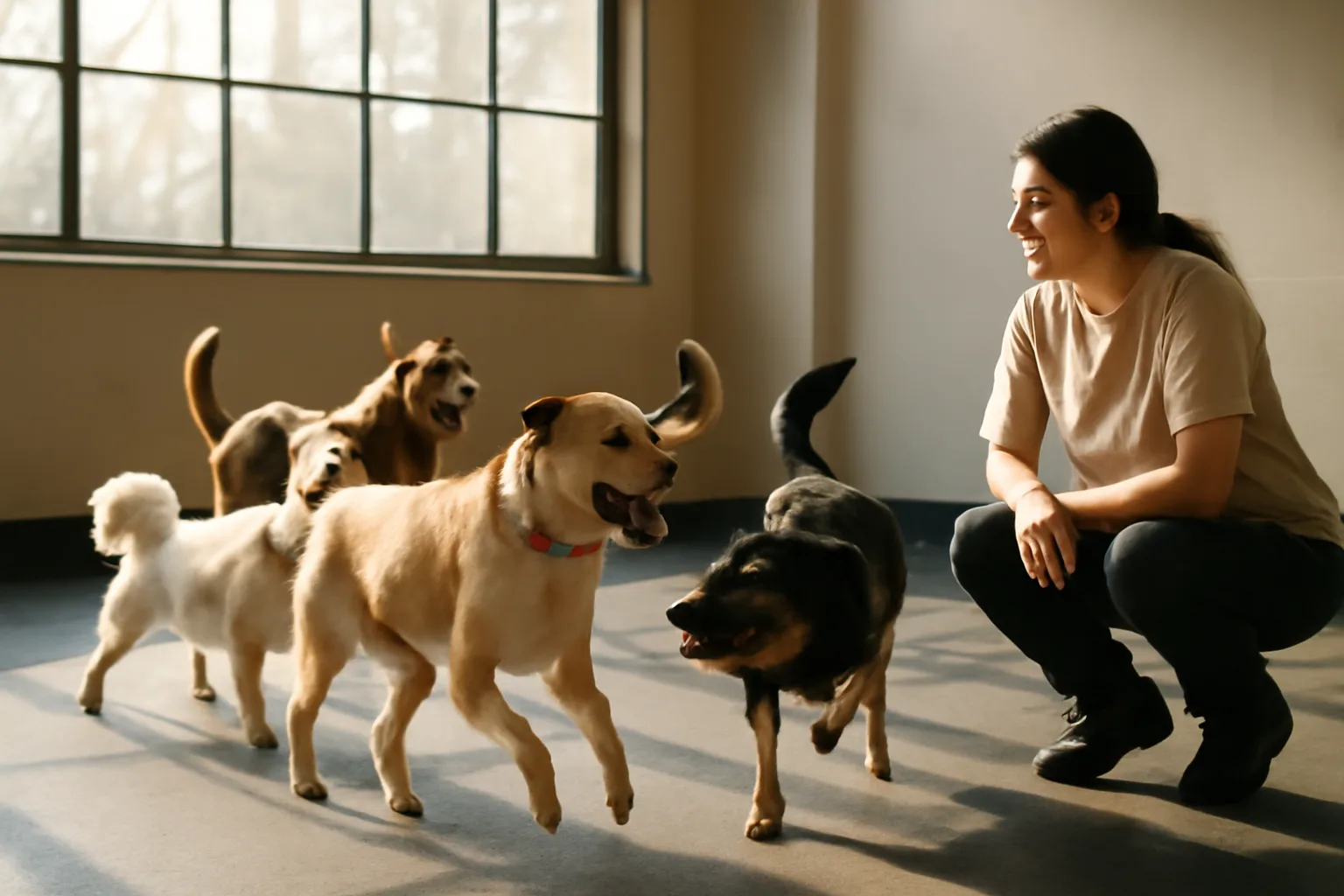
People search "doggy day" meaning a few different things, and the answer changes what you should read next. Most often it's shorthand for doggy daycare, the drop-off service where a dog plays and socializes during business hours instead of sitting home alone. Sometimes it means a single day of boarding, as in "how much for a doggy day" at a kennel. Occasionally someone typing it fast actually wants dog registration or how to get papers for a dog, which is a completely unrelated topic (breeding paperwork, not daycare). This article covers all three, because the search traffic proves people conflate them. If you're a pet owner, the cost sections below are for you. If you're opening or expanding a boarding or daycare facility, the licensing and zoning sections matter more, and you'll want to bookmark dog boarding and doggy day care as companion reads. One quick distinction worth locking in early: a dog license (a tag from your city or county proving rabies vaccination) has nothing to do with AKC registration papers (proof of pedigree from a breed registry). They're handled by completely different offices, and mixing them up wastes a lot of phone calls.
how much does dog boarding cost?
Dog boarding in the US typically runs $35 to $85 per night for a standard kennel or home-boarding stay, with upscale "dog hotel" suites in major metros running $75 to $150 a night. Daycare (no overnight stay) is cheaper, usually $25 to $45 per day. These are national ballpark figures pulled from what facilities publicly post; there's no federal price database for pet services, so treat any number here as a range, not a quote. A few things move the price hard: - Region: boarding in Manhattan or San Francisco can run double what it costs in a mid-size Midwest city.
- Facility type: a chain daycare like Dogtopia often prices differently than an independent kennel or in-home boarder, and franchise pricing tends to be more standardized city to city.
- Add-ons: extra walks, medication administration, grooming, and "suite upgrades" (webcam access, private rooms) can add $10 to $40 a day on top of the base rate.
- Season: holiday weeks (Thanksgiving, Christmas, July 4th) often carry a surcharge of $5 to $20 a night because demand spikes and boarders book out weeks in advance. Multi-night stays sometimes get a discount, 10-15% off after the first week is common but not universal. If you're comparing options near you, dog hotels near me and pet boarding walk through how to evaluate a facility beyond just the sticker price.
how much is dog boarding per week or month?
Weekly boarding usually lands between $250 and $500, and monthly (rare, but it happens for military deployments or long hospital stays) can run $1,000 to $2,500 depending on the facility and any long-stay discount. Do the math yourself before assuming a weekly rate is just nightly x 7; almost every kennel we've seen quote weekly rates builds in some discount, typically 10 to 20% off the nightly rate. Some kennels cap at 2-3 weeks and require a vet check-in for anything longer, partly for liability and partly because long-stay dogs need more behavioral monitoring. If you're a facility operator setting your own rates, undercutting local competitors by a wide margin usually signals a corner is being cut somewhere (staffing ratios, cleaning frequency, vet-on-call arrangements), and savvy pet owners notice.
how to register a dog with your city or county
Dog registration (commonly called a dog license) is a local government requirement, not a federal one. Rules vary by state and even by county, but the general pattern is: get your dog a current rabies vaccination from a licensed vet, then bring proof of that vaccination to your city or county clerk, animal control office, or treasurer's office (the exact office differs by jurisdiction) along with a small fee. Most counties require renewal annually or every 1-3 years, tied to the rabies vaccine's duration. Fees commonly run $10 to $25 a year for an intact/altered dog, though some counties charge less for spayed/neutered animals and more for intact ones as an incentive. Some states, like California, authorize counties to require dog licensing under state health and safety code, but the actual administration (fee amount, renewal cycle, penalty for lapsing) is set locally, so "how to register a dog" always ends with "check your specific county's website." If you operate a boarding or daycare facility, you'll often be asked for proof of the dog's current license or rabies tag at drop-off, separate from any vaccination records you already collect for kennel cough or bordetella. Building that into your intake form saves arguments later.
how to get a dog license
| rabies vaccination | required before licensing, 1 or 3-year vaccine | your vet | |
|---|---|---|---|
| license fee | $10-$25/year | county clerk or treasurer | |
| renewal cycle | 1-3 years | county website | |
| late penalty | fee can double | county website | This is a local-government process from start to finish; there's no federal dog license. |
Getting a dog license takes three steps in nearly every US jurisdiction: vaccinate for rabies, gather proof (a rabies certificate from your vet), and submit that proof plus a fee to your local licensing authority. The authority is usually the county clerk, county treasurer, or a local animal control agency, not a state office. Some counties now let you register online through a portal; others still require an in-person visit or mailed check. Late fees are common if you let a license lapse, sometimes doubling the base fee. A handful of states also require a rabies tag to be physically worn on the collar at all times, and animal control officers can cite owners for a dog off-leash without one. If you're building intake paperwork for a boarding or daycare business, it helps to keep a simple table of what your state and neighboring counties require, since dogs from out-of-county often show up at drop-off. | requirement | typical range | who to check with |
how do you get a dog papers? (AKC registration explained)
"Papers" means registration with a breed registry, most commonly the American Kennel Club (AKC), and it works completely differently from a city dog license. A puppy gets AKC papers because its litter was registered by the breeder, tracing back through both parents' AKC registration. You cannot walk a random adult dog into an office and get it "papered" after the fact if its parents weren't registered. The standard path: the breeder registers the litter with AKC, then each puppy gets an individual registration application (often called a "blue slip" historically, though AKC has moved much of this online) that the new owner completes to put the dog in their own name. AKC's own guidance describes registration as recording a dog whose parents are registered purebreds of a recognized breed with the club. If your dog's parents were never registered, or you don't know the parentage, there's no legitimate way to retroactively create AKC papers. Some registries (not AKC) will register dogs based on appearance or DNA testing alone; these carry far less weight and most serious breeders and buyers know the difference. So if you're asking "how do you get a dog papers" for a dog you already own and didn't get from a papered litter, the honest answer is: you generally can't, at least not through AKC. Mixed-breed and unknown-parentage dogs can be registered with alternative registries, but that's a different product with different credibility in the purebred world.
how to get papers for a dog you're breeding
If you're the breeder, getting papers for your litter means registering with AKC (or another registry) before or shortly after the puppies are born, using both parents' existing registration numbers. AKC requires the sire and dam to already be registered, and there's a litter registration fee plus an individual puppy registration fee, both of which AKC publishes and periodically adjusts, so check AKC's current fee schedule rather than relying on any number printed elsewhere. A DNA profile is sometimes required, especially for breeds or kennels AKC flags for compliance checks, or when a sire has been used extensively. If you plan to breed and sell puppies regularly, that's also the point where you cross from hobbyist into a business the USDA may regulate, which is a very different conversation than city dog licensing.
how to become a dog breeder (and when USDA gets involved)
Becoming a dog breeder legally means understanding three separate layers: your state's breeder or kennel licensing law, your county zoning rules, and federal USDA/APHIS licensing if you sell wholesale or exceed certain thresholds. There's no single "become a breeder" license that covers all three; they stack. At the federal level, USDA's Animal Welfare Act regulates certain people who breed and sell dogs. The regulations at 9 CFR 1.1 define a "retail pet store" exemption and lay out when a breeder selling directly to the public still needs a federal license: generally, once a breeder maintains more than 4 breeding females and sells any animal it did not breed and raise, or sells animals sight unseen (without the buyer physically meeting the animal before purchase), it falls outside the exemption and needs a USDA license under the Animal Welfare Act [1]. Breeders who sell every puppy in face-to-face transactions, where the buyer meets the puppy in person before the sale, are typically exempt regardless of how many litters they produce, because that's the "retail pet store" exemption Congress built into the Animal Welfare Act at 7 U.S.C. 2132(f) [2]. Separately, most states have their own commercial breeder or "kennel" license laws that kick in at lower thresholds than USDA's, often triggered by litter count or gross annual revenue from puppy sales rather than the sight-unseen distinction. These vary enormously. Check your state department of agriculture's page directly; don't assume your state mirrors USDA's rules. County zoning is the third layer, often the one breeders forget until a neighbor complains. Even a fully USDA-licensed and state-licensed breeding operation can get shut down or fined for operating in a zone that doesn't allow kennels, or for exceeding a county's dog-count limit. Before you commit to a property, call the county zoning office and ask directly whether a commercial kennel or breeding operation is a permitted or conditional use in that parcel's zone.
what licenses does a boarding or daycare facility actually need?
A boarding or daycare business typically needs a combination of a state kennel/facility license (if your state requires one, and many don't have a dedicated one), a local business license, a county zoning approval or conditional use permit, and sometimes a health or fire inspection sign-off, before you can legally open the doors. The exact stack depends entirely on your state and county; there's no national template. Some states license commercial dog kennels through a state Department of Agriculture, with distinct categories for high-volume breeders versus boarding kennels; other states instead handle most of this at the county/city level with far less state-level kennel licensing. That patchwork is exactly why "just Google the requirements" often fails; you end up on a state page that doesn't apply to your county, or a county page written for zoning appeals, not new kennel applicants. Because the zoning-hearing side (proving to a planning board that noise, parking, and setback requirements are met) is often the hardest and slowest part, it pays to prepare that packet before you sign a lease, not after. That's the exact gap our $149 one-time Kennel License & Zoning Packet is built to close: it organizes the state licensing requirements, facility standard checklists, and county zoning-hearing prep into one packet so you're not reverse-engineering three different government websites the week before your hearing. It's a prep tool, not legal representation, and it doesn't guarantee any board approves your application.
kennel license vs. dog license vs. AKC papers: quick comparison
| dog license | city/county clerk or animal control | rabies vaccination + ID for a pet dog | $10-$25/year | |
|---|---|---|---|---|
| kennel/facility license | state dept. of agriculture or county | your boarding/daycare/breeding business meets state standards | varies widely by state, often $50-$500+ | |
| AKC registration ("papers") | American Kennel Club | pedigree, traced through registered parents | litter + individual fees, set by AKC | If you're opening a facility, you likely need the middle row (state/county kennel license) plus zoning approval, and possibly nothing to do with the other two rows unless you also breed dogs on-site. |
These three terms get mixed up constantly, so here's a side-by-side. | term | who issues it | what it proves | typical cost |
how much does it cost to open a doggy daycare or boarding kennel?
Start-up costs for a small independent boarding or daycare facility commonly range from $50,000 to $250,000+, depending on whether you're leasing and retrofitting an existing space or building new, plus ongoing costs for staffing, insurance, and licensing. Licensing and zoning fees themselves are usually a small slice of that, often a few hundred to a few thousand dollars total across zoning application fees, state license fees, and inspection fees, but they're the part that can stall or kill a project if handled late. The bigger risk isn't the fee amount, it's the timeline. A zoning hearing can take 60 to 120 days from application to decision in many counties, and if the board asks for revisions (a new site plan, an updated noise study, additional parking), that clock restarts. Facility operators who've already signed a lease with a fixed start date are the ones who feel this pain hardest. Reading up on dog kennels zoning categories before you sign anything is worth the hour it takes.
state and county resources to check before you apply
Every state's department of agriculture (or in some states, the department of health or a separate licensing board) maintains its own kennel and breeder licensing page, and every county's planning/zoning department maintains its own zoning code online, usually searchable by parcel or address. There's no shortcut around checking both directly. USDA APHIS maintains the federal layer, and the regulatory definitions that determine who needs a federal dealer/breeder license live in the Code of Federal Regulations, specifically 9 CFR Part 1 (definitions) and 9 CFR Part 2 (licensing requirements) [1]. Your state department of agriculture's site (search "[your state] department of agriculture animal welfare" or "kennel license") will have the state layer, and your county's zoning or planning department page will have the local layer, often under a heading like "conditional use permit" or "special exception" for kennels. USDA APHIS also publishes its own explanation of who needs a license under the Animal Welfare Act, describing licensees as those who breed animals for wholesale resale or otherwise deal in regulated animals commercially [3]. Cross-checking that guidance against the CFR text itself is a good habit before you assume you're exempt. None of this is legal advice, and this article isn't written by a law firm or zoning consultant, and doesn't represent anyone before any board. If your project is complex (multiple parcels, a variance request, neighbor opposition expected), an actual land-use attorney or local zoning consultant earns their fee fast.
Frequently asked questions
how much does dog boarding cost per night?
Most US boarding kennels charge $35 to $85 per night for standard care, with upscale dog hotels in major cities running $75 to $150 a night. Daycare-only (no overnight stay) runs cheaper, typically $25 to $45 a day. Exact pricing depends heavily on your region and the facility's amenities, so treat these as planning ranges, not quotes.
how do you register a dog with the city?
Get a current rabies vaccination from a licensed vet, then bring the rabies certificate and a small fee (commonly $10-$25/year) to your city or county's licensing office, usually the county clerk, treasurer, or animal control agency. Renewal cycles run 1-3 years depending on the vaccine and local rules. This is a local, not federal, requirement, so exact steps vary by county.
how do you get a dog papers?
AKC papers come from registering a litter whose sire and dam are both already AKC-registered; there's no process to retroactively "paper" a dog with unknown or unregistered parents through AKC. If you bought a puppy from a registered litter, the breeder should give you an individual registration application to transfer the dog into your name.
how can I get papers for my dog if I don't know the parents?
Through AKC specifically, you generally can't; AKC registration requires both parents to already be registered purebreds. Alternative registries will register dogs based on appearance, DNA test, or owner attestation, but these carry far less credibility with serious breeders and buyers than AKC papers.
how to become a dog breeder legally?
Check three layers: your state's breeder/kennel licensing law (varies by state, some states have none), your county zoning rules for kennels or breeding operations, and whether you cross USDA/APHIS's federal licensing threshold under 9 CFR Part 1 and 2 (commonly triggered by more than 4 breeding females plus sight-unseen sales). All three can apply at once.
how to get a dog license without a rabies certificate?
Most counties won't issue a dog license without proof of current rabies vaccination; it's usually a hard requirement, not optional. If your dog can't be vaccinated for a documented medical reason, some counties accept a vet-signed waiver, but you'll need to call your specific county's animal control office to confirm they allow it.
do I need a USDA license to sell puppies?
You generally need a USDA/APHIS license if you have more than 4 breeding females and sell puppies sight-unseen (without the buyer meeting the puppy in person first), under the retail pet store exemption criteria defined in 9 CFR Part 1. Breeders who sell every puppy face-to-face are typically exempt from federal licensing, though state rules may still apply.
how much is dog boarding for a week?
Weekly boarding typically costs $250 to $500, since most kennels discount the per-night rate by roughly 10-20% for week-long stays. Add $10-$40/day for extras like medication administration, extra walks, or suite upgrades. Rates vary a lot by region and season, especially around major holidays.
what's the difference between a dog license and AKC registration?
A dog license is a local government requirement proving rabies vaccination and ownership; it costs $10-$25/year and is issued by your city or county. AKC registration ("papers") is a private breed registry record proving pedigree, issued by the American Kennel Club, tied to a litter's registered parents, and has nothing to do with your city license.
how do I get papers for a mixed-breed dog?
AKC doesn't register mixed-breed dogs for pedigree purposes, though AKC does allow mixed-breed dogs to enroll in its Canine Partners program for things like AKC-sanctioned sports and events, which isn't the same as breed "papers." For general registration of any dog regardless of breed, alternative registries exist but carry less weight than AKC purebred papers.
does every state require a kennel license for boarding facilities?
No. Some states license commercial kennels through the state Department of Agriculture with specific categories; others push most of the regulation down to the county or city level with little to no state-level kennel license. You have to check your specific state's department of agriculture page rather than assuming a national standard.
how long does a zoning approval take for a new kennel or daycare?
Plan for 60 to 120 days from application to a zoning board decision in many counties, longer if the board requests revisions like an updated site plan or noise study. Timelines vary widely by county, so call the local planning/zoning office early, ideally before you sign a lease, to get a realistic estimate for your area.
Sources
- 9 CFR Part 1, Animal Welfare Act definitions (retail pet store exemption): who needs a USDA dealer/breeder license, including the sight-unseen sales and more-than-4-breeding-females thresholds
- 9 CFR Part 2, Animal Welfare Act licensing requirements: the federal licensing requirements for dealers and breeders regulated under the Animal Welfare Act
- California Health and Safety Code Section 121690: California authorizes county-level dog licensing tied to rabies control requirements
- USDA APHIS, "Animal Welfare Act and Animal Welfare Regulations" (licensing guidance): USDA APHIS describes who must be licensed as a dealer or breeder under the Animal Welfare Act
- 9 CFR 2.1, Requirements and application for license: the specific application and licensing procedure a breeder or dealer must follow to obtain a USDA license