Last updated 2026-07-25
TL;DR
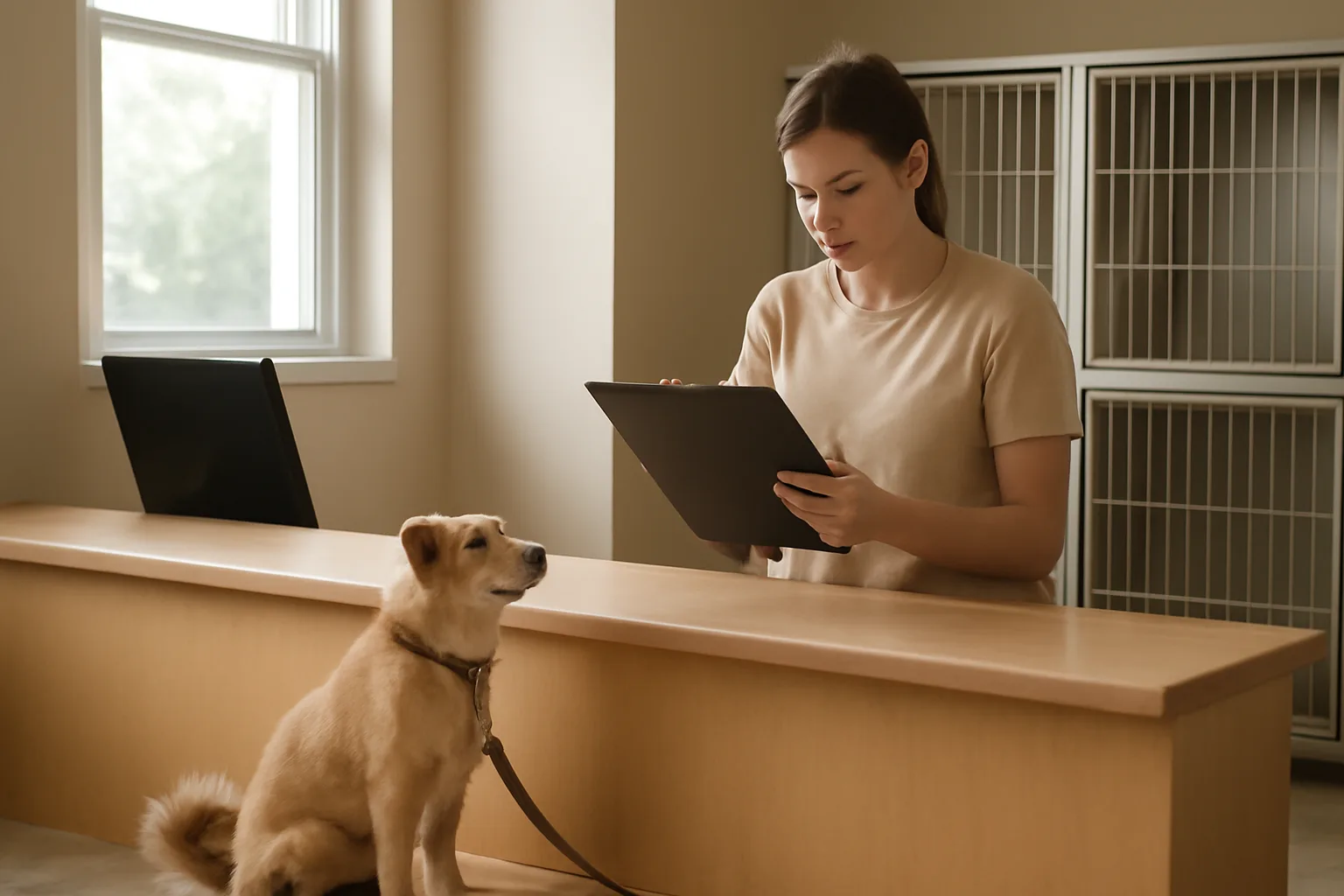
A dog boarding application is the intake form a kennel or daycare uses to screen dogs (vaccine records, behavior history, vet contact). Boarding itself typically costs $25 to $85 per night depending on region and amenities. If you're opening a facility, that's a separate matter: you'll need a state or county kennel license, zoning approval, and possibly a USDA license if you sell puppies across state lines.
What is a dog boarding application, exactly?
A dog boarding application is the intake paperwork a kennel, daycare, or boarding facility asks pet owners to fill out before their dog stays overnight or attends daycare. It's not a government license. It's a private business form, similar to a rental application, that collects vaccine records, emergency contacts, feeding instructions, and behavioral history so the facility can accept the dog safely. Most applications ask for proof of rabies, distemper/parvo (DHPP), and bordetella vaccinations. Many facilities now also require canine influenza (H3N2 or H3N8) vaccination, especially in areas that have had recent outbreaks. Some ask for a fecal test within the last 6 to 12 months to screen for parasites. If you operate a facility, your application should also include a liability waiver, a section on medication administration, and consent to seek emergency vet care if the owner can't be reached. This is separate from any facility license you carry. A well-built intake form protects you legally. It does not substitute for the underlying kennel license or zoning approval your county requires to operate at all.
How much does dog boarding cost?
Dog boarding generally runs $25 to $85 per night in the US, with most owners paying somewhere in the $35 to $55 range for a standard kennel or home-boarding stay. Prices swing hard by region and format: a chain facility in a major metro with play-all-day packages can run $60 to $100+ per night, while a rural in-home boarder might charge $25 to $35. Daycare (day-only, no overnight) usually costs less, often $20 to $40 per day. Add-ons push the total up fast: administering medication commonly adds $1 to $10 per dose, grooming or a bath at pickup adds $15 to $50, and extra playtime or private suites can add $10 to $30 per night. There's no single authoritative government source for pet boarding prices. Most of the pricing data circulating online comes from pet industry marketplaces (Rover, Wag) and franchise pricing pages, not a federal survey. Treat any "average boarding cost" figure, including the ranges above, as a directional estimate rather than a hard number. If you're the one setting prices as an operator, look at three to five competitors within a 15-mile radius, price your base rate near the local median, and charge separately for anything that adds staff time (meds, extra walks, bathing). That's it. Don't overthink the pricing model before you've even filled ten kennels.
How do I register a dog (not the business)?
Registering a dog as a pet owner usually means one of two things: getting a dog license from your city or county, or registering the dog's pedigree with a breed registry like the American Kennel Club (AKC). These are different processes for different purposes. A dog license is a local government requirement, tied to rabies vaccination, that most counties and cities enforce. AKC registration, by contrast, has nothing to do with the law. It's a private paperwork trail proving a dog's parentage for breed purposes. A dog can be fully legal (licensed, vaccinated) with zero AKC papers, and a dog can have full AKC papers with no local license at all. Owners sometimes confuse the two because both involve a form and a fee.
How do I get a dog license?
You get a dog license through your city or county clerk's office, animal control department, or county treasurer, usually by showing proof of current rabies vaccination and paying an annual fee. Requirements and fees vary by jurisdiction. There's no national dog licensing law in the US. Most counties that require dog licenses charge somewhere between $10 and $25 per year for a spayed/neutered dog, with unaltered dogs often charged double or more as an incentive toward spay/neuter. Some counties, like many in Ohio under the state's dog registration law, set the fee and process at the county auditor level; Ohio Revised Code Chapter 955 requires dog registration and lets counties set specifics through their auditor's office [1]. Other states leave licensing entirely to individual municipalities, so a dog in one town might need a license while a dog three miles away, in an unincorporated area, doesn't. The basic steps almost everywhere: 1. Get your dog a rabies vaccine from a licensed vet (usually required annually or every three years depending on vaccine type and local rule). 2. Bring or mail proof of that vaccination to your city/county licensing office. 3. Pay the fee (commonly $10 to $25/year, sometimes less for senior citizens or spayed/neutered dogs). 4. Receive a tag to attach to your dog's collar. Some jurisdictions also require microchipping before they'll issue a license. Check your specific county's animal control page before assuming the rules are the same as your last town.
How do you get papers for a dog (AKC or breed registration)?
"Papers" for a dog usually means registration with a breed registry, most often the AKC, proving the dog's parents (and further back) are of a recognized purebred line. You get papers by registering the litter (if you're the breeder) or by having the breeder transfer registration to you (if you're the buyer). If you bought a purebred puppy from a breeder, ask directly whether the litter is AKC-registered. If it is, the breeder gives you an AKC Dog Registration Application (often called a "blue slip" historically, now typically handled online) that you fill out and submit to transfer registration into your name. The AKC's own registration page describes verifying dog eligibility based on the litter record filed by the breeder. If your dog doesn't have papers and the breeder is unreachable or the litter was never registered, you generally cannot get retroactive AKC papers. The AKC requires documented parentage. There's no path to invent papers for a dog with unknown or undocumented breeding, and DNA testing alone doesn't create AKC registration. Some owners in that position use AKC's Purebred Alternative Listing (PAL) program, which lets purebred dogs without papers compete in certain events without full registration, but that's not the same as breed registration. A mixed-breed dog cannot get AKC papers at all, regardless of documentation, because AKC registration applies to recognized purebred dogs, not mixes.
How do you become a dog breeder (and when do federal rules apply)?
| Sell puppies in person, buyer visits your home, 4 or fewer breeding females | No (retail exemption) | |
|---|---|---|
| Sell puppies sight unseen (online, shipped, buyer never visits) | Yes, regardless of number of females | |
| Sell to pet stores, brokers, or research facilities (wholesale) | Yes | |
| More than 4 breeding females AND selling any dogs wholesale or sight unseen | Yes | Sight-unseen sales require a license regardless of scale, per the 2013 Federal Register rule amending the definition of retail pet store under the AWA [3]. If you're not sure whether your sales model triggers a license, APHIS's Animal Care division has a licensing unit you can call directly rather than guessing. Misclassifying yourself can mean fines that historically have run into the thousands of dollars per violation under AWA enforcement actions. On top of any federal requirement, most states separately require a commercial breeder license once you exceed a certain number of adult breeding dogs or litters per year. These thresholds are state-specific: some states set the bar at 10 or more breeding females, others count litters sold per year (commonly a threshold around 20 to 40 litters annually triggers state-level commercial breeder rules in several states), and several states have no statewide breeder license at all, leaving it to county or city rules. Check your state department of agriculture's page directly, because these numbers are not standardized nationally. If you're planning to operate as a boarding, daycare, or breeding facility rather than a hobbyist, the paperwork stacks up fast: state kennel license, county zoning approval or conditional use permit, possibly a USDA license, plus local business licensing. For anyone building that packet from scratch, our Kennel License & Zoning Packet walks through the standard documents most states and counties ask for, though you'll still confirm final fees and forms with your specific state and county offices since none of this is legal representation before a board. |
Becoming a dog breeder legally starts with your state and local rules, not federal ones, for most small-scale breeders. But once you cross certain thresholds, usually tied to selling to the public sight unseen or selling a certain volume of dogs, USDA licensing kicks in. The federal Animal Welfare Act, enforced by USDA's Animal and Plant Health Inspection Service (APHIS), requires a license for anyone who breeds and sells dogs at wholesale for resale, or who sells dogs sight unseen (meaning the buyer never meets the dog or visits the facility in person before purchase). The regulatory definitions covering "dealer" status and licensing thresholds are set out in 9 CFR Part 1, Section 1.1, which defines terms like "retail pet store" and "wholesale" for Animal Welfare Act purposes [2]. Breeders who sell puppies directly to the public in person, from their own home or property, and who have four or fewer breeding females, are generally exempt under the retail pet store exemption established by the 2013 rule change. Here's the practical breakdown most breeders run into: | Situation | USDA license typically required? |
What does a dog boarding facility application look like for regulators (not customers)?
If you're the one opening a boarding or daycare facility, you'll fill out a different kind of application entirely: one submitted to your state department of agriculture or state veterinarian's office (for a kennel/animal facility license) and one submitted to your county or city zoning office (for a conditional use permit or special exception, since kennels are rarely allowed "by right" in residential or even general commercial zones). A typical state kennel license application asks for: - Business name, address, and owner information
- Maximum dog capacity and current headcount
- Facility diagram showing kennel runs, isolation area, and drainage
- Proof of a working relationship with a licensed veterinarian
- Sanitation and record-keeping plan
- Fire and safety compliance documentation A typical county zoning application for a kennel or boarding facility asks for: - Site plan showing setbacks from property lines and neighboring residences
- Parking plan
- Noise mitigation plan (sound studies are sometimes required near residential zones)
- Odor and waste management plan
- Proof of ownership or a signed lease with landlord consent for kennel use Zoning is almost always the harder hurdle, not the state license. Most state kennel licenses are a matter of meeting facility standards and paying a fee. Zoning approval often requires a public hearing where neighbors can object, and boards can (and do) deny applications over noise or traffic concerns even when every state facility standard is met. Review county zoning requirements early, ideally before you sign a lease, because a great building in the wrong zone means starting over.
How long does it take to get a kennel or boarding license approved?
Timelines vary widely, but a realistic range for the full process (state license plus local zoning) is 60 to 180 days, and it can run longer if a zoning hearing gets continued or a site plan needs revisions. State kennel license review alone is often faster, sometimes 2 to 6 weeks once a complete application is submitted, but zoning is the variable that stretches timelines. Zoning boards typically meet monthly, not weekly. If your application isn't complete by the submission deadline (often 30 days before the hearing date), you miss that month's docket entirely and wait for the next one. Add time for any required public notice period, commonly 10 to 30 days before a hearing depending on the jurisdiction, and it's easy to see how a seemingly simple approval stretches to four or five months. The single biggest time-waster operators report is submitting an incomplete application, missing a site plan detail or a required setback measurement, and getting bounced to the next hearing cycle. Confirming your exact document checklist with the zoning office before your hearing date, not the week of, is the difference between a one-pass approval and a three-month delay.
What facility standards do boarding kennels need to meet?
Facility standards vary by state, but most state kennel regulations cover primary enclosure size, temperature control, sanitation frequency, and staffing ratios. If you're USDA-licensed (selling wholesale or sight unseen), federal Animal Welfare Act regulations set specific minimums: primary enclosures must provide each dog space to turn around, stand, sit, and lie down normally, with additional space requirements scaled to the dog's size, per 9 CFR 3.6 [4]. Federal rules also require ambient temperature in indoor housing facilities be kept between 45°F and 85°F for dogs not acclimated to more extreme temperatures, with specific exceptions and timing limits, under 9 CFR 3.2 and 3.3 [4]. State-only facilities (not USDA-licensed) follow their state's own standards instead, which are sometimes stricter and sometimes looser than federal minimums. There's no universal rule. Common standards across most state kennel codes: - Solid, waterproof, non-porous flooring that can be sanitized
- Daily waste removal
- Separate isolation space for sick or aggressive dogs
- A ventilation system that prevents ammonia buildup
- Fresh water available at all times
- A written emergency and fire evacuation plan For operators building out a new space or renovating, it's worth reviewing facility standards requirements before finalizing floor plans, since retrofitting drainage or flooring after a build-out is far more expensive than designing it in from the start.
What's the difference between a boarding license, a breeder license, and a pet shop license?
These are three separate license categories in most states, and a facility that does more than one activity (say, boarding plus occasional puppy sales) may need more than one license. A boarding/kennel license covers housing other people's dogs temporarily. A breeder license covers producing and selling puppies you bred. A pet shop license covers retail sale of animals, a different regulatory category with its own rules in most states, often including sourcing disclosure requirements. Some states fold all three into one general "animal facility" or "kennel" license with different tiers or add-on permits depending on activity. Others, like several states with dedicated commercial breeder statutes, license breeding operations completely separately from boarding kennels, with different inspection standards, fee schedules, and renewal cycles. There's no shortcut here. Check your specific state department of agriculture's licensing page for the exact category your business falls into, because operating under the wrong license type is one of the more common (and expensive) mistakes new operators make. If you're comparing daycare-only operations to overnight boarding to breeding, note that dog boarding and doggy day care often fall under lighter regulatory tiers than breeding, since no puppies are being produced or sold on-site, just housed temporarily.
Frequently asked questions
How much does dog boarding cost per night?
Typically $25 to $85 per night, with most owners paying $35 to $55 for a standard stay. Chain facilities in major metros run higher ($60-$100+), rural in-home boarding runs lower ($25-$35). These figures come from industry pricing surveys and marketplaces (Rover, Wag), not a government data source, since no federal agency tracks pet boarding pricing.
How do I register a dog with the city or county?
Bring proof of current rabies vaccination to your city or county's animal control or clerk's office, then pay the annual licensing fee, commonly $10 to $25 depending on your jurisdiction and whether the dog is spayed/neutered. You'll get a tag for the collar. Rules and fees are set locally; there's no single national dog registration system.
How do you get a dog license if you just moved to a new county?
Contact your new county's animal control department or treasurer's office directly and ask for their licensing requirements; don't assume your old county's rules carry over. Most require current rabies proof and a fee within 30 days of establishing residency, though the exact deadline varies by jurisdiction.
How do I get papers for a dog I already own?
If the dog was never registered by the breeder at birth, you generally cannot retroactively get full AKC papers; there's no path to create documented parentage after the fact. If your dog is purebred but unregistered, look into AKC's Purebred Alternative Listing (PAL) program, which allows event participation without full registration.
How can I get papers for my dog if I don't know the breeder?
Without breeder contact or litter records, you cannot obtain AKC registration; the AKC requires a documented parentage trail filed by the breeder at the litter's birth. DNA testing can identify breed makeup but does not create registration papers. Programs like AKC PAL exist for unregistered purebreds but don't substitute for full papers.
How do you become a dog breeder legally?
Start with your state department of agriculture's breeder licensing page to check if you exceed their threshold (commonly tied to number of breeding females or litters per year). Separately, check whether your sales model (sight unseen or wholesale) triggers a federal USDA/APHIS license under the Animal Welfare Act, regardless of your operation's size.
When does a dog breeder need a USDA license?
APHIS requires a license if you sell dogs sight unseen (buyer never visits in person before purchase) or sell wholesale to pet stores, brokers, or research facilities, regardless of how many breeding females you have. Breeders who sell only in person, from home, with four or fewer breeding females typically qualify for the retail exemption.
How much does a kennel or boarding facility license cost?
This varies too widely by state to state a single number honestly; state kennel licenses commonly range from under $50 to several hundred dollars annually depending on capacity tier, and county zoning/permit fees are separate line items. Check your specific state department of agriculture and county zoning office for current fee schedules.
Do I need zoning approval to open a dog boarding business?
Almost certainly yes. Kennels and boarding facilities are rarely permitted "by right" in residential or general commercial zones; most jurisdictions require a conditional use permit or special exception, which involves a public hearing where neighbors can raise noise or traffic objections.
How long does dog boarding license approval take?
A realistic range is 60 to 180 days for the combined state license and local zoning process. State license review alone can take 2 to 6 weeks; zoning is the slower variable since boards often meet monthly and incomplete applications get bumped to the next cycle.
What's the difference between a dog license and AKC registration papers?
A dog license is a local government requirement tied to rabies vaccination, enforced by your city or county. AKC registration papers are a private breed-registry record proving a purebred dog's parentage, unrelated to any law. You can have one, both, or neither, depending on your dog and where you live.
Can a mixed-breed dog get AKC papers?
No. AKC registration applies only to dogs of recognized purebred lines with documented parentage. Mixed-breed dogs are not eligible for AKC registration regardless of documentation, though AKC does offer a Canine Partners program for mixed-breed dogs to participate in certain events without registration papers.
What information does a dog boarding application ask for?
Typically vaccine records (rabies, DHPP, bordetella, sometimes canine influenza), emergency vet contact, feeding and medication instructions, behavioral history, and a signed liability waiver. This is a private business intake form, separate from any government kennel license the facility itself must hold to operate legally.
Sources
- Ohio Legislature, Ohio Revised Code Chapter 955: Ohio requires dog registration through county auditors under state law
- eCFR, Title 9 Part 1.1 (Animal Welfare Act definitions): Federal definitions of retail pet store, dealer, and wholesale under the Animal Welfare Act that determine USDA licensing thresholds
- eCFR, Title 9 Part 3 Subpart A (Animal Welfare, Dogs): Federal minimum enclosure size and temperature standards for licensed dog facilities under the Animal Welfare Act
- Federal Register, USDA APHIS Retail Pet Store Rule (2013): The 2013 rule change requiring a USDA license for sight-unseen dog sales regardless of breeding female count
- Ohio Legislature, Ohio Revised Code Section 955.01: Ohio's statutory definitions governing dog registration requirements administered by county auditors