Last updated 2026-07-24
TL;DR
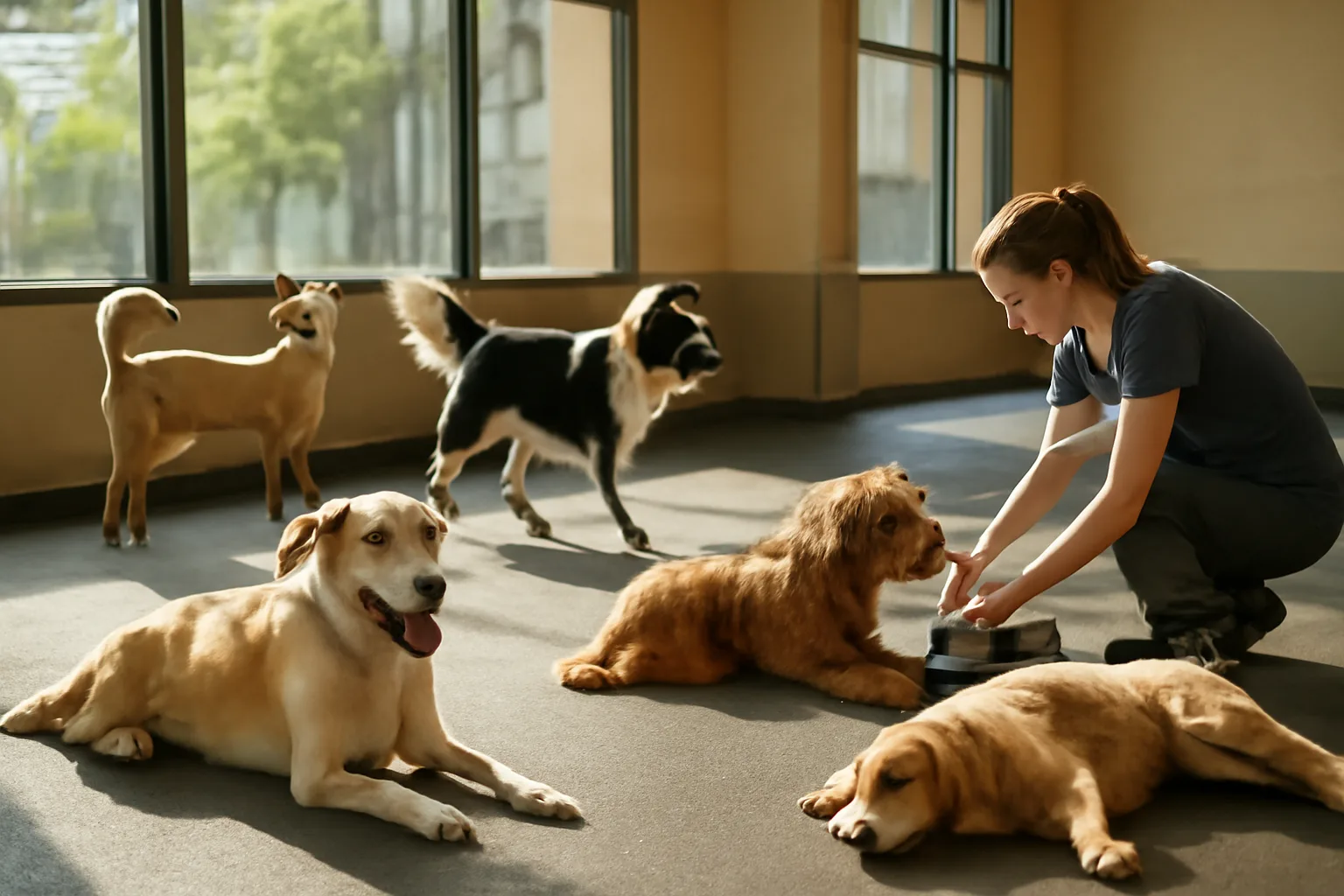
"Dogs all day" usually means all-day boarding or daycare for dogs, and in Charlotte that runs roughly $25-$40 for daycare and $35-$65 a night for boarding, depending on the facility. Every dog in Mecklenburg County needs a rabies vaccine and a county pet registration (often called a "dog license"). Breeders who sell across state lines or hit certain volume thresholds may also need a USDA license.
What does "dogs all day" mean in Charlotte, and how much does it cost?
"Dogs all day" is what a lot of Charlotte pet owners type into Google when they're looking for a place that will take their dog from morning drop-off to evening pickup, either as daycare or overnight boarding. It's not a single official service category. It's just how people search. Some mean daycare (dog goes home at night), some mean boarding (dog stays overnight, maybe for a few days while they travel), and some just mean "is there a place near me open all day for dogs." In Charlotte, full-day dog daycare typically runs $25 to $40 per day at independent operators, and $30 to $45 at larger franchise locations. Overnight boarding runs wider: basic kennel-style boarding starts around $35 to $45 a night, while boarding with more space, home-style setups, or added play time can run $55 to $75 a night or more. Multi-dog discounts and weekly rates are common, and prices creep up around holidays. Thanksgiving week and the week around Christmas are the two times Charlotte boarding facilities routinely sell out, so book early. There's no government price index for pet boarding, so these are market ranges based on typical service pricing patterns seen across mid-size Southeastern metro areas, not a fixed government number. If you're an operator setting your own rates, look at what comparable local dog boarding and pet boarding facilities charge for similar square footage and staff ratios, then adjust for your overhead.
How much is dog boarding, really, and what changes the price?
The honest answer is: it depends more on what's included than on the city you're in. A basic run-of-the-mill kennel with twice-daily walks costs less than a facility offering webcam access, all-day play groups, and private suites. Things that push boarding prices up: private or suite-style lodging instead of a standard kennel run, extra play sessions, medication administration, specialized diets, and add-ons like grooming or training sessions bundled into the stay. Things that keep prices down: shared kennel runs, limited staff supervision hours, and no daytime play group. For operators building a rate sheet, a decent framework is to price your base rate at your true cost per dog per day (labor, utilities, food if provided, insurance allocation) plus a margin, then charge separately for anything that adds staff time. A lot of new operators underprice boarding in year one because they're anchored to whatever number they saw on a competitor's website, without accounting for their own labor costs per dog. If you're planning a facility and haven't nailed down your staffing ratios yet, that's worth doing before you set prices, not after.
How do you register a dog in Charlotte or Mecklenburg County?
Registering a dog in Mecklenburg County means getting your dog a county pet registration tag, sometimes still called a "dog license" out of habit, through Mecklenburg County Animal Care and Control. State law requires it: North Carolina General Statute 67-1 gives counties the authority to require rabies vaccination and registration of dogs and cats [1]. To register, you generally need proof of current rabies vaccination from a licensed veterinarian, then you register the pet with the county, either online, by mail, or in person at the animal shelter or registration office. Fees are usually lower for spayed or neutered pets than for intact animals, a structure many North Carolina counties use to encourage sterilization. The exact current fee schedule changes periodically, so check Mecklenburg County's own page for the current numbers rather than relying on a number printed somewhere else. If you operate a boarding or daycare facility, you'll want every dog's registration and rabies status verified at drop-off. That's more than a smart liability practice. Many county animal control ordinances require kennels and boarding facilities to keep vaccination records on file for every animal in their care.
How do you get a dog license, and is that the same thing as registration?
In most of North Carolina, including Mecklenburg County, "dog license" and "pet registration" mean the same thing in practice: a county-issued tag proving your dog is vaccinated against rabies and known to animal control. Some states use the term "dog license" more formally with its own separate statute; North Carolina counties tend to fold licensing into the rabies control and registration statute under G.S. 67-1 [1]. To get one: take your dog to a vet (or a low-cost rabies clinic, which Mecklenburg County and local nonprofits run periodically) for a current rabies vaccine, get the certificate, then submit that certificate plus the registration fee to the county. Tags are usually good for one to three years depending on the vaccine your vet administers. Some rabies vaccines are labeled for one year, others for three. If you're opening a boarding or daycare facility rather than registering a personal pet, you're dealing with a different, separate process: a business or kennel license from the county or city, plus zoning approval, which is not the same paperwork as an individual dog's rabies tag. Don't confuse the two when you're budgeting for a facility launch.
How do you get papers for a dog (AKC registration and what "papers" actually means)?
When people ask "how do I get papers for my dog," they almost always mean breed registry paperwork, most commonly American Kennel Club (AKC) registration, not a government license. Registry "papers" prove pedigree and breed lineage. They have nothing to do with local licensing or rabies compliance. To register a purebred puppy with AKC, the breeder normally registers the litter after the puppies are born (via an AKC litter registration application, which requires the sire and dam both be individually registered with AKC), and then each puppy gets its own registration transferred to the new owner. If you bought a puppy and the breeder didn't provide registration paperwork, contact the breeder directly first. If the parents were AKC registered, the breeder should be able to complete a litter registration retroactively in many cases. If your dog's parentage isn't documented and you can't get traditional papers, AKC also offers a Purebred Alternative Listing (PAL) program for dogs that appear purebred but lack full registration history, which allows participation in some AKC events without conferring full pedigree registration. Mixed-breed dogs can get "papers" too, through programs like AKC Canine Partners, which registers dogs of any breed or mix for enrollment in some AKC activities, again without pedigree claims.
How do you get papers for your dog if you're the breeder?
If you're the one breeding the litter, getting "papers" for your puppies starts before the puppies exist: both parent dogs need their own individual AKC registration (or the registry you're working with) on file first. You can't register a litter from an unregistered dam or sire. Once the litter is born, the breeder submits an AKC litter application, which includes the sire and dam's registration numbers, the whelping date, and the number of puppies. AKC then issues individual registration slips for each puppy, which the breeder signs over to each buyer. Buyers then complete their own registration in their name. A lot of small and hobby breeders skip this because it costs money and time, and that's a legitimate choice as long as buyers know upfront the puppies won't come with registry papers. Where breeders get into trouble is implying a dog is "AKC registered" or has papers coming when the parents were never registered at all. That's a consumer complaint magnet and, in some states, can brush up against consumer protection law depending on how it's advertised.
How do you become a dog breeder legally, and what licenses apply?
Becoming a legal dog breeder in the US involves layered requirements: possibly a state kennel or breeder license (North Carolina doesn't have a blanket statewide breeder license, but some counties and cities have local kennel permit ordinances), possibly a USDA license, and always basic animal welfare compliance regardless of scale. The federal trigger is the Animal Welfare Act (AWA), enforced by USDA's Animal and Plant Health Inspection Service (APHIS). Under the AWA regulations, a "dealer" generally includes anyone who sells more than 4 female breeding dogs' worth of puppies per year for resale, wholesale, breeding stock, or use as pets to a retailer or another dealer, unless an exemption applies. The regulation's definitions and licensing requirements are set out in 9 CFR Part 1, Section 1.1 (definitions) and Part 2, Subpart A (licensing) [2]. A key exemption: breeders who sell puppies directly to the public, face-to-face, from their own home or premises, are typically treated as a "retail pet store" and exempt from dealer licensing under the AWA's retail exemption, even at higher volume. USDA APHIS explains this in its Animal Care policy materials on the retail pet store exemption, tied to the statutory definition of "retail pet store" in 7 U.S.C. 2132(f) [3]. So the practical breakdown: if you sell wholesale, sell sight-unseen to buyers who never visit in person, or sell through a broker or pet store, you almost certainly need a USDA license once you're above the small-scale threshold. If every buyer meets the dog and puppies in person at your location before buying, you likely qualify for the retail exemption regardless of volume, though state law can still require something separately. Always check current APHIS licensing guidance directly, because thresholds and exemption interpretations get updated [2] [3]. State-level rules also matter and vary a lot: some states require a commercial breeder license above a certain number of intact females or litters per year, separate from anything federal. North Carolina doesn't have a single statewide breeder licensing law comparable to states like Ohio or Pennsylvania, but individual counties and municipalities can and do require local kennel permits for anyone keeping a certain number of dogs on one property. Check your specific county's animal ordinance before assuming you're in the clear.
What zoning and facility rules apply to Charlotte boarding and daycare operators?
Zoning is usually the first wall new boarding and daycare operators hit, and it trips people up more than licensing does. Mecklenburg County and the City of Charlotte both regulate where kennels, boarding facilities, and animal daycare businesses can operate, and the rules differ by zoning district. Residential districts generally prohibit commercial kennels outright; the business needs to be in a district zoned for commercial or specific conditional use, and some districts require a conditional use permit and a public hearing even where kennels are technically allowed. Before signing a lease or making an offer on a property, call the Charlotte-Mecklenburg zoning office (or the relevant municipal planning department if you're outside city limits, since Mecklenburg County has several incorporated towns each with their own zoning authority) and ask directly whether "animal boarding" or "kennel" is a permitted use, a conditional use, or not allowed at all for that specific parcel's zoning district. Get this in writing if you can. A location that looks perfect can be dead on arrival because of a zoning line you didn't check. Facility standard expectations, separate from zoning, typically cover things like ventilation, drainage, noise mitigation, secure fencing, separation of sick or quarantine animals, and staff-to-dog supervision during play groups. These aren't uniform across every jurisdiction. Check your specific county's animal control ordinance and any state Department of Agriculture rules that might apply if you're also boarding as part of a licensed breeding kennel.
Do dog boarding and daycare facilities need a USDA license?
Usually not, and this trips people up because they conflate breeding rules with boarding rules. USDA APHIS licensing under the Animal Welfare Act is aimed primarily at breeders (dealers), exhibitors, and certain research facilities, not standard commercial boarding kennels or daycare centers that don't sell animals [2]. That said, if your boarding facility is attached to a breeding operation, or you board animals as part of a business that also deals in animal sales at wholesale, the USDA license requirement can apply to the breeding or dealing side of the business even if pure boarding services wouldn't trigger it on their own. It's the selling and dealing activity that pulls in APHIS jurisdiction, not the act of housing someone else's pet overnight. Boarding and daycare operators still deal with plenty of oversight, just from different agencies: county animal control (rabies compliance, kennel permits), local zoning and building code, fire marshal review for occupancy, and in some states, a state Department of Agriculture inspection program specifically for boarding kennels. North Carolina's own animal welfare oversight for boarding kennels runs through counties rather than a single statewide licensing agency, so requirements really do vary by where you're located.
What does opening a boarding or daycare facility in Charlotte actually cost, beyond rent?
Rent and buildout are the obvious big-ticket items, but the licensing and compliance side adds up fast too, and a lot of first-time operators underbudget it. Expect line items for: a business license, county kennel or animal facility permit fees (these vary by county and are usually in the low hundreds of dollars, not thousands, but check your specific county), zoning review or conditional use permit application fees (these can run higher, sometimes into four figures depending on whether a public hearing is required), fire and building inspections, and general liability insurance sized for animal care businesses. A lot of operators also underestimate the time cost, more than the dollar cost. A conditional use permit that requires a public hearing can add two to four months to your timeline before you're even allowed to open, and that's before buildout. If your business plan assumes a three-month runway from lease signing to opening day, and your zoning district requires a conditional use hearing, you're probably wrong by a couple months. Build the padding in now. This is exactly the kind of prep work a licensing and zoning packet is built for: a structured way to organize your kennel license application, zoning documentation, and facility standards checklist before you walk into a county office or a zoning hearing, instead of discovering gaps the day you show up. If you want a starting framework rather than building the checklist from scratch, the $149 one-time Kennel License & Zoning Packet is built around exactly this kind of prep, though it doesn't replace talking to your own local zoning office or an attorney if your situation is complicated.
How do daycare and boarding facilities compare on staffing and space needs?
| Typical staff-to-dog ratio | 1:10 to 1:15 during active play | 1 overnight staff or on-call per building, tighter daytime ratios | |
|---|---|---|---|
| Peak hours | Weekday mornings/evenings (drop-off/pickup) | Holidays, school breaks, long weekends | |
| Space per dog | Open play area, less individual space needed | Individual kennel/suite space required | |
| Overnight liability | Usually none (dogs go home) | Higher (need overnight monitoring plan) | |
| Typical Charlotte-area price | $25-$40/day | $35-$75/night | These numbers are market patterns, not a regulatory standard from any single source. Actual staffing requirements depend on your state's animal welfare rules (if any specify ratios) and your insurance carrier's requirements. Some states do specify minimum supervision, but North Carolina doesn't set a statewide numeric staff-to-dog ratio. Check whether your county ordinance does. |
Daycare and overnight boarding have different operational demands, and mixing up the assumptions between them is a common planning mistake for new operators. | Factor | Daycare | Overnight boarding |
Frequently asked questions
How much does dog boarding cost in Charlotte?
Basic overnight boarding in the Charlotte area typically runs $35 to $45 a night, with suite-style or higher-service boarding running $55 to $75 or more. Full-day daycare runs about $25 to $40. Prices rise around Thanksgiving and Christmas week, when facilities often book up weeks in advance.
How do you register a dog in Mecklenburg County?
Get your dog's current rabies vaccination from a licensed vet, then submit the vaccination certificate along with the registration fee to Mecklenburg County Animal Care and Control. Registration (often called a dog license) is required under North Carolina G.S. 67-1, which authorizes counties to mandate rabies vaccination and registration.
How do you get a dog license?
A "dog license" in most North Carolina counties, including Mecklenburg, is really the county pet registration tag issued after proof of current rabies vaccination. You get it by bringing a vaccination certificate to the county registration office (or submitting online, where available) along with the registration fee, which is usually lower for spayed/neutered pets.
How do you get papers for a dog?
"Papers" usually means AKC (or another registry's) pedigree registration, which requires the puppy's sire and dam to already be individually registered with that registry. The breeder files a litter registration after birth, then transfers individual puppy registration to the buyer. This is separate from any government license or county registration.
How can I get papers for my dog if the breeder never gave them to me?
Contact the breeder first; if the parents were AKC registered, they may be able to complete a retroactive litter registration. If the parents weren't registered, traditional pedigree papers aren't possible, but AKC's Purebred Alternative Listing or Canine Partners programs may let your dog participate in some events without full pedigree registration.
How do you become a dog breeder legally?
Start by confirming state and county rules: some states require a commercial breeder license above a certain number of females or litters; North Carolina doesn't have one statewide law but some counties do have local kennel permits. Then check whether your sales volume and method (wholesale vs. face-to-face retail) trigger USDA APHIS licensing under the Animal Welfare Act.
Do I need a USDA license to breed and sell dogs?
Generally yes if you sell more than 4 breeding females' worth of puppies per year wholesale, to brokers, or sight-unseen to buyers, per Animal Welfare Act regulations enforced by USDA APHIS (9 CFR Part 1). If every buyer meets the puppy in person at your home or premises before purchase, you likely qualify for the retail pet store exemption regardless of volume.
Do dog boarding and daycare businesses need a USDA license?
Usually no. USDA APHIS licensing under the Animal Welfare Act targets breeders, dealers, and exhibitors, not standard boarding or daycare businesses that don't sell animals. Boarding operators instead deal with county kennel permits, zoning approval, and local health/fire code, not federal APHIS licensing, unless boarding is bundled with a licensed breeding operation.
What zoning approval does a Charlotte dog daycare need?
It depends entirely on the parcel's zoning district. Residential zones typically prohibit commercial kennels outright; commercial or specific conditional-use districts may allow it, sometimes only after a conditional use permit application and public hearing. Call the Charlotte-Mecklenburg zoning office directly before signing a lease to confirm the specific parcel's allowed uses.
How much is dog boarding compared to daycare?
Daycare is generally cheaper per visit because dogs go home at night and need less individual space: roughly $25-$40/day in the Charlotte market. Overnight boarding costs more because it requires dedicated kennel/suite space and overnight supervision, running roughly $35-$75/night depending on service level.
How long does it take to open a licensed boarding facility?
It varies widely by county and zoning district. If your zoning requires only a permitted-use confirmation, you might be open in a few weeks after buildout. If a conditional use permit and public hearing are required, add two to four months before you can even start construction, on top of buildout time.
Is a dog license the same as AKC registration?
No, these are completely different things. A dog license (county registration) proves rabies vaccination compliance to your local government and has nothing to do with breed. AKC registration ("papers") documents pedigree and breed lineage through a private registry and has no bearing on legal compliance with local animal control law.
Sources
- North Carolina General Assembly, N.C. General Statute 67-1 (Rabies control): North Carolina law authorizes counties to require rabies vaccination and registration of dogs and cats
- Animal Welfare Act regulations, 9 CFR Part 1 (Definitions) and Part 2, Subpart A (Licensing): AWA dealer licensing threshold and definitions for breeders selling dogs
- Animal Welfare Act, retail pet store definition, 7 U.S.C. 2132(f): Face-to-face retail sales at the breeder's premises may qualify for exemption from USDA dealer licensing
- USDA APHIS Animal Welfare Act licensing overview (Federal Register, AWA license and registration final rule): USDA APHIS is the federal agency responsible for licensing dealers and breeders under the Animal Welfare Act
- City of Charlotte: Zoning ordinance provisions govern where boarding and daycare facilities may operate in Charlotte
- Mecklenburg County Animal Care & Control: How to register and license a dog in Mecklenburg County, including rabies vaccination requirements
- North Carolina General Assembly: State public health statutes covering rabies control and dog registration requirements