Last updated 2026-07-24
TL;DR
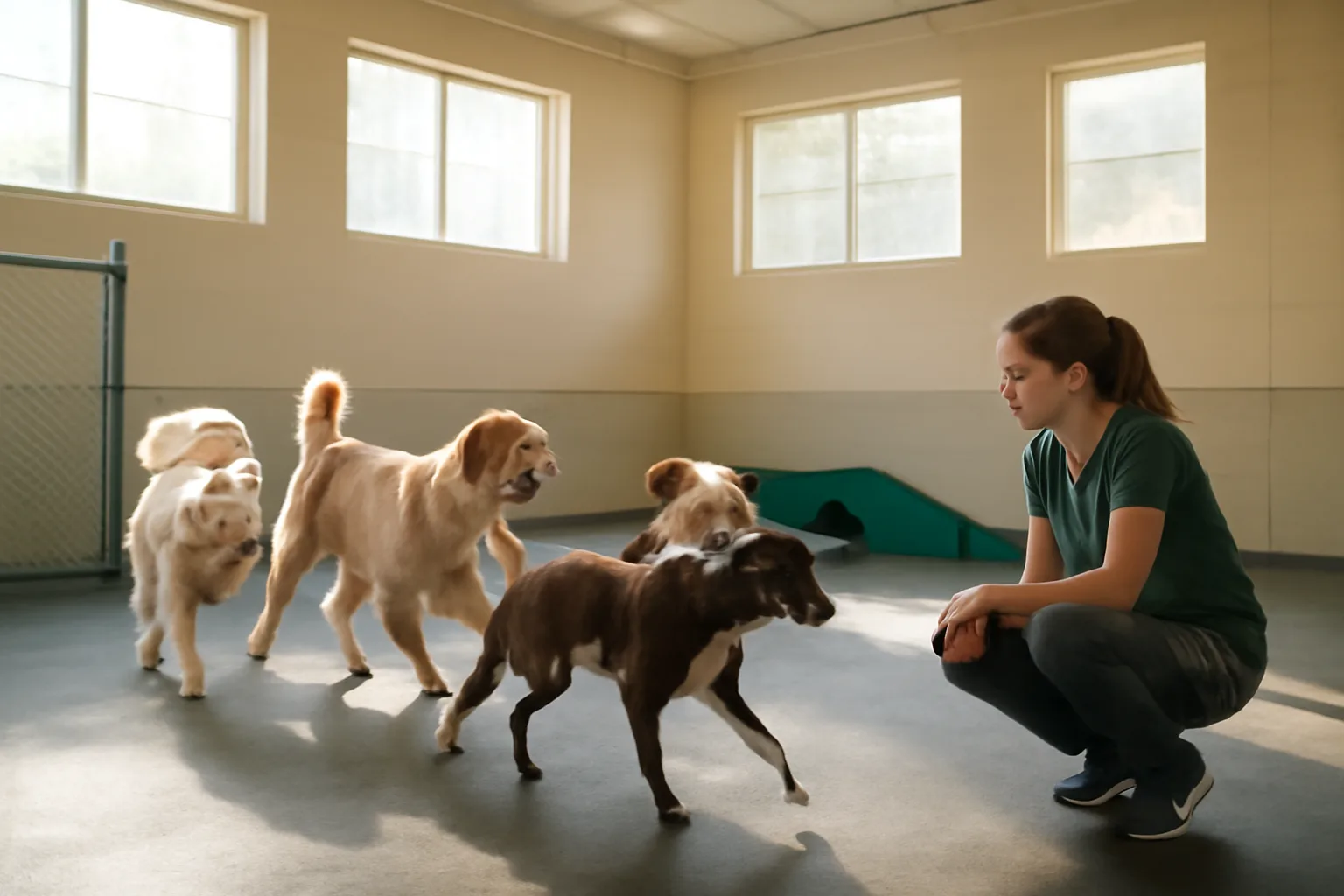
Doggy daycare in Charlotte NC typically runs $25 to $40 a day, with boarding around $35 to $65 a night depending on the facility. Operators need a Mecklenburg County animal permit, a business license, and zoning approval (usually conditional or special use in most residential-adjacent districts), plus USDA oversight only kicks in for breeders selling wholesale or across state lines.
How much does dog boarding cost in Charlotte NC?
Dog boarding in Charlotte generally costs $35 to $65 per night depending on whether you're looking at a basic kennel run or a suite-style setup with webcams and extra playtime. Daycare (drop-off, no overnight) runs cheaper, usually $25 to $40 a day, with multi-day packages bringing the per-day rate down by $3 to $8. These are market rates, not government-set fees. There's no Charlotte-specific published rate survey, so the range above comes from checking listed pricing at facilities across the metro and comparing it to national averages, where Rover and other national platforms report typical boarding costs in the $25 to $85/night range depending on city and add-ons. Charlotte sits solidly in the middle of that band, not a cheap market but not a coastal-city price tag either. If you're the operator setting prices, don't just match a competitor's website number. Factor in your actual cost per dog: staff-to-dog ratio, square footage per dog required by your county's animal control rules, insurance, and whether you're doing cage-free group play (higher liability, usually priced higher) versus traditional kennel runs. A lot of new operators underprice for the first year to build a client base, then get stuck raising rates on a loyal client list, which is an awkward conversation. Price close to right from day one. For comparison shopping across boarding formats, see our breakdowns on dog boarding and dog hotels near me.
What licenses does a doggy daycare need in Mecklenburg County?
In Mecklenburg County (which covers Charlotte), a commercial dog daycare or boarding facility needs an Animal Care and Control permit, a City of Charlotte or county business license, and zoning sign-off before you can open. Mecklenburg County Animal Care and Control enforces animal-related ordinances countywide, including facility inspections for commercial boarding and daycare operations [1]. The permit process typically checks: adequate ventilation, sanitation and waste disposal plans, secure fencing and containment, separation of aggressive or sick animals, and vaccination record-keeping (rabies certificates at minimum, since North Carolina law requires rabies vaccination for dogs over four months old under G.S. 130A-185). You'll also need a state sales tax number if you're selling retail goods (leashes, treats, etc.) alongside services, through the NC Department of Revenue. None of this is optional and none of it happens overnight. Budget 60 to 120 days from application to opening if zoning is straightforward, longer if you need a variance or special use permit hearing.
What zoning do you need for a doggy daycare in Charlotte?
Charlotte and Mecklenburg County operate under the Charlotte Unified Development Ordinance (UDO), which replaced the old zoning code in 2023. Commercial kennels, boarding facilities, and daycare operations for animals are typically only permitted outright in specific commercial and industrial districts, and often require a conditional or special use permit in mixed-use or neighborhood commercial zones [2]. If your building sits in a straight commercial district (like most CG or MUDD-zoned corridors), you may be able to open with a standard permit and a use confirmation letter from the Charlotte-Mecklenburg Planning, Design & Development Department. If you're in a district that doesn't list animal daycare as a permitted use, you'll need a rezoning petition or a special/conditional use permit, which means a public hearing in front of the Zoning Board of Adjustment or City Council depending on the request type. Noise is usually the sticking point. Boarding and daycare facilities generate barking, and Charlotte's noise ordinance (Chapter 15 of the City Code) sets limits that can come up at a hearing even if your use is technically permitted. If you're near residential zoning, expect the board to ask about sound mitigation, hours of outdoor play, and how many dogs are outside at once. Check your parcel's zoning designation first through the Mecklenburg County GIS/polaris system before you sign a lease. A landlord telling you 'it's zoned commercial, you're fine' is not the same as confirming animal boarding is a listed permitted use for that specific district.
How do you register a dog in Charlotte / Mecklenburg County?
Registering a dog in Mecklenburg County means getting it a county rabies tag and, if required, a pet license, through Mecklenburg County Animal Care and Control or a participating veterinarian. North Carolina state law (G.S. 130A-185) requires all dogs and cats over four months old to be vaccinated against rabies, and the vaccinating vet issues a rabies certificate and tag at that time. Mecklenburg County uses that rabies tag as the primary registration tool; there isn't a separate 'dog license' fee stacked on top in most of the county the way some other states require. If you board or provide daycare for dogs, you should require proof of current rabies vaccination (and typically Bordetella and DHPP) before accepting any dog, and keep copies on file. This isn't just good practice, it's what your county permit inspection will check for. If a client asks 'how do I register my dog' before boarding with you, the simple answer is: take the dog to a licensed vet, get the rabies vaccine, get the tag and certificate, done. No separate municipal license application is typically needed in Mecklenburg County beyond that, though this can change, so confirm current requirements directly with Animal Care and Control before printing it in your intake paperwork.
How do you get a dog license?
A 'dog license' in most jurisdictions means proof of current rabies vaccination, sometimes paired with a separate county tag renewed annually. Requirements vary heavily by state and even by county within a state, so there's no single national answer. In North Carolina, the operative requirement is the rabies vaccination itself (G.S. 130A-185), administered by a licensed veterinarian, with the resulting tag serving as the de facto license in most counties, including Mecklenburg. Some NC counties and municipalities layer on additional registration fees or tags, so if you operate a facility that draws clients from surrounding counties (Cabarrus, Union, Gaston, York County SC), don't assume Mecklenburg's rules apply to every dog walking through your door. Ask where the dog is normally kept and check that county's specific rule. If you're building intake forms for a boarding or daycare business, the practical move is to require: current rabies certificate, vaccinating vet's name and phone number, and date of last Bordetella and DHPP boosters. That covers your liability regardless of which county issued the underlying rabies tag.
How do you get papers for a dog?
'Papers' usually means one of two different things, and people mix them up constantly: AKC (or other breed registry) registration papers proving pedigree, or basic ownership/vaccination documentation. If a client asks you this at a daycare front desk, they almost always mean the AKC kind. To register a puppy with the American Kennel Club, the breeder typically registers the litter first, then individual puppy registration (or transfer of ownership) happens through the AKC's registration process, which requires the litter application, proof of the sire and dam's registration, and a fee [3]. If you bought a dog from a breeder who never registered the litter, you generally cannot manufacture papers after the fact; AKC registration has to trace back to a registered litter application filed at or near the time of breeding. If there's no breed registry paperwork and the dog is a rescue or unknown-lineage mix, there's no 'papers' to get in the pedigree sense. What you can get instead is a vet record, a microchip registration, and a rabies certificate, which is what actually matters for boarding, daycare, travel, and most licensing purposes anyway. Nobody at a boarding facility or an airline is asking for AKC papers; they want vaccination proof.
How do you get papers for your dog if you're the breeder?
If you bred the litter yourself and want AKC papers for the puppies, you register the litter with the American Kennel Club using the AKC Dog Registration process, which requires both parents already be AKC-registered, a litter registration application, and the applicable fee [3]. Once the litter is registered, individual puppy registration applications (often called 'blue slips' historically, now largely handled online) go out to the buyers. Other registries (UKC, CKC, and various breed-specific clubs) have their own separate processes and fee schedules; a dog registered with one registry isn't automatically registered with another. If you're breeding with any regularity, papers are the smallest part of your compliance picture. The bigger question is whether you've crossed a threshold that requires a USDA license, which we cover next.
How do you become a dog breeder legally in North Carolina?
Becoming a legal dog breeder in North Carolina means checking three separate layers: state breeder regulation, county zoning, and federal USDA licensing, and treating each one as a real gate, not paperwork you'll get to eventually. North Carolina doesn't have a single statewide 'breeder license' the way some states do, but it does regulate commercial breeding operations under the NC Pet Shop / Animal Welfare rules administered through the Department of Agriculture & Consumer Services, and larger operations may need boarding kennel or pet shop registration depending on how animals are sold [4]. Check current requirements directly with NCDA&CS before assuming you're exempt. Federally, the trigger is the Animal Welfare Act. USDA APHIS requires a license from anyone who breeds and sells dogs at wholesale (meaning you sell to a broker, pet store, or research facility, or you sell sight-unseen to buyers who never see the animal or the premises in person before purchase) and who maintains more than four breeding females, with limited exemptions . APHIS states plainly: 'Anyone who breeds and sells more than one litter of dogs or cats per year to a broker or pet store... must be licensed' under the relevant regulations . If you sell every puppy face-to-face, in person, direct to the end buyer, from your own home or property, you typically qualify for the 'retail pet store' exemption and don't need a USDA license, but the exemption has specific conditions worth confirming against the actual regulation text rather than a summary. Locally, breeding kennels also need to clear Charlotte/Mecklenburg zoning the same way a boarding facility does. Residential zones often cap the number of dogs allowed on a property before it's classified as a kennel use requiring commercial zoning and permits.
When do dog breeders and boarding operators need a USDA license?
| Boarding/daycare, owner-drop-off pets only | No | Not a breeder or dealer activity | |
|---|---|---|---|
| Breeder selling all puppies face-to-face, in-person, direct to buyer | Usually exempt (retail pet store exemption) | Buyer sees animal & premises before purchase | |
| Breeder selling to pet stores, brokers, or sight-unseen (online/shipped) | Yes | Wholesale/dealer activity under AWA | |
| Breeder with 4 or fewer breeding females, selling only retail | Generally exempt | Below the regulatory retail threshold | |
| Breeder with more than 4 breeding females selling wholesale | Yes, license required | Crosses AWA breeder threshold | If you're a boarding facility that also breeds a litter or two on the side and sells a few puppies to out-of-state buyers sight unseen, you may have unknowingly triggered a federal licensing requirement. This is a common blind spot for operators who think of themselves as 'a boarding business that also breeds' rather than 'a dealer under the Animal Welfare Act.' Check the exact current thresholds directly on the APHIS licensing page before assuming you're exempt . |
USDA APHIS licensing applies to dog breeders and dealers, not to standard boarding or daycare operations serving individual pet owners. The Animal Welfare Act regulations (9 CFR Chapter I, Subchapter A) require a license for anyone breeding dogs for wholesale resale, brokers, and certain research-animal suppliers, with specific numeric thresholds tied to breeding female counts and sales channels . Here's the table most operators actually need: | Activity | USDA license typically required? | Key trigger |
What facility standards does a Charlotte-area boarding kennel need to meet?
Commercial boarding kennels in Mecklenburg County need to meet Animal Care and Control's facility standards covering enclosure size, sanitation, ventilation, temperature control, and record-keeping, checked during permit inspection and periodic follow-up visits. Specific numeric standards (square footage per dog, minimum air changes per hour, etc.) are set at the county/state level and should be confirmed directly with Animal Care and Control before you finalize a floor plan, since requirements can differ for daycare-only versus overnight boarding. If you're also USDA-licensed as a breeder operating on the same premises, a separate and more detailed federal facility standard applies under 9 CFR Part 3, covering things like minimum enclosure dimensions tied to the dog's size, and specific temperature ranges for indoor housing facilities . These are two different rulebooks. Meeting county boarding standards does not automatically satisfy USDA facility standards if you're also running a licensed breeding operation, and vice versa. General facility planning basics (drainage, flooring material, noise buffering, separate isolation space for sick animals) are worth building in from the start regardless of which specific numeric code applies, because retrofitting concrete flooring or adding a floor drain after your county inspector flags it is far more expensive than designing it in during buildout.
How long does it take to open a licensed daycare or boarding facility in Charlotte?
Realistically, budget 3 to 6 months from lease signing to opening day if your zoning is already permitted-by-right, and 6 to 12 months if you need a rezoning or special/conditional use permit hearing. The timeline breaks down roughly as: zoning confirmation and any required hearing (4 to 16 weeks depending on hearing backlog), county animal facility permit application and inspection (2 to 6 weeks after buildout is done), business license and tax registration (usually quick, 1 to 3 weeks), and buildout itself, which depends entirely on your contractor and whether the space needs plumbing or HVAC changes for kennel-grade ventilation. The single biggest timeline killer is discovering a zoning problem after signing a lease. Confirm the parcel's actual zoning designation and permitted-use status with Charlotte-Mecklenburg Planning before you sign anything, not after. A lot of first-time operators build a full business plan and buy equipment before checking zoning at all, then find out three months in that their chosen location needs a conditional use permit and a public hearing. That's the expensive mistake to avoid. If you want a structured way to pull together the zoning packet and license documentation before you approach the county or a hearing board, the $149 Kennel License & Zoning Packet builder organizes the standard document set (site plan checklist, use narrative, facility standards summary) that most jurisdictions ask for, so you're not assembling it from scratch under deadline pressure.
What should you compare before choosing a daycare or boarding format?
Group-play daycare, traditional kennel boarding, and franchise models like Dogtopia each carry different startup costs, staffing ratios, and zoning classifications, so the right format depends on your building, your budget, and your local market. Group-play cage-free daycare needs more open floor space and a higher staff-to-dog ratio for safety, which raises payroll costs but often lets you charge a premium versus a traditional kennel-run model. Traditional boarding (individual runs/kennels) needs less staff supervision per dog but more square footage overall once you account for individual enclosures, and it's the format most existing zoning codes were written with in mind, so it's often easier to get approved. Franchise models bring brand recognition and operational systems (Dogtopia, Camp Bow Wow, and similar chains) but come with franchise fees, ongoing royalties, and less flexibility to adapt your floor plan to a quirky building. If you're evaluating a franchise versus building independently, compare the total capital required against your local market's willingness to pay premium daycare rates, more than the franchise's marketing pitch. For general format comparisons, see doggy day care and dog kennels.
Frequently asked questions
How much does dog boarding cost in Charlotte NC?
Dog boarding in Charlotte typically runs $35 to $65 per night depending on the facility and enclosure type, with daycare (no overnight stay) running $25 to $40 a day. Suite-style or webcam-monitored boarding sits at the higher end. Multi-day packages usually knock $3 to $8 off the per-day rate. There's no government-set price; this is market pricing that varies by operator.
How do I register a dog in Charlotte or Mecklenburg County?
Take the dog to a licensed veterinarian for a rabies vaccination, required by North Carolina law (G.S. 130A-185) for all dogs over four months old. The vet issues a rabies certificate and county tag, which functions as the primary registration in Mecklenburg County. There typically isn't a separate municipal dog license fee stacked on top, but confirm current rules with Animal Care and Control.
How do you get a dog license?
In most places, including Mecklenburg County, a 'dog license' is really proof of current rabies vaccination issued by a licensed vet, resulting in a rabies tag and certificate. Requirements vary by state and county, and some jurisdictions add a separate registration fee on top. Check with your county's animal control office directly since rules differ even between neighboring counties.
How do I get papers for a dog?
If you mean AKC-style pedigree papers, that requires the breeder to have registered the litter with the AKC at or near the time of breeding; you can't retroactively create papers for a dog whose litter was never registered. If you mean basic documentation, get a vet record, microchip registration, and rabies certificate, which is what boarding facilities and airlines actually require.
How do I get papers for my dog if there's no breeder registration?
If the litter was never registered with AKC or another breed registry, there's no way to add pedigree papers after the fact. Instead, get the dog microchipped and registered in a microchip database, obtain a current rabies certificate from a vet, and keep vaccination records. That documentation covers boarding, daycare, travel, and most licensing needs even without breed papers.
How do you become a dog breeder in North Carolina?
Check three layers: state animal welfare/pet shop rules through NC Department of Agriculture & Consumer Services, county zoning approval for a kennel or breeding use, and federal USDA APHIS licensing if you sell wholesale, use brokers, or sell sight-unseen with more than four breeding females. Selling every puppy in person directly to buyers usually keeps you in the retail exemption, avoiding USDA licensing.
Does a dog daycare or boarding facility need a USDA license?
No, standard boarding and daycare facilities serving individual pet owners don't need USDA APHIS licensing. That requirement applies to breeders and dealers under the Animal Welfare Act, specifically those selling wholesale, through brokers, or sight-unseen, and who keep more than four breeding females. If your facility also breeds and sells puppies that way, you may need a separate license.
What zoning do I need for a dog daycare in Charlotte NC?
Under the Charlotte Unified Development Ordinance, commercial kennels and daycare facilities are permitted outright in most commercial and industrial districts, but usually need a conditional or special use permit in mixed-use and neighborhood commercial zones. Confirm your parcel's specific district and permitted-use status through Charlotte-Mecklenburg Planning before signing a lease.
How long does it take to get a boarding facility licensed and open in Charlotte?
Plan on 3 to 6 months if your location is already zoned for the use, and 6 to 12 months if you need a rezoning or conditional use permit hearing. That includes zoning confirmation, buildout, county animal facility permit inspection, and business license registration. Zoning surprises after signing a lease are the most common cause of delay.
What's the difference between AKC papers and a rabies tag?
AKC papers document pedigree and breed registry, useful for showing, breeding, or proving lineage, and they trace back to a litter registration filed by the breeder. A rabies tag documents current vaccination status, required by state law and checked by boarding facilities, groomers, and animal control. Most boarding and daycare intake forms only require the rabies tag, not AKC papers.
Do I need a business license to open a doggy daycare in Charlotte?
Yes. Alongside your Mecklenburg County Animal Care and Control permit and zoning approval, you need a City of Charlotte or county business license and, if selling retail products, a state sales tax registration through the NC Department of Revenue. Requirements and fees are set locally, so confirm current amounts directly with the relevant county or city office.
Can I run a dog daycare out of my house in Charlotte?
It depends entirely on your zoning district and how many dogs you're keeping or caring for regularly. Most residential zones cap the number of animals before a use is classified as a commercial kennel requiring rezoning or a special use permit. Check your specific parcel's zoning with Charlotte-Mecklenburg Planning before advertising home-based daycare services.
Sources
- North Carolina General Statutes, G.S. 130A-185: North Carolina requires rabies vaccination for dogs and cats over four months old
- City of Charlotte Code of Ordinances, Chapter 15 (Noise): Charlotte's noise ordinance sets sound limits relevant to boarding/daycare facilities near residential zoning
- USDA APHIS, 9 CFR Chapter I, Subchapter A (Animal Welfare): The Animal Welfare Act regulations set licensing categories and thresholds for breeders and dealers
- USDA APHIS, 9 CFR Part 3 (Specifications for Humane Handling, Care, Housing): USDA facility standards for licensed dog breeders specify enclosure size and housing temperature requirements
- Electronic Code of Federal Regulations (eCFR): 9 CFR Part 2 outlines the licensing requirements applicable to dog breeders and boarding/daycare operators under the Animal Welfare Act.
- City of Charlotte: Doggy daycare and boarding facilities must comply with Charlotte's zoning ordinance requirements before operating.
- North Carolina General Assembly: North Carolina law defines standards and requirements for animal shelters and boarding facilities under the Animal Welfare Act (Chapter 19A).