Last updated 2026-07-25
TL;DR
"Bluebonnet Pet Ranch" describes a common Texas-region boarding/breeding facility model: acreage-based kennels combining dog boarding, daycare, and sometimes breeding. Boarding runs roughly $25-$65/night nationally (APPA, 2023-2024 survey data). Dog licensing is a city or county function, not federal. AKC-style "papers" come from registering a litter with a registry, not a government agency. USDA licensing kicks in for breeders selling wholesale or online sight-unseen above certain volume.
what is a bluebonnet pet ranch and how does that model work?
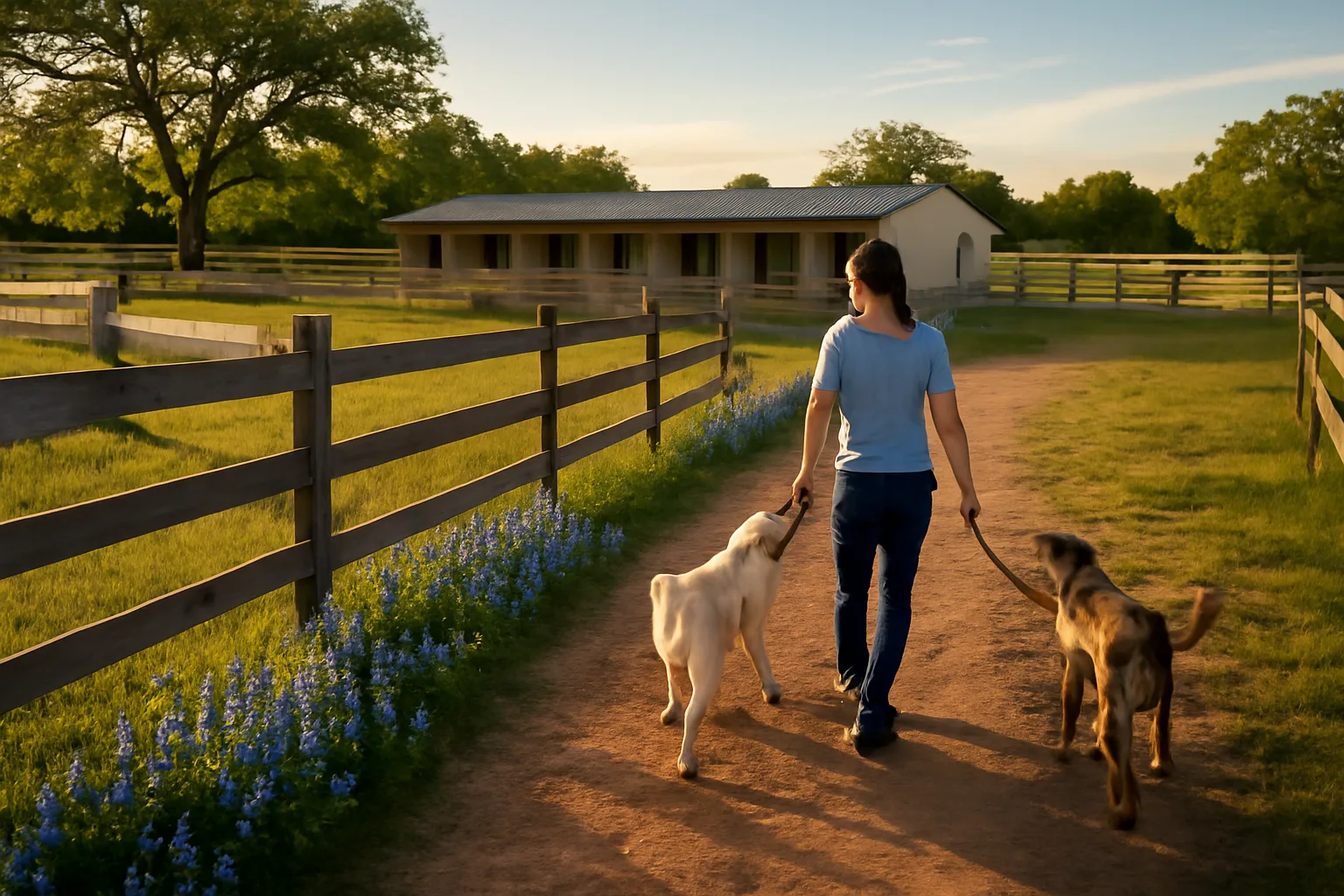
"Bluebonnet Pet Ranch" isn't a single national chain with one standard playbook. It's the kind of name you see attached to acreage-based dog operations across Texas and the broader Southwest: a few fenced acres, a mix of indoor kennel runs and outdoor play yards, and often a combination of services under one roof (or one fence line). Boarding, daycare, and sometimes breeding or puppy sales all happen on the same property. This matters for the article because the model itself is instructive. Any operator building a "ranch style" facility, meaning more land, more dogs, and often a breeding component alongside boarding, runs into a specific set of licensing questions that a small in-town daycare doesn't face as intensely. You're dealing with county zoning for animal use on rural or semi-rural parcels, state kennel or breeder licensing, and potentially a federal USDA license if you sell puppies wholesale or sight-unseen. The rest of this piece walks through those layers: what boarding actually costs to run and charge for, how dog licensing and registration actually work (it's not what most new owners think), how breeders get "papers" for puppies, and when a facility like this crosses from a state-only operation into USDA-licensed territory. If you're modeling a facility after this kind of operation, treat every fee and rule below as something to verify locally. Explore how a state-by-state licensing comparison works before you commit to a business plan built around any single number.
how much does dog boarding cost?
Dog boarding in the US typically runs $25 to $65 per night for a standard kennel or daycare-style boarding room, with luxury "suite" boarding at dedicated facilities running higher, sometimes $75-$120/night in metro markets. These are industry-observed ranges reported by boarding and pet-service trade sources; there's no single federal price survey, so treat any number, including this one, as a market range rather than a fixed rate. What actually drives the price at a given facility: overnight staffing ratio, whether dogs get private runs or group housing, add-ons (grooming, extra playtime, medication administration), and local labor cost. A ranch-style operation on cheaper rural land with lower overhead can sometimes undercut in-city daycares on nightly rate while still making better margin, because the land and lease costs are so much lower per square foot. If you're pricing a new facility, don't just copy a competitor's board rate. Work backward from your labor cost per dog-hour (a common industry rule of thumb is one staffer per 10-15 dogs during active daycare hours, tighter overnight), your utilities and insurance, and your target margin. A facility charging $35/night with $28/night in labor, food, and overhead isn't a real business, it's a lifestyle liability. Compare boarding and daycare cost structures before setting your rate card, and look at what dog hotels in your market charge for the premium tier.
how is dog boarding priced differently from daycare?
Boarding (overnight stays) and daycare (daytime only, dog goes home at night) are priced and staffed differently, and conflating them is a common mistake for new operators. Daycare is usually priced per day, often $25-$45, and depends on continuous supervision during business hours. Boarding is priced per night and requires overnight staffing or monitoring, which is the single biggest cost difference between the two models. Many "ranch" style operations layer both: daycare during the week for local commuting owners, boarding for travelers, sometimes with a weekly or monthly package rate. If you're building a facility from scratch, decide early which is your primary revenue driver, because it changes your staffing schedule, your insurance conversation, and even your zoning classification in some counties (24-hour animal occupancy sometimes triggers a different permit tier than daytime-only use). Check with your county zoning office directly, since "kennel" definitions that include overnight boarding often carry different setback and noise rules than daycare-only uses.
how do you register a dog?
"Registering" a dog usually means one of three different things, and people conflate them constantly: getting a dog license from your city or county, registering a litter's pedigree with a breed registry like AKC, or microchip registration with a database company. None of these is the same process, and none of them is run by the federal government. Dog licensing (the government kind) is handled at the city or county level, sometimes the state, and it's about rabies vaccination compliance and animal control recordkeeping, not breed identity. You typically bring proof of a current rabies vaccination to your local animal control or county clerk office, pay a fee, and get a tag. Some states set the framework in statute, tying license issuance to proof of rabies vaccination, but the actual licensing office and fee schedule is local. Breed registry registration (AKC, UKC, etc.) has nothing to do with government licensing. That's a private organization's paperwork process, covered in the next section. Microchip registration is a third, separate thing: once a chip is implanted, you register your contact info with the chip manufacturer's database (or a universal registry) so a shelter or vet can find you if the dog is lost. None of these three processes substitutes for the others.
how to get a dog license (city, county, or state)?
You get a dog license from your local government, almost always a city or county office, sometimes handled through animal control, sometimes through the county clerk or tax assessor. There is no federal dog license and no single national portal. The general process nationwide: prove your dog is current on rabies vaccination (a vet-issued rabies certificate is the standard proof), fill out a short application, pay a fee (commonly in the $10-$25/year range for altered dogs, often $25-$50+ for unaltered dogs, though every jurisdiction sets its own fee), and receive a tag to attach to the collar. Many counties offer a multi-year license option that costs less per year than annual renewal. Because this is entirely local, the honest answer to "how do I get a dog license" is: search "[your city or county] + dog license" and go to the.gov result, not a third-party site. If you're a boarding or daycare operator, you should also confirm whether your county requires proof of the client dog's license (more than rabies and vaccination records) before you can legally board it, since a few counties fold licensing compliance into their kennel inspection checklist.
how do you get a dog papers, and how do you get papers for your dog?
"Papers" means registration with a breed registry, most commonly the American Kennel Club (AKC), and it comes from the breeder at the time of the litter, not from a government office and not after the fact for an already-adult dog you didn't get papers with originally. Here's the actual mechanism: a breeder who owns two AKC-registered dogs of the same breed registers the litter with AKC after whelping, which generates individual registration numbers for each puppy. The breeder then transfers registration to the puppy's new owner using AKC's registration application (often called a "blue slip" historically, now typically a digital or paper form provided at sale). If you bought a puppy without papers because the breeder never registered the litter, there is no legitimate way to add papers after the fact. Some scam operations will sell fake pedigree documents; AKC and reputable registries have no retroactive process for an unregistered dog with unknown parentage. If your dog has an unknown or mixed background and you just want ID and health documentation (not a pedigree), the closest legitimate equivalent is microchip registration plus a vet wellness record, not "papers" in the AKC sense. For breeders reading this: if you're producing litters yourself, you register with AKC, UKC, or another registry directly as the breeder of record, and your registration paperwork is what gives your buyers the ability to register their puppy.
how to become a dog breeder (and where state and federal rules kick in)?
Becoming a dog breeder legally means clearing three possible layers: state breeder licensing (varies enormously by state, some states have none for small breeders), county zoning approval for kennel or breeding use on your property, and potentially a federal USDA license if you sell wholesale, sight-unseen, or above a certain volume threshold. The federal threshold is the one most new breeders get wrong. Under the Animal Welfare Act regulations at 9 CFR Part 1, a person who has more than four breeding female dogs and sells puppies sight-unseen (meaning the buyer never physically sees the animal or the facility before purchase, common with online or broker sales) needs a USDA license as a "dealer." The regulation's definition of "retail pet store" specifically carves out an exemption for breeders who sell puppies in face-to-face transactions, where the buyer sees the animal in person before purchase, regardless of how many breeding females they have [1]. State rules stack on top of that federal layer and vary widely. Ohio, for example, has a dedicated high-volume breeder license triggered at a specific number of dogs sold or kept per year, administered under Ohio Revised Code Chapter 956 [2]. Others have no state breeder license at all and rely on county-level kennel permits plus general animal welfare law. If you're at the ranch-scale end (many breeding females, multiple litters per year, some wholesale or online sales), assume you'll need to check all three layers, more than one. See how breeder-specific rules compare state to state before you plan your breeding program's sales channel.
what USDA threshold applies to a ranch-scale boarding or breeding operation?
The USDA APHIS threshold that matters most for a ranch-style breeding operation is the "four breeding females plus sight-unseen sales" test described above, but a boarding-only or daycare-only facility (no breeding, no sales) generally does not need a USDA license at all, because the Animal Welfare Act's licensing requirement targets dealers, exhibitors, and certain breeders, not commercial boarding kennels [1]. Where it gets confusing is the hybrid ranch model: a property that boards dogs for local owners and also breeds and sells puppies. In that case, the boarding side is governed by state and county rules only, while the breeding/sales side is evaluated separately against the USDA sight-unseen and breeding-female-count tests. It's entirely possible to be USDA-exempt on the breeding side (because you sell every puppy face-to-face on the property) while still needing a state breeder or kennel license and a county zoning permit for the same operation. APHIS licensing, once required, involves a facility inspection against the Animal Welfare Act's housing, veterinary care, and recordkeeping standards under 9 CFR Parts 1 through 3 [3]. If you think you're near the threshold, the honest move is to call your regional APHIS Animal Care office directly rather than guess; misclassifying yourself either way (assuming you're exempt when you're not, or paying for a license you don't need) causes real problems.
how does county zoning treat a multi-acre pet ranch differently than an in-town kennel?
County zoning almost always treats a rural, acreage-based kennel or breeding operation differently than an in-town daycare, usually more favorably on setback and noise rules but more strictly on well/septic capacity and agricultural-use classification. A property zoned agricultural or rural residential may allow kennel use as a permitted or conditional use, but the county will still often require a minimum lot size, a minimum distance from neighboring dwellings, and sometimes a specific animal-waste management plan tied to septic system capacity. This is exactly where a lot of ranch-style operators get tripped up. They assume that because they have five acres and no immediate neighbors, they're automatically fine. But many counties require a conditional use permit or special exception hearing even on ag-zoned land once the use crosses from "personal pets" into "commercial kennel," and that hearing is where neighbors get formal notice and a chance to object. Preparing for that zoning hearing the right way, meaning you show up with a site plan, a waste management plan, and a noise mitigation plan already worked out, is the difference between a 20-minute approval and a continuance that costs you another two months. Always confirm directly with your county planning or zoning department before signing a lease or breaking ground. Zoning definitions of "kennel," "animal boarding facility," and "breeding operation" differ county to county even within the same state, and a use that's permitted by-right in one county can require a full conditional use permit two counties over.
what facility standards apply once you're licensed?
Once you clear zoning and licensing, ongoing facility standards typically cover kennel run size and construction, ventilation, temperature control, sanitation and waste disposal, fire and emergency planning, and staff-to-animal ratios, drawn from a mix of state kennel codes and (if USDA-licensed) the federal Animal Welfare Act regulations at 9 CFR Part 3 [4]. The federal standard, which applies only if you're USDA-licensed, sets specific minimums: primary enclosures must give each dog enough space to stand, sit, lie down, and turn around normally, with specific square-footage formulas tied to the dog's size, and indoor housing facilities must be maintained at a temperature not lower than 50°F for dogs not acclimated to lower temperatures, under 9 CFR 3.2 and 3.6 [4]. State kennel codes for boarding-only operators vary but often mirror similar space and sanitation logic even without referencing USDA rules directly. For a ranch-scale facility running both boarding and breeding, the practical move is to build to the stricter standard from day one, even on the boarding side where it's not federally required. Retrofitting kennel runs after a USDA or state inspector flags undersized enclosures costs far more than building them right the first time. Review facility standards for kennels and daycares and cross-check them against whichever registry or state code applies to your specific animal count.
what should you check before opening a ranch-style boarding or breeding facility?
Before signing a lease or breaking ground on a ranch-style facility, confirm five things directly with the relevant government office: your county's zoning classification for the parcel and whether kennel/breeding use is permitted, conditional, or prohibited; your state's kennel or breeder licensing requirement and fee; whether your breeding volume and sales method cross the USDA sight-unseen/four-female threshold; your local rabies and dog licensing ordinance as it applies to boarded dogs; and your septic or waste system's actual permitted capacity for the animal count you're planning. A lot of new operators do this in the wrong order: they find a property, fall in love with it, and only then start calling zoning offices. Reverse it. Call the county zoning office first with the parcel number in hand, then confirm state licensing requirements, then figure out your USDA exposure if breeding is part of the plan. That order saves you from a lease deposit lost to a use that was never going to be approved on that parcel. This is genuinely the part where a lot of first-time operators either overpay a consultant for basic document assembly or, worse, skip it and show up to a zoning hearing with nothing but a business card. A $149 one-time Kennel License & Zoning Packet exists for exactly this gap: it's a structured way to pull together the licensing checklist and zoning-hearing prep documents you need before you talk to your county, without pretending to replace an actual attorney or a local zoning consultant if your case is contested.
boarding vs. daycare vs. breeding: which licenses apply to which service?
| Service | Government licensing layer | Typical trigger | |
|---|---|---|---|
| Overnight boarding | State kennel license (varies), county zoning permit | Any commercial overnight dog care | |
| Daytime daycare | State kennel/daycare license (some states exempt small operations), county zoning/use permit | Commercial daytime supervision, group housing | |
| Breeding, retail/face-to-face sales | State breeder license (state-dependent), county zoning | Litter sales directly to buyers who see the dog first | |
| Breeding, wholesale or sight-unseen sales | USDA APHIS dealer license, plus state and county layers | More than 4 breeding females AND sight-unseen sales [1] | The table above is a starting framework, not a substitute for checking your specific state and county. Some states license boarding and daycare together under one "animal facility" category; others split them. A handful of states (check your own state department of agriculture site) have no state-level kennel license at all and leave it entirely to county and city ordinance. Compare state licensing frameworks to see where your state falls before you assume any single row above applies to you exactly as written. |
Frequently asked questions
How much does dog boarding cost per night?
Standard dog boarding typically runs $25 to $65 per night depending on region and facility type, with premium suite-style boarding running $75-$120/night in some metro markets. There's no federal price database for this; these are industry-observed market ranges, so always get a direct quote and check what's included (feeding, meds, extra playtime) before comparing.
How much is dog boarding compared to daycare?
Boarding (overnight) usually costs more per day than daycare because it requires overnight staffing or monitoring. Daycare often runs $25-$45/day, while boarding runs $25-$65+/night. Some facilities offer weekly boarding packages that lower the effective nightly rate, so ask about multi-night discounts if you're a long-term client.
How do you register a dog with the city or county?
Bring proof of current rabies vaccination (a vet-issued certificate) to your local animal control office or county clerk, fill out a short application, and pay the licensing fee, commonly $10-$25/year for altered dogs. This is a local government process; search '[your city/county] dog license' and use only the .gov result to confirm current fees and forms.
How do you get a dog license?
Dog licenses come from your city or county, not the state or federal government. You'll need proof of rabies vaccination and a completed application, and you'll pay a local fee (often $10-$50/year depending on whether the dog is spayed/neutered). Multi-year licenses are often cheaper per year than annual renewal; check your local animal control office's fee schedule.
How do you get papers for a dog?
Papers (breed registry documents like AKC registration) come only from the breeder registering the litter at the time it's born, using registries like AKC or UKC. If a dog was never registered as a puppy, there's no legitimate process to add papers retroactively; anyone offering to do that for a fee is running a scam. Unregistered adult dogs can still get a microchip and vet records, just not a pedigree.
How can I get papers for my dog if the breeder never registered it?
You generally can't. AKC and other legitimate registries require registration to happen at the litter level, tied to verified parentage, at or near birth. There's no retroactive registration path for an adult dog with unknown or unverifiable parents. If you need identification and ownership proof instead, register a microchip and keep vet records; that's a different (and still useful) kind of documentation, just not a pedigree.
How to become a dog breeder legally?
Check three layers: your state's breeder licensing law (varies widely, some states have none for small-scale breeders), your county's zoning rules for breeding/kennel use on your property, and whether your sales volume and method (sight-unseen sales plus more than 4 breeding females) trigger a federal USDA dealer license under the Animal Welfare Act. Confirm all three before your first litter, not after.
What USDA threshold requires a breeder to get licensed?
USDA APHIS generally requires a dealer license when a breeder has more than four breeding female dogs and sells puppies sight-unseen (buyer never sees the dog or facility in person before purchase). Breeders who sell every puppy face-to-face are typically exempt under the Animal Welfare Act's retail pet store exemption, regardless of how many females they keep, per 9 CFR Part 1.
Does a boarding or daycare-only business need a USDA license?
No. USDA/APHIS licensing under the Animal Welfare Act targets dealers, breeders selling sight-unseen, and exhibitors, not commercial boarding or daycare operations. A boarding kennel with no breeding or sales component generally only needs to comply with state kennel licensing and county zoning, not federal USDA licensing.
Is a dog license the same as breed registry papers?
No, and this is one of the most common mix-ups. A dog license is a local government requirement tied to rabies vaccination compliance and animal control recordkeeping. Breed registry papers (AKC, UKC) are private pedigree documentation tied to a breeder's litter registration. You can have one without the other; most pet dogs have a license but no papers.
Do I need a county zoning permit to board dogs on my property?
In most counties, yes, if you're operating commercially (charging clients, boarding dogs that aren't yours). Zoning departments typically classify commercial dog boarding as a kennel use requiring either a permitted-use confirmation or a conditional use permit, depending on your zoning district. Always confirm directly with your county planning or zoning office before taking paying clients.
What's the difference between AKC registration and USDA licensing?
AKC registration is a private breed registry process that documents pedigree and lets puppy buyers register their own dog; it has nothing to do with government law. USDA licensing is a federal regulatory requirement under the Animal Welfare Act for certain commercial breeders and dealers, focused on animal welfare standards, not pedigree. A breeder can be USDA-licensed and not use AKC, or AKC-registered and USDA-exempt.
Sources
- Code of Federal Regulations, 9 CFR 1.1, Definitions (retail pet store and dealer): Four breeding female threshold, sight-unseen sales trigger, and retail pet store exemption definitions underlying USDA dealer licensing
- Ohio Revised Code, Chapter 956, Dog Breeding: Example of a state-level high-volume breeder license triggered at a specific dog count threshold
- Code of Federal Regulations, 9 CFR Part 2, Regulations (Licensing): USDA APHIS licensing and inspection process for dealers and breeders under the Animal Welfare Act
- Code of Federal Regulations, 9 CFR Part 3, Standards for Dogs and Cats: Federal minimum enclosure size, temperature, and sanitation standards for licensed dog facilities
- eCFR: Facility standards and inspection requirements apply once a breeding or boarding operation is USDA licensed.
- eCFR: Definitions used to determine what constitutes a licensed breeder or dealer under federal law.
- Texas Secretary of State - Texas Administrative Code: State-level licensing and facility standards for dog breeders and boarding kennels in Texas, relevant to a Texas-based 'bluebonnet' ranch model.