Last updated 2026-07-24
TL;DR
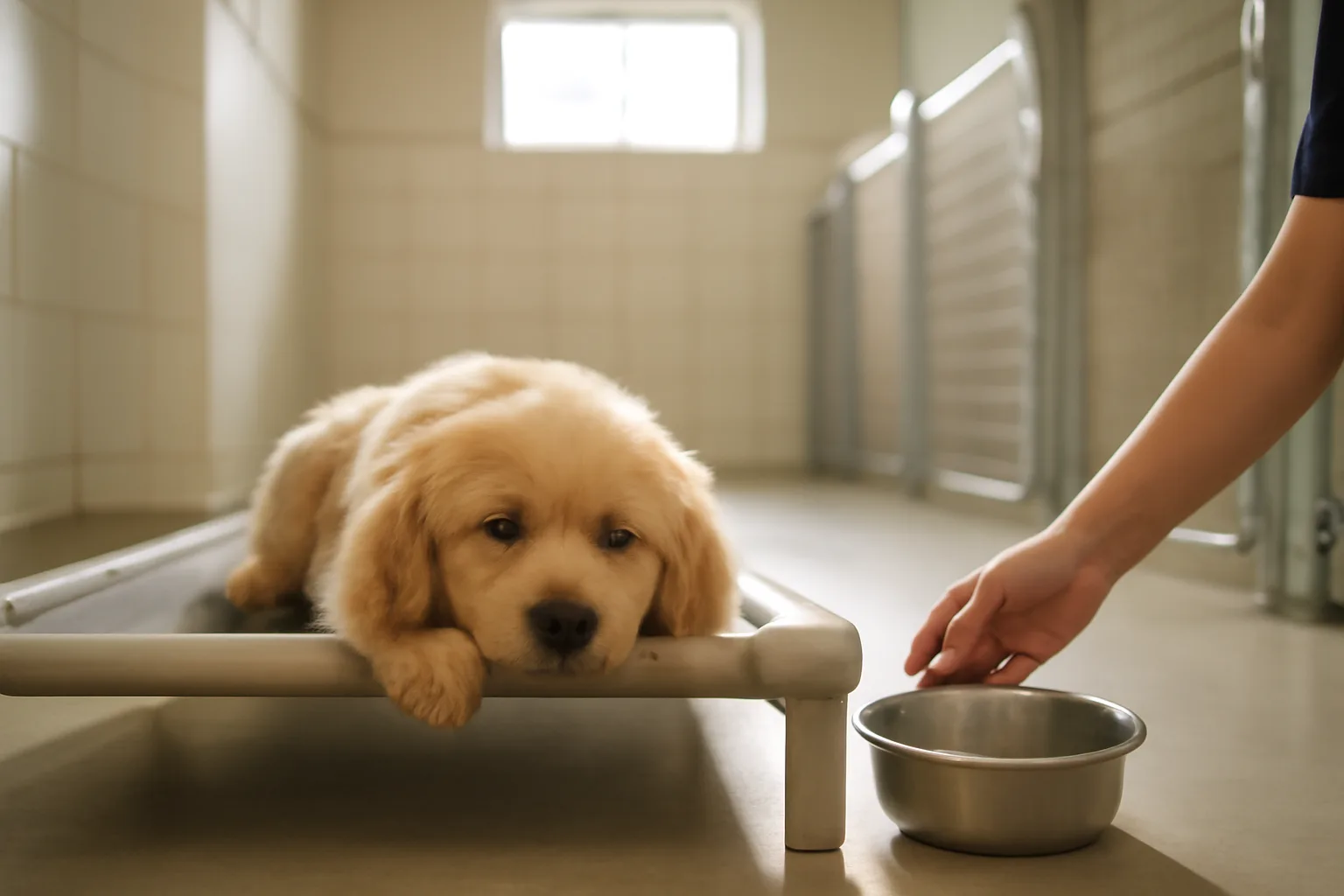
Puppy boarding typically costs $30 to $85 per night, more than adult dog boarding because facilities often require extra vaccines, incomplete-series waivers, or separate play groups. Most reputable kennels won't take puppies under 4 months without a full or near-complete vaccine series. Registration papers (AKC or similar) have nothing to do with boarding eligibility; vaccine records and a vet health check do.
How much does dog boarding cost for a puppy?
| Overnight boarding (puppy) | $30-$85/night | Higher end in major metros |
|---|---|---|
| Daycare only (puppy) | $20-$45/day | Often requires temperament test first |
| Puppy surcharge (add-on) | $5-$15/night | Not universal, varies by facility |
| Overnight boarding (adult dog) | $25-$75/night | Baseline most puppy rates are built from |
Expect to pay somewhere between $30 and $85 a night for puppy boarding, with the low end common in rural areas and the high end typical in cities like San Francisco, Boston, or Chicago. Daycare-only puppy sessions usually run $20 to $45 a day. These are the same rough bands you'll see for adult dog boarding, but puppies often land on the higher side of the range because facilities charge more for the extra supervision, more frequent bathroom breaks, and smaller group sizes puppies need. There's no federal price-setting body for pet boarding, so every number here is market-driven, not regulated. The most-cited industry surveys (from groups like the American Pet Products Association) put average annual boarding/pet-sitting spend per dog owner in the hundreds of dollars per year, but per-night rates vary so much by metro area that a single national average isn't that useful. If you're a facility operator setting rates, call five competitors within 15 miles and price against them directly. That's more reliable than any national number. Some facilities add a puppy surcharge of $5 to $15 per night on top of standard boarding, justified by the extra staff attention young dogs need (accidents, separation anxiety, more frequent potty breaks). Others fold it into a flat "under 6 months" rate. If you operate a facility, decide this before you open, not after your first puppy client complains about a surprise line item. For comparison shopping, see how rates break down at dog boarding and pet boarding facilities generally, since puppy rates are usually a variant of the base adult rate rather than a separate pricing structure. | Service type | Typical price range | Notes |
Why do puppies cost more to board than adult dogs?
Puppies need more hands-on care, and facilities price for that time. A staff member watching six adult dogs can usually watch two or three puppies for the same wage cost, because puppies need more frequent potty breaks, closer supervision during play (bite inhibition is still developing), and separate space from adult dogs during vaccine gaps. Many boarding facilities also carry higher insurance exposure with puppies under 4 months, since that age group is more vulnerable to parvovirus and distemper if their vaccine series isn't finished. Some kennels handle this by refusing puppies until the full series is done (usually complete by 16 weeks per most veterinary vaccine protocols), others accept partial series but isolate those puppies from the general population, which costs the facility more in space and staff time. If you operate a facility, this is where you make a real decision, not a marketing one: will you accept incomplete-series puppies at all? Many operators say no, full stop, and it's a defensible call given how contagious and lethal canine parvovirus is in unvaccinated young dogs. The tradeoff is you lose puppy business until owners finish the series around 14 to 16 weeks.
What vaccines does a puppy need before boarding?
Most boarding kennels require at minimum a DHPP (distemper, hepatitis, parainfluenza, parvovirus) series appropriate for the puppy's age, plus bordetella (kennel cough) vaccine at least 5 to 7 days before arrival, and rabies once the puppy is old enough (usually 12 to 16 weeks depending on state law and vaccine label). Facilities set their own minimum requirements; there's no single national standard. Rabies vaccination timing and requirements are set state by state, not federally, so check your state's specific rule rather than assuming a national rule applies. Some states require rabies vaccination by 12 weeks, others by 16 weeks or 6 months; your state veterinarian's office or state department of agriculture page is the authority here, not a general pet website. Bordetella is the one owners forget most often. It needs lead time, usually a week, to take effect, so a puppy vaccinated the morning of drop-off isn't actually protected yet. If you run a facility, put this in writing in your intake paperwork and enforce it; "kennel cough" outbreaks are the single most common thing that damages a facility's reputation with repeat boarding clients. For facility owners setting policy, check your state's animal health rules through your state department of agriculture, since some states regulate boarding kennel vaccine requirements directly as a condition of the kennel license, more than as a business best practice.
How to register a dog (and does it matter for boarding)?
Registering a dog usually means one of two different things, and people often conflate them: getting a dog license from your city or county (a legal requirement in most jurisdictions), or registering a dog's pedigree with a breed registry like the American Kennel Club (AKC), which is optional and has nothing to do with legal compliance. For boarding purposes, no facility cares whether your dog is AKC-registered. What they care about is proof of current vaccines and, in many counties, proof of a valid dog license, since some municipal codes require dogs over a certain age to be licensed regardless of whether they're being boarded. If your county requires dog licensing (many do, tied to rabies vaccination proof), that's usually handled through your county's animal control or clerk's office, with fees typically in the $10 to $25/year range for altered dogs and higher for unaltered dogs in many jurisdictions, though exact fees vary by county and you should check your local ordinance directly rather than assume a number. If you're asking "how do you register a dog" because you're opening a boarding facility and wondering what you as a business need to register, that's a different and more serious question, covered in the operator section below.
How to get a dog license, step by step
Getting a dog license is a local (usually county or city) process, not a state or federal one, and the steps are close to universal across jurisdictions even though the fee and portal differ: 1. Confirm your dog is currently vaccinated for rabies (proof of rabies vaccination is required in nearly every jurisdiction that issues dog licenses). 2. Find your county or city's animal control, clerk, or treasurer's office page; most now offer online license applications. 3. Submit proof of rabies vaccination, your dog's basic info (breed, age, sex, spay/neuter status), and the fee. 4. Receive a tag; most jurisdictions require it to stay on the dog's collar. 5. Renew annually or per your rabies vaccine's duration (1-year or 3-year vaccines affect renewal timing in many counties). Fees are set locally, so a number here would be a guess if I gave you one nationally. Search "[your county] dog license" and you'll usually land on the correct.gov page directly. This is unrelated to breed registry papers and unrelated to whether your dog can be boarded, though a current rabies tag is often proof enough to satisfy a boarding facility's rabies requirement.
How do you get papers for a dog (AKC registration)?
"Papers" almost always means registration with a breed registry, most commonly the American Kennel Club (AKC), which documents a dog's parentage and breed. This is a private registry process, not a government one, and has zero legal bearing on ownership, licensing, or boarding eligibility. To register a puppy with AKC, the litter itself first needs to be registered by the breeder (both parents already AKC-registered, breeder submits an AKC Litter Application), and then individual puppies get registered to their new owners, often through an AKC Registration Application that comes with the puppy at sale. If you bought a puppy advertised as "AKC registered" but didn't receive registration paperwork, contact AKC directly; they publish guidance on registering a litter and transferring registration to a new owner through their own site. If a puppy's parents aren't registered, or the breeder never registered the litter, you generally cannot get standard AKC papers after the fact; there's no retroactive paper-generating process for a dog whose lineage was never documented at birth. Some owners in that position look into a purebred alternative listing option offered by AKC, which allows an unregistered but apparently purebred dog to compete in companion events (obedience, agility) without full registration, but that route is not equivalent to full registration and doesn't establish pedigree. None of this affects boarding. Vaccine records, not breed papers, are what a kennel checks at intake.
How to become a dog breeder (and when USDA licensing kicks in)
Becoming a dog breeder legally involves state and sometimes federal steps, and the federal line is the one people misunderstand most. The U.S. Department of Agriculture, through APHIS (Animal and Plant Health Inspection Service), requires a federal license under the Animal Welfare Act for breeders who sell dogs sight unseen (meaning the buyer never physically meets the dog or visits the breeding facility before purchase) if they have more than 4 breeding females, per the current regulatory threshold. The actual regulatory text sets out who counts as a "retail pet store" exempt from dealer licensing, and the definition turns on direct, face-to-face sales: under 9 CFR 1.1, a retail pet store is one that sells animals "at retail for pet purposes only" to buyers "in a face-to-face transaction" [1]. If you sell puppies only in person, at your own home or facility, to buyers who see the puppy and the premises before purchase, you likely fall under the traditional retail exemption regardless of how many females you keep, though you should still check your state's separate breeder licensing rules, since states often regulate more strictly than the federal floor. If you sell any puppies sight-unseen (internet sales shipped to a buyer who never visited), and you keep more than 4 breeding females, you almost certainly need a USDA license as a "dealer" under 9 CFR Part 2 [2]. That triggers facility inspections, recordkeeping requirements, and space/care standards under 9 CFR Part 3 covering things like enclosure size, temperature, and veterinary care [3]. Separately from any federal requirement, most states license commercial breeders directly, often at a lower threshold than USDA's, and many counties add zoning rules on top of that (how many dogs you can keep, distance from property lines, whether a kennel is a permitted use in your zone). This stacking of federal, state, and county rules is exactly why breeder licensing is more complicated than boarding licensing; a boarding facility usually deals with state and county rules only, while a breeder crossing sales thresholds adds a federal layer. If you're building out a facility that does both boarding and breeding, or you're not sure which threshold applies to you, a $149 one-time Kennel License & Zoning Packet can walk you through the state, county, and federal pieces you need to check for your specific situation; it's not a substitute for legal advice or a guarantee of approval, but it organizes the checklist so you're not guessing which agency to call first.
What licenses does a puppy boarding facility actually need?
Running a boarding facility, as opposed to breeding, is regulated almost entirely at the state and county level, not federal. USDA/APHIS licensing under the Animal Welfare Act generally applies to breeders, dealers, exhibitors, and research facilities defined and regulated under 9 CFR Parts 1 and 2, not to boarding or daycare operations that don't sell or exhibit animals [1] [2]. That's the single most important distinction for someone opening a puppy boarding business: you're very unlikely to need a federal license just to board dogs, even puppies. What you do need, almost universally: - A state kennel or pet care facility license, if your state regulates boarding businesses (many do, some route it through the state department of agriculture, others through a separate consumer protection or licensing board).
- A county or city business license.
- Zoning approval or a conditional use permit confirming a kennel or boarding facility is an allowed use in your zone; this is often the step that trips up new operators, since a location can meet every building code requirement and still be denied for zoning.
- Local health or fire inspection sign-off in many jurisdictions, especially if you offer overnight boarding with staff present. Every one of these varies by state, county, and sometimes city, so treat any specific fee or form number you read online as a guided fill-in until you verify it on your own state department of agriculture and county zoning office pages. If you're comparing what a full facility buildout looks like against smaller-scale competitors, dog kennels and dog hotels near me cover the range from small home-based operations to larger commercial builds.
Does boarding a puppy require special facility standards?
Some states apply stricter facility standards for young puppies specifically, most commonly around minimum age for boarding, separate housing from adult dogs, and flooring/bedding requirements to prevent injury to very young or small dogs. These rules live in state animal facility codes or state agriculture department regulations, not in a single federal rulebook, since (as covered above) USDA's Animal Welfare Act standards mainly govern breeders and dealers, not boarding kennels. If your state does regulate boarding kennels directly, common requirements include minimum enclosure sizes scaled to dog size, sanitation and cleaning schedules, ventilation and temperature control standards, and staff-to-dog ratios during business hours. A few states borrow language close to USDA's 9 CFR Part 3 standards even for boarding facilities, since it's a well-established framework, but this is a state choice to adopt similar language, not a sign that USDA directly regulates boarding. As a practical matter, even where no state rule specifically addresses puppies, well-run facilities separate puppies under 6 months from the general adult population during play, for both safety (adult dogs can injure puppies during rough play) and disease control (limiting exposure while vaccine series are incomplete). This is standard practice recommended by veterinary behaviorists, not a legal requirement in most states, but insurers and liability lawyers both like to see it documented in your operating procedures.
What should a puppy boarding intake form require?
A solid intake form for puppy boarding should require rabies vaccine status (or an explicit under-age exemption if the puppy is too young per state law), DHPP series status with dates, bordetella vaccine date (with the 5-7 day lead time noted), a note on whether the puppy has finished its full vaccine series or is still mid-series, vet contact info, any known bite history or resource-guarding behavior, feeding schedule and any food allergies, and emergency contact authorization for veterinary treatment if the owner can't be reached. The mid-series question matters most for puppies. A puppy that's had 2 of 3 DHPP shots is not fully protected, and reputable facilities either decline mid-series puppies or isolate them completely from other dogs, including during play groups, until the series is done (typically by 14-16 weeks of age per standard veterinary protocols). Getting your intake paperwork right also protects you legally. If a puppy gets sick during a stay and the owner claims the facility didn't disclose exposure risk, a documented, signed intake form showing the owner acknowledged the puppy's incomplete vaccine status is a real defense. This is exactly the kind of operational document that should be reviewed against your state's specific liability and licensing rules, since some states require specific disclosures in writing as a condition of the kennel license itself.
How do zoning rules affect a puppy boarding or daycare business?
Zoning is usually the step that kills or delays a boarding business plan, more often than the facility license itself. Most residential zones don't permit commercial kennels outright; you'll typically need either a location already zoned commercial/agricultural for that use, or a conditional use permit / variance granted after a public hearing. County zoning offices, not state agencies, control this, and the rules differ wildly even between neighboring counties in the same state. Some counties cap the number of dogs allowed before a use is classified as a "kennel" requiring special permitting (thresholds of 3, 4, or 5 dogs are common triggers in various local codes), others regulate based on noise, setback from property lines, or hours of operation. If you're planning a zoning hearing, go in with a site plan, a noise mitigation plan (indoor-only play areas, sound-dampening, no outdoor runs adjacent to neighboring homes), and letters of support if you can get them from immediate neighbors. Boards weigh perceived neighborhood impact heavily, and "puppies barking all day" is a real objection you should have an answer for before someone raises it. Compare notes on facility setup with operators of established brands like Dogtopia or smaller local doggy day care operations, since the zoning hurdles are usually similar regardless of brand size.
How much does it cost to license and zone a puppy boarding facility?
There's no honest single national number here, because state kennel license fees, county business license fees, and zoning/conditional use permit fees are all set locally and vary widely, sometimes from a few hundred dollars total to well over a thousand once you count application fees, site plan review, and inspection fees. What's consistent is the structure: you're usually paying for (1) a state or county facility/kennel license, (2) a local business license, and (3) a zoning application or conditional use permit fee, and possibly (4) a public hearing notice/advertising fee if your county requires one. Each of these has its own fee schedule on the relevant state department of agriculture or county zoning office website, and that's the only place to get a real number for your specific location. Budget for delay as much as for the fee itself. Zoning hearings can take 60 to 120 days from application to decision in many counties once you account for public notice periods and hearing board schedules, and that's before any appeal if you're denied. If you want a structured way to track which documents each layer (state, county, federal if applicable) requires before you walk into a hearing, the $149 Kennel License & Zoning Packet organizes that checklist; it doesn't file anything for you or represent you before a board, but it saves you from missing a document category that delays your hearing date by a full cycle.
Frequently asked questions
How much does dog boarding cost for a puppy specifically?
Puppy boarding usually costs $30 to $85 a night, similar to or slightly above adult dog boarding rates, with some facilities adding a $5 to $15 puppy surcharge for the extra supervision young dogs need. Rates vary heavily by region; call local facilities directly for accurate pricing in your area.
How to register a dog with my city or county?
Registering (licensing) a dog is done through your county or city's animal control, clerk, or treasurer's office, usually online. You'll need proof of current rabies vaccination and basic dog info, and you'll pay a fee (commonly $10-$25/year for altered dogs, varies by county) in exchange for a license tag.
How do you get a dog papers if the breeder didn't register the litter?
If a breeder never registered the litter with AKC or another registry, there's generally no way to retroactively get full registration papers, since registries require documentation at the litter's birth. Some owners use a purebred alternative listing option instead, which allows event participation without full pedigree registration.
How do you register a dog for AKC papers?
AKC registration starts with the breeder registering the litter (both parents already AKC-registered) via an AKC Litter Application, then individual puppy registrations transfer to new owners, often included at purchase. Contact AKC directly if you bought a puppy advertised as registered but never received the paperwork.
How to become a dog breeder legally?
Check your state's breeder licensing rules first (most states regulate at a lower threshold than federal law), then your county zoning rules for keeping breeding dogs. You only need a federal USDA/APHIS license if you sell puppies sight-unseen and keep more than 4 breeding females; in-person retail sales are generally exempt from federal licensing.
How to get a dog license and what does it require?
Confirm current rabies vaccination, then apply through your county or city animal control/clerk office, typically online. You'll submit vaccine proof and dog details, pay a local fee, and receive a tag. Renewal timing follows your rabies vaccine's duration (1-year or 3-year) and your local code.
How to get papers for my dog if I just want proof of ownership?
If you mean legal proof of ownership rather than breed papers, that's your dog license (from your county) plus your purchase receipt or adoption paperwork, not an AKC registration. Breed registry papers document lineage; they aren't legal ownership documents and aren't required to own a dog.
Can I get papers for a dog with unknown parentage?
No standard breed registry will issue full pedigree papers for a dog with unknown or undocumented parentage, since registration depends on verified lineage recorded at birth. AKC's purebred alternative listing option is the closest thing, letting apparently purebred dogs of unknown registration compete in companion events without full papers.
What vaccines does my puppy need before a boarding stay?
Most facilities require a DHPP series appropriate to age, bordetella at least 5-7 days before drop-off, and rabies once your puppy is old enough per state law (commonly 12-16 weeks). Requirements vary by facility and state, so confirm directly with your kennel and check your state's rabies vaccination law.
Does a puppy boarding facility need a USDA license?
Almost never. USDA/APHIS licensing under the Animal Welfare Act applies to breeders, dealers, and exhibitors as defined in 9 CFR Part 1, not boarding or daycare facilities that don't sell or exhibit animals. Boarding facilities are regulated at the state and county level (kennel licenses, business licenses, zoning), not federally.
At what age can a puppy start boarding or daycare?
Most facilities set a minimum age of 4 months, tied to having a substantially complete core vaccine series, though some accept younger puppies with isolation protocols. There's no single legal minimum age nationally; each facility sets its own policy, often influenced by its state's rabies vaccination age requirement.
Why is puppy boarding sometimes more expensive than adult dog boarding?
Puppies need more staff time (frequent potty breaks, closer play supervision, smaller groups) and sometimes require isolated housing during incomplete vaccine series, both of which cost the facility more per dog. That extra cost often shows up as a per-night surcharge or a higher baseline puppy rate.
Sources
- eCFR, Title 9 Section 1.1 - Definitions (Animal Welfare Act, retail pet store): The Animal Welfare Act defines a retail pet store as one selling animals for retail purposes only in a face-to-face transaction, which underlies the exemption from dealer licensing
- eCFR, Title 9 Part 2 - Regulations (Animal Welfare Act licensing/registration): Dealer licensing requirements and definitions under the Animal Welfare Act, including the retail pet store exemption conditions
- eCFR, Title 9 Part 3 - Standards (Animal Welfare Act facility standards): Federal facility standards for enclosure size, sanitation, and veterinary care that apply to USDA-licensed dog dealers and breeders
- American Kennel Club, Purebred Alternative Listing Program: AKC offers a purebred alternative listing option that allows an unregistered but apparently purebred dog to compete in companion events without full pedigree registration
- American Animal Hospital Association: AAHA vaccination guidelines outline the recommended core vaccine schedule for puppies, relevant to what boarding facilities require before intake.
- U.S. Small Business Administration: Local and state business licensing requirements, including zoning permits, apply to pet boarding and daycare facilities.
- Centers for Disease Control and Prevention: Boarding facilities should follow guidance on preventing disease transmission between boarded animals, including puppies with incomplete vaccinations.