Last updated 2026-07-25
TL;DR
Getting a kennel permit means clearing three separate hurdles: county zoning approval, a state or county kennel license (often $10 to a few hundred dollars depending on dog count), and, if you're breeding and selling across state lines, a USDA APHIS license once you exceed the retail-sale exemption. Order matters: zoning first, then licensing, then USDA registration.
What exactly is a kennel permit?
A kennel permit is the local or state authorization that lets you keep more dogs than an ordinary pet owner, or operate a business involving dogs, on a given property. It's not one single document. Depending on where you live, "kennel permit" might mean a county animal control kennel license, a city zoning conditional use permit, a state kennel/pet dealer license through your department of agriculture, or some combination of all three. Most jurisdictions define a "kennel" by a dog-count threshold. Cross that number (commonly 4, 5, or 6 dogs over a certain age, though this varies a lot by county) and you're legally required to get a kennel license even if you're not running a business at all, just a household with a lot of dogs. Run a boarding facility, daycare, or breeding operation and you almost always need a kennel permit regardless of headcount, because you're operating commercially. The permit itself usually covers things like facility sanitation, dog-to-space ratios, noise mitigation, waste disposal, and proof of rabies vaccination for every dog on site. Some states fold kennel licensing into a broader "animal facility" or "pet dealer" license structure. Others leave it almost entirely to counties, which means the rules two towns apart can be wildly different. If you're planning to open a dog boarding or doggy day care facility, treat the kennel permit as step one of a longer process, not the whole process.
How do I actually get a kennel permit, step by step?
The order you tackle this in matters more than people expect. Doing zoning last is the single most common (and expensive) mistake. 1. Confirm zoning first. Call your county or city planning/zoning office before you sign a lease or make an offer on property. Ask directly: "Is a commercial kennel or animal boarding facility a permitted use, a conditional use, or prohibited in this zone?" Get the answer in writing if you can. 2. Check the state layer. Look up your state department of agriculture's animal welfare or consumer protection division. Some states (Pennsylvania is the clearest example) run a full state kennel licensing program with defined classes and fees [1]. Others have no statewide kennel law at all and leave it to counties. 3. Apply for the county or city animal license. This is usually the actual "kennel permit" document, issued by animal control or the county clerk. Expect to submit a site plan, proof of rabies vaccination for resident dogs, and sometimes a facility inspection before approval. 4. Schedule your facility inspection. Most jurisdictions require an on-site check of runs, fencing, drainage, and sanitation before they'll issue anything. Build 2 to 6 weeks of lead time into your plan for this. 5. Register with USDA APHIS if it applies. If you're breeding dogs for sale and dealing with buyers sight unseen, or selling wholesale, you may need a federal license (details below). 6. Renew on schedule. Kennel permits are almost always annual. Missing a renewal date can lapse your legal status to operate, more than trigger a late fee. If you want a structured way to pull county and state requirements together into one document before you walk into a hearing, that's the specific gap the $149 Kennel License & Zoning Packet is built to fill. It doesn't file anything for you or represent you before a board; it organizes what you need to bring.
How much does dog boarding cost (and does that affect my permit)?
For pet owners, boarding typically runs $25 to $85 per night for a standard kennel or daycare-style stay, with upscale "dog hotel" suites running $50 to over $100 a night in larger metro markets. Prices vary heavily by region, dog size, and whether the facility offers webcams, private suites, or added playtime. There's no federal or state dataset that tracks average boarding prices nationally; these ranges come from aggregated market pricing across major providers and local listings, not a government source, so treat any specific number as a rough guide rather than a citation-grade fact. For operators, your permit doesn't set your prices, but it does set your capacity, and capacity drives revenue. County kennel licenses commonly cap the number of dogs allowed on-site based on square footage, run size, or zoning conditions. If your permit caps you at 20 dogs and average nightly boarding runs $50, that's a hard ceiling of $1,000 a day in boarding revenue before daycare or grooming add-ons. Knowing your permitted capacity before you sign a commercial lease saves you from building out space you're not allowed to fully use. If you're comparing pet boarding models against a franchise approach like Dogtopia, remember that franchise-provided build specs still have to clear your local zoning and kennel licensing independently. A franchise brand doesn't pre-clear your county.
How do I register a dog (and is that the same as a kennel permit)?
No, registering a dog and getting a kennel permit are two different things. Registering a dog usually means getting a dog license from your city or county, which is an individual pet requirement tied to rabies vaccination, not a business or multi-dog authorization. A kennel permit is what you need when you're housing multiple dogs commercially or exceed your local household dog-count limit. You can hold both: every dog at your boarding facility should be individually licensed by its owner (or by you, if you own breeding stock), and your facility itself needs the separate kennel or business license. If you're opening a facility, ask new clients for proof of current dog license and rabies vaccination at intake. Many county kennel license conditions actually require you to verify this for every dog you board, so it's more than good practice, it can be a licensing condition you're already bound to.
How do I get a dog license, step by step?
Getting a dog license is usually a same-day or same-week process, much faster than a kennel permit. Here's the typical path: 1. Get proof of current rabies vaccination from your veterinarian. Nearly every county requires this before issuing a license. 2. Contact your county clerk, treasurer's office, or animal control department. In many states, dog licensing is handled at the county level under state statute (New York's Agriculture and Markets Law Article 7 is a good example of a state framework that pushes licensing down to municipalities) [2]. 3. Pay the fee. Dog license fees are typically modest, often in the $10 to $25 range annually, though this varies by county and by whether the dog is spayed/neutered (many counties charge less for altered dogs). 4. Attach the tag. Most jurisdictions require the tag on the collar at all times, and some make this legally enforceable with fines for non-compliance. 5. Renew annually or per your county's cycle, some counties issue multi-year licenses tied to rabies vaccine duration. This is a per-dog owner obligation. It doesn't authorize a kennel, breeding operation, or boarding business by itself.
How do you get papers for a dog, and what does that actually mean?
"Papers" almost always means registration with a breed registry like the American Kennel Club (AKC), not a government document. This confuses a lot of new breeders and buyers because it sounds official, but it's a private organization's paperwork, not a state or federal permit. To register a litter with the AKC, both parents generally need to already be AKC-registered, the breeder submits a litter application with the sire and dam's registration numbers, and puppies receive individual registration certificates once processed. If you bought a dog without papers and want to register it retroactively, the AKC has limited pathways (like Purebred Alternative Listing/Indefinite Listing Privilege for spay/neuter purposes) but full pedigree registration generally isn't possible without documented lineage. If a breeder tells you they can "get you papers" for a mixed-breed or undocumented dog, be skeptical. Breed registry papers reflect lineage, and that can't be manufactured after the fact through a state or federal office. This is separate from your state kennel license and separate from USDA registration; none of those agencies issue "papers" in the pedigree sense.
How do I become a dog breeder legally?
Becoming a legal dog breeder means clearing three layers most new breeders don't expect: local zoning, state kennel/breeder law, and potentially federal USDA licensing. Start with zoning, same as boarding operators. Many residential zones restrict how many intact females or breeding pairs you can keep before you trip into "kennel" or "commercial breeding" classification, which can require a conditional use permit or rezoning. Next, check your state's specific breeder statute. Several states have dedicated commercial breeder laws with numeric thresholds. Ohio, for example, defines a "high volume breeder" as anyone with 9 or more intact female dogs who sells 60 or more puppies in a year, and requires a state license through the Ohio Department of Agriculture for anyone meeting that definition [3]. Third, check federal USDA APHIS requirements (details in the next section). This is the layer most hobby breeders miss, and it's the one with real federal penalties attached. Finally, join or at least review your breed's registry requirements (AKC or otherwise) if you intend to register litters. That's a private-organization layer, separate from any government permit. If you're building out kennel infrastructure for breeding, the same dog kennels facility-standard rules that apply to boarding operators (fencing, drainage, sanitation, dog-to-space ratios) usually apply to your whelping and housing areas too, since most county kennel definitions don't distinguish by purpose.
When do I need a USDA license as a breeder?
You need a USDA APHIS license once you're a "dealer" under the Animal Welfare Act, which generally means you sell puppies wholesale, sell to pet stores, or sell dogs sight unseen (online, over the phone, through classified ads) without the buyer physically meeting the animal or seeing the parent before purchase. The underlying regulation, 9 CFR 2.1, requires "dealers" as defined under the Act to hold a license, and 9 CFR 1.1 defines a retail pet store exemption tied to face-to-face sales; APHIS has explained in public guidance that a breeder who sells any dog sight unseen, meaning the buyer never physically views the animal before purchase, falls outside that retail exemption and needs a license regardless of how few dogs they keep [4]. Historically, APHIS also applied a bright-line marker of more than 4 breeding females as a common threshold where the retail exemption stops applying for in-person sellers, though the sight-unseen trigger is the one that catches most small operators by surprise. So the two triggers that most commonly pull a small breeder into USDA licensing are: (1) more than 4 breeding females, combined with wholesale or sight-unseen sales, or (2) selling to a broker, pet store, or research facility regardless of scale. A hobby breeder with 2 breeding females who only sells locally and lets buyers meet the puppies in person typically stays under the retail exemption and doesn't need a USDA license. If you do need one, APHIS licensing involves an application, a facility inspection to the Animal Welfare Act standards in 9 CFR Part 3, and an annual license fee that's tiered by the dollar volume of animals sold [5]. Inspections are unannounced and recurring, not one-time. Get this wrong and the penalties aren't trivial. The Animal Welfare Act (7 U.S.C. § 2149) authorizes civil penalties of up to $10,000 per violation (adjusted periodically for inflation under federal penalty adjustment rules), plus license suspension or revocation [6].
What does a kennel facility inspection actually check?
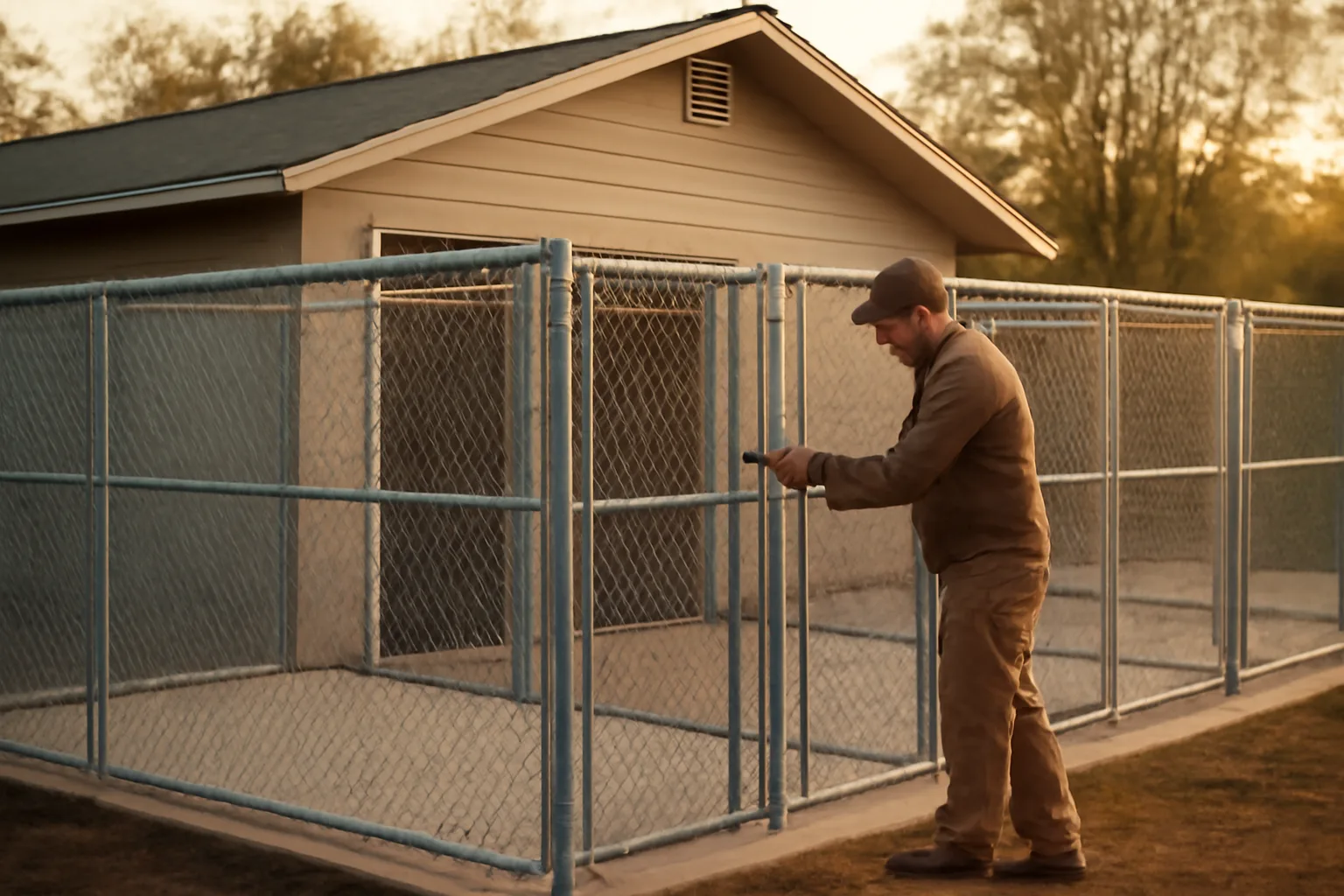
Whether it's a county inspector for your kennel license or a USDA APHIS inspector for your breeder license, facility inspections generally check the same core categories: enclosure size and construction, sanitation and waste removal, ventilation and temperature control, water and food access, veterinary care records, and staffing adequate to the number of animals on site. Under federal Animal Welfare Act standards (9 CFR Part 3, Subpart A), housing facilities for dogs must provide, among other things, primary enclosures that give each dog enough space to turn around freely, stand, sit, and lie in a normal position, with specific minimum space calculations tied to the dog's length [7]. State and county kennel codes often mirror these federal minimums even when USDA isn't involved, because they're a reasonable and defensible baseline. Prepare for both a paperwork review and a walk-through. Inspectors typically want to see vaccination records, a written sanitation schedule, pest control documentation, and an emergency/disaster plan. Facilities that fail inspections most often get flagged for enclosure size violations, inadequate record-keeping, and sanitation gaps, not exotic or rare violations. If you're still in the planning phase, read up on general facility-standards expectations before you finalize a floor plan. Retrofitting a building after a failed inspection costs a lot more than designing to code the first time.
How much does a kennel permit itself cost?
There's no single national fee because kennel permits are issued at the state or county level, and every jurisdiction sets its own schedule. What we can say honestly: fees tend to scale with the number of dogs housed, and states that run tiered kennel license systems typically post specific fee schedules on their department of agriculture websites. Pennsylvania's kennel license program is a useful public example of how tiering works: the state issues kennel classes based on the number of dogs kept or sold in a year, with license classes ranging from small kennels up through Class R (200+ dogs), and each class carries its own statutory fee posted by the PA Department of Agriculture [1]. Other states and most counties run much simpler flat-fee systems, sometimes under $100 total for a basic kennel license, plus separate inspection or zoning fees. Budget for more than just the license line item. A realistic kennel permit budget usually includes: the license fee itself, a zoning application or conditional use permit fee (often $200 to $2,000+ depending on your county and whether a public hearing is required), inspection fees, and any required site improvements (fencing, sound barriers, drainage) an inspector flags before sign-off. Because fees and thresholds genuinely differ county to county and state to state, don't rely on a single number you saw online, including in this article, without confirming it against your specific state department of agriculture and county zoning office pages.
How do I prepare for a zoning hearing for my kennel or boarding facility?
Most kennel and boarding facility denials happen at the zoning stage, not the licensing stage, so this deserves real prep time. Zoning boards typically want to see a site plan, a noise mitigation plan, a parking and traffic plan, and evidence you've talked to neighbors before the hearing, not after a complaint. Bring documentation, more than intentions. Boards respond better to "here's our sound-dampening fence spec and our staff-to-dog ratio" than to "we'll be responsible operators." If your county requires a conditional use permit (most do for commercial kennels in anything but agricultural or industrial zones), expect a public comment period where neighbors can object, sometimes the single biggest variable in whether you get approved. Check your specific county zoning office's published requirements before the hearing; requirements for setback distances, maximum dog counts, and hours of operation vary enormously county to county and there's no way to generalize them responsibly here. This is also where a lot of first-time applicants get overwhelmed, because they're compiling zoning documents, state kennel license applications, and USDA paperwork all at once with no single checklist. That's the specific problem the $149 Kennel License & Zoning Packet is designed to solve: it helps you organize the county zoning packet and state license documentation you need before a hearing or application, though it's not legal advice and doesn't represent you before any board. For facility layout ideas once you're through zoning, dog hotels near me style competitive research can help you benchmark what similar approved facilities in your market actually built.
Frequently asked questions
How much does dog boarding cost?
Typical dog boarding runs $25 to $85 per night depending on region, dog size, and amenities, with upscale suite-style boarding sometimes exceeding $100 a night in major metros. There's no federal pricing dataset for this; figures come from aggregated market listings, not a government source, so treat them as a general range.
How do I register a dog?
Contact your city or county clerk, treasurer, or animal control office, and bring proof of current rabies vaccination from your vet. You'll pay a small annual fee (often $10 to $25, less for spayed/neutered dogs in many counties) and receive a license tag that must stay on the dog's collar.
How much is dog boarding, on average?
Most standard kennel or daycare-style boarding costs $25 to $85 per night in the U.S., with pricing driven by region, dog size, and add-on services like grooming or extra playtime. Luxury "dog hotel" suites can run over $100 a night. No government agency tracks a national average, so this is a market estimate, not a cited statistic.
How do you get a dog papers?
"Papers" means registration with a breed registry like the AKC, not a government document. Both parent dogs generally need existing AKC registration, and the breeder files a litter application with the sire's and dam's registration numbers to get individual puppy certificates. There's no state or federal office that issues pedigree papers.
How do you register a dog with a breed registry versus with the government?
Government registration means a local dog license tied to rabies vaccination, handled by your city or county. Breed registry registration (AKC or similar) is a private process tracking lineage, requiring registered parents and a litter application. They're unrelated systems and neither substitutes for the other.
How do I become a dog breeder legally?
Confirm your property's zoning allows breeding at your intended scale, check your state's breeder or kennel license law (some states set numeric thresholds like Ohio's 9-female, 60-puppy "high volume breeder" definition), and determine if you cross the USDA APHIS dealer threshold. Most hobby breeders selling face-to-face locally avoid the federal layer.
How do I get a dog license?
Bring proof of current rabies vaccination to your county clerk, treasurer's office, or animal control department, fill out the license application, and pay the fee (commonly $10 to $25 a year, varying by county and spay/neuter status). Renew annually or per your county's cycle and keep the tag on the collar.
How do I get papers for a dog I already own?
If the dog's parents weren't AKC-registered, full pedigree registration usually isn't possible after the fact. The AKC does offer limited pathways like Purebred Alternative Listing for unregistered purebreds meeting specific criteria, mainly for enrolling in AKC events, but it doesn't create pedigree history that doesn't exist.
How can I get papers for my dog if I don't know the breeder?
Without documented parentage, you generally can't get full pedigree registration. Some registries offer limited enrollment programs for apparently purebred dogs of unknown origin, intended for participation in certain events rather than full pedigree status. A DNA breed test can identify likely ancestry but doesn't substitute for registry papers.
Do I need a kennel permit just to keep several dogs at home?
Possibly, yes. Many counties define a "kennel" by dog count alone (often 4 to 6 dogs over a certain age), triggering a license requirement even for non-commercial households. Check your specific county's animal control ordinance since thresholds and exemptions vary significantly.
What's the difference between a kennel license and a USDA license?
A kennel license is state or county-level and covers most boarding, daycare, and small breeding operations. A USDA APHIS license is federal and only applies if you're a "dealer" under the Animal Welfare Act, generally meaning wholesale sales, sight-unseen sales, or more than 4 breeding females combined with those sale types.
How long does it take to get a kennel permit approved?
Timelines vary widely. A straightforward county kennel license with no zoning hearing might take 2 to 6 weeks. Add a conditional use zoning permit requiring a public hearing, and the process can stretch 2 to 6 months depending on your county's hearing calendar and whether neighbors contest the application.
Can I lose my kennel permit after I get it?
Yes. Kennel permits are typically annual and conditioned on passing recurring inspections and staying under your licensed dog-count cap. Sanitation violations, noise complaints that trigger zoning re-review, or lapsed rabies documentation on resident dogs are common reasons counties suspend or revoke kennel licenses.
Sources
- Pennsylvania Department of Agriculture, Dog Law kennel licensing: Pennsylvania issues tiered kennel license classes with fees based on the number of dogs kept or sold annually
- New York State Senate, Agriculture and Markets Law Article 7: State agriculture law establishes the dog licensing framework that counties and municipalities administer
- Ohio Revised Code 956.01, Dog Breeding Definitions: Ohio defines a high volume breeder as anyone with 9 or more intact female dogs who sells 60 or more puppies annually, requiring state licensing
- Electronic Code of Federal Regulations, 9 CFR 2.1, Requirement to obtain a license: Breeders selling wholesale or sight-unseen, or falling outside the retail pet store exemption, are considered dealers requiring a USDA license
- Electronic Code of Federal Regulations, 9 CFR 2.6, License fees: USDA APHIS licensing includes an application, facility inspection, and annual fee tiered by animal sales volume
- Cornell Legal Information Institute, 7 U.S.C. § 2149: The Animal Welfare Act authorizes civil penalties of up to $10,000 per violation and license suspension or revocation
- Electronic Code of Federal Regulations, 9 CFR Part 3 Subpart A: Federal Animal Welfare Act standards specify minimum primary enclosure space requirements for dogs based on their length