Last updated 2026-07-25
TL;DR
Dogtopia Viera is a franchised dog daycare and boarding location in Viera, Florida, with daycare and boarding typically priced in the $35-$45/day range depending on the market. This article uses it as a case study to explain how boarding costs work nationally, how facilities get licensed and zoned, and what breeders and boarders need to know about state and USDA rules.
What is Dogtopia Viera and how does it fit the Dogtopia model
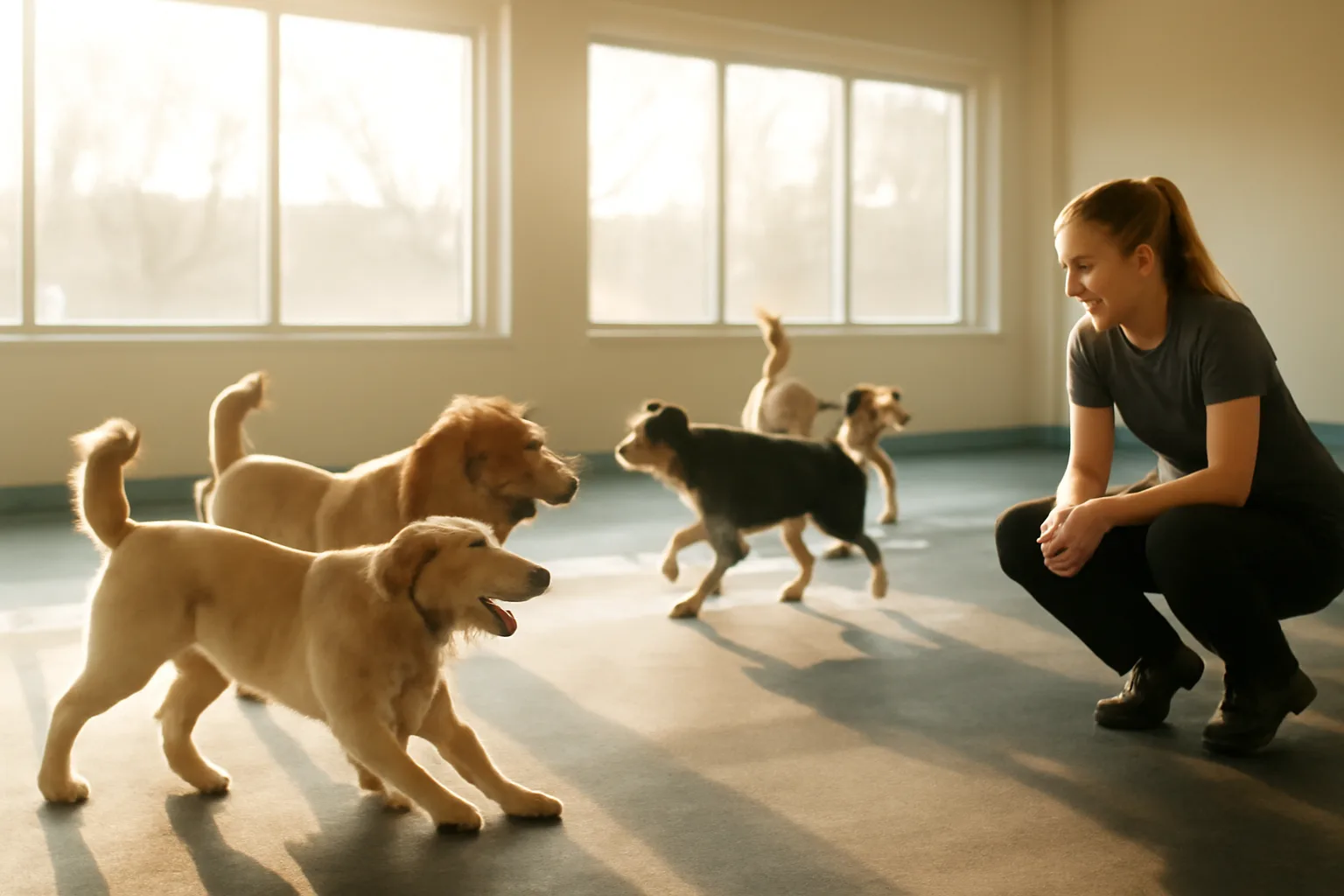
Dogtopia is a national franchise chain that runs dog daycare, boarding, and spa services out of freestanding commercial buildings, usually 8,000 to 15,000 square feet with open-play rooms, webcams, and a retail front counter. Viera, Florida (part of unincorporated Brevard County, near Melbourne) has a Dogtopia location operating under this same franchise playbook: open-play daycare during the day, boarding overnight, and add-on services like nail trims and baths. If you're researching "Dogtopia Viera" because you're comparing boarding options for your own dog, the practical answer is: call the specific location for current daily rates, package pricing, and vaccine requirements, because franchise locations set their own prices within brand guidelines and rates change. If you're researching it because you're thinking about opening a similar facility, either as a Dogtopia franchisee or an independent competitor, the more useful exercise is understanding what it actually takes to stand up a facility like this: the licensing, the zoning, the build-out costs, and the ongoing compliance work that a franchise's corporate support team normally handles for you but that an independent operator has to do alone. This article does both. It answers the consumer-facing cost questions first, then walks through the operator-side licensing and registration questions that come up constantly for anyone opening a dog boarding or doggy day care business, plus the breeder registration questions that get lumped into the same search traffic.
How much does dog boarding cost
| Basic kennel/run boarding | $25-$40 | Shared space, minimal supervision, older-style kennel | |
|---|---|---|---|
| Franchise daycare-boarding (Dogtopia-style) | $40-$65 | Open play, webcams, staff ratios, climate control | |
| In-home/pet-sitter boarding | $35-$75 | One-on-one, no kennel overhead, travel time | |
| Luxury suite boarding | $60-$120+ | Private rooms, TV, raised bedding, premium add-ons | If you're pricing out your own facility, the honest planning number is: don't anchor to the cheapest kennel in your county or the priciest boutique in a coastal city. Pull three to five comps within a 15-mile radius, factor in your build-out quality, and price accordingly. |
Boarding rates vary heavily by region, facility type, and whether the dog needs a private suite versus a shared kennel run. National surveys and franchise pricing pages put standard overnight boarding somewhere between $25 and $85 per night for a single dog, with upscale "suite" boarding at chains like Dogtopia, Camp Bow Wow, or independent luxury kennels running $50 to $100+ per night in higher cost-of-living metros. Daycare (no overnight stay) tends to run cheaper, typically $20 to $45 per day, and most chains sell discounted multi-day packages (10-day, 20-day punch cards) that knock 10-20% off the per-day rate. In Florida specifically, including the Viera/Brevard County market, daycare and boarding pricing generally sits in the middle of the national range, roughly $30-$45/day for daycare and $40-$65/night for boarding at franchise locations, though this is directional and any specific Dogtopia location's current rate sheet is the only real source of truth. Here's a rough comparison of what boarding actually costs across format types, based on typical market ranges rather than any single company's rate card: | Boarding type | Typical nightly rate | What drives the price |
How do you register a dog (state and local dog licensing)
Registering a dog usually means getting a county or city dog license, which is separate from any kennel or business license. Most counties require dog owners to license dogs once they're a certain age (commonly 4-6 months) and require proof of current rabies vaccination to do it. The general process: take your dog's rabies certificate to the county animal services office or an approved vet clinic, pay the licensing fee (commonly $10-$30/year for spayed/neutered dogs, sometimes double or triple that for intact dogs as a financial nudge toward sterilization), and you get a tag to put on the collar. Many counties now let you register online or by mail. Brevard County, where Viera sits, runs its licensing through Brevard County Animal Services, and requirements (fees, rabies proof, tag renewal cycles) are set at the county level, so always check the specific county page rather than assuming a statewide rule [1]. This dog license is a consumer-side requirement and has nothing to do with a commercial kennel license. If you're opening a boarding or daycare facility, you'll need a separate commercial/kennel license from the county or city, on top of any state-level requirements, and that's a different application with different fees, inspections, and standards.
How to get a dog license step by step
Getting a dog license is usually a five-step process, though the exact order and portal (online vs. in-person) depends on your county: 1. Get your dog's rabies vaccination current, from a licensed vet, and get the certificate. 2. Find your county or city's animal services/animal control licensing page (search "[county name] animal services dog license"). 3. Fill out the license application, usually needing the dog's name, breed, age, and your address. 4. Pay the fee. Expect a lower fee for spayed/neutered dogs and a higher one for intact dogs in most jurisdictions that use this two-tier structure. 5. Receive the tag and attach it to the collar; renew annually or per your county's cycle (some do multi-year licenses tied to rabies vaccine duration). Some counties fold this into the same visit as your rabies shot at a vet clinic that's an approved licensing agent. Others require a separate trip to the animal control office. If you've moved counties or states recently, don't assume your old license transfers. It doesn't. Register fresh in your new jurisdiction.
How do you get papers for a dog, and what does 'papers' actually mean
"Papers" almost always means AKC (American Kennel Club) registration papers, which document a dog's parentage and breed lineage, not a license or legal ownership document. A lot of confusion comes from people mixing up three totally different things: AKC registration papers, a state/county dog license, and a USDA breeder license. They serve different purposes and none of them substitutes for another. To register a dog with the AKC, the litter has to come from two AKC-registered parents, and the breeder typically completes an AKC Litter Registration Application after the puppies are born, which then lets each individual puppy get registered under an "AKC Registration Application" (often called a "blue slip" historically, now usually a digital or paper form the breeder hands over at sale) [2]. If you bought a puppy and the breeder never registered the litter, you generally cannot get retroactive "papers" without the breeder's cooperation, since registration ties back to verified parentage on the breeder's end. If you already own a mixed-breed dog or a purebred whose parents weren't registered, you cannot get AKC papers after the fact just by filling out a form. There's no process to manufacture pedigree papers for a dog whose lineage wasn't documented at breeding time. Some owners confuse this with getting a dog "registered" in the sense of a license (see the section above) or with alternative registries (like the American Canine Association or continental kennel clubs) that have looser standards than AKC, but these carry far less weight for show, breeding, or resale purposes.
How to become a dog breeder (state rules and USDA thresholds)
Becoming a dog breeder legally means dealing with three separate layers: state/local breeder licensing (varies widely), and federal USDA licensing once you cross certain sales thresholds. There's no single "become a breeder" license; it's a patchwork. At the federal level, the USDA's Animal Welfare Act requires a license from APHIS (Animal and Plant Health Inspection Service) if you breed dogs for wholesale and sell to pet stores, brokers, or research facilities, or if you sell more than a certain number of dogs directly to the public sight-unseen (i.e., without the buyer physically seeing the animal or the facility before purchase or transport). Specifically, APHIS requires a license for anyone who sells or negotiates the sale of animals for use as pets and generates more than $500 in gross income from those sales in a calendar year while breeding for wholesale, though most hobby breeders selling retail, face-to-face, from their own home fall under the "retail pet store" exemption in the regulations and don't need a federal license [3]. The exact retail exemption language is technical: it hinges on whether sales happen face-to-face at the time of transfer, so a breeder who ships puppies sight-unseen across state lines is far more likely to trigger licensing than one who sells locally with in-person pickup. At the state level, many states require a separate commercial breeder license once you keep a certain number of intact females or produce a certain number of litters per year. These thresholds differ enormously. As one example, some states set the bar around 5-10 intact female dogs used for breeding as the point where a commercial kennel/breeder license kicks in, but you have to check your specific state department of agriculture page, because thresholds, fees, and inspection requirements are not standardized nationally [4]. County and city zoning is the third layer, and it's the one people forget until they're already in trouble. Even if you're under every state and federal threshold, your county zoning code may cap how many dogs you can keep on residential-zoned property, or may require a conditional use permit / special exception for any commercial breeding operation, regardless of dog count. This is why breeders scaling past a hobby level need to check county zoning before assuming state or federal exemption means they're in the clear.
How do USDA thresholds actually work for boarding, daycare, and breeding operators
The USDA/APHIS licensing structure under the Animal Welfare Act (7 U.S.C. 2131 et seq.) was built primarily around breeding, wholesale, exhibition, and research animals, not standard retail dog boarding or daycare, which generally fall outside APHIS licensing entirely because they don't involve the sale or wholesale distribution of animals . If you're opening a pure boarding/daycare facility like a Dogtopia-style location, USDA/APHIS licensing typically isn't the relevant federal layer for you; your compliance work is almost entirely state and county (business license, kennel license, health department for any on-site retail food/treats, fire and building code for the physical space). Where APHIS becomes relevant to boarding/daycare operators is if the same facility also breeds and sells dogs on the side, which does happen at some larger kennel operations. In that case, the breeding side of the business needs to be evaluated against the federal thresholds separately from the boarding side. For breeders specifically, APHIS defines a "dealer" as someone who sells animals for research, exhibition, or use as pets to wholesalers, brokers, or retailers, or who sells to the public without face-to-face transactions, and dealers generally must be licensed . The USDA's own guidance states plainly: "If you are a breeder of dogs and you sell any dogs at wholesale (to another person or business that resells the animals) you must be licensed under the AWA" and separately, breeders who sell puppies over the internet or by phone without the buyer meeting the animal in person before sale generally need a license too, since that channel doesn't qualify for the face-to-face retail exemption .
How much does it cost to open a dog daycare or boarding facility like Dogtopia
Franchise disclosure documents for daycare/boarding chains give the most reliable real-world cost ranges available, since these are legally required disclosures rather than marketing estimates. Dogtopia's own Franchise Disclosure Document has listed total initial investment ranges in the rough neighborhood of $700,000 to $1.4 million depending on market and build-out size, though FDD figures update yearly and any specific number should be pulled from the current-year FDD rather than assumed from older reporting . That figure includes the franchise fee, leasehold improvements, equipment, initial inventory, and working capital. Independent operators building a comparable facility from scratch (not via franchise) commonly land in a wide range too, often $250,000 to $750,000+ depending on whether you're leasing and renovating an existing commercial shell versus building new, plus region-specific construction costs. The build-out is usually the biggest line item: fencing, drainage, HVAC sized for animal odor and humidity control, non-slip flooring, and fire-rated separation walls between kennel/play areas and any public space all add up fast. On top of construction, budget for: state/local business license fees (commonly $50-$500 depending on jurisdiction), a commercial kennel license if your city/county requires one separately from a general business license (fees vary widely, often $100-$1,000+ annually), zoning review or conditional use permit fees if the property isn't already zoned for kennel/animal boarding use (these can run into the thousands once you add engineering or traffic studies some counties require), and liability insurance, which for a boarding/daycare facility commonly runs several thousand dollars a year depending on capacity and claims history.
What zoning and facility standards apply to a Dogtopia-style location
Zoning is almost always the first wall independent operators hit, because "kennel" or "animal boarding" uses are frequently restricted to commercial or industrial zones, sometimes requiring a conditional use permit even in commercially zoned areas, due to noise and odor concerns from neighbors. Franchise operators like Dogtopia deal with this too; corporate real estate teams typically pre-screen sites for zoning compatibility before signing a lease, which is exactly the kind of due diligence an independent operator has to do themselves or pay a consultant for. Common zoning triggers include: noise ordinances (outdoor play yards near residential property lines are a frequent objection at zoning hearings), setback requirements from property lines, parking minimums tied to square footage, and sometimes a hard cap on total number of animals on-site regardless of square footage. If your county requires a public hearing for a conditional use permit, expect to need a site plan, sometimes a noise/odor mitigation plan, and possibly a traffic study, and expect neighbors to show up and object, especially in areas with existing single-family housing nearby, which is common for suburban markets like Viera. Facility standards, separate from zoning, cover things like minimum square footage per dog, sanitation and disinfection protocols, ventilation rates, and staff-to-dog supervision ratios during open play. These standards come from a mix of state agriculture department rules (if your state licenses commercial kennels) and local health/building codes. There's no single federal facility standard for boarding/daycare the way there is for USDA-licensed breeders, so this is genuinely state-by-state and sometimes city-by-city territory; the dog kennels licensing landscape reflects that patchwork directly.
What's the difference between Dogtopia, other franchise chains, and independent facilities
If you're comparing Dogtopia to competitors like Camp Bow Wow, Woof's Playhouse, or a locally-owned facility, the practical differences that matter for pricing and operations are: franchise fee structure and corporate support (Dogtopia and similar chains charge ongoing royalties, typically a percentage of gross revenue, in exchange for brand recognition, a proven build-out template, and marketing support), staffing model (open-play daycare chains generally run higher staff-to-dog ratios during play sessions than old-style kennel-run boarding), and camera/technology add-ons (webcam access for owners has become close to standard at franchise daycare chains and is now a competitive baseline rather than a premium feature). For a consumer picking between a Dogtopia location and an independent competitor, the deciding factors are usually consistency (franchise locations follow standardized protocols across locations, which matters if you travel and board your dog in different cities) versus price (independents can sometimes undercut franchise pricing since they're not paying royalties, though not always, since real estate and labor costs often matter more than royalty overhead). For an operator deciding whether to franchise or go independent, the honest tradeoff is: franchising buys you a tested playbook, help clearing some of the zoning and build-out unknowns, and brand recognition from day one, at the cost of an ongoing royalty (commonly in the mid-single-digit percentage of gross revenue for daycare/boarding franchises) plus the upfront franchise fee. Going independent means you keep 100% of revenue but you're solving every zoning, licensing, and operational problem yourself, often for the first time.
How do you actually get licensed and zoned for a boarding/daycare facility
Getting a boarding or daycare facility licensed and zoned correctly is a sequencing problem more than a paperwork problem. Do it in the wrong order and you'll sign a lease on a property that zoning will never approve, or you'll build out a space before your kennel license inspection tells you the flooring or drainage fails standards. A workable order looks like this: confirm zoning first (call or email the county zoning office and ask directly whether "animal boarding" or "kennel" use is permitted by-right or requires a conditional use permit on the specific parcel), then apply for your state/local business license and any state commercial kennel license if your state requires one, then schedule your pre-occupancy facility inspection (health department, fire marshal, and animal control/agriculture department depending on jurisdiction), then open. Skipping the zoning confirmation step is the single most common expensive mistake independent operators make, because a signed commercial lease doesn't override a zoning denial. This is genuinely where a structured packet helps, since pulling together zoning confirmation, state licensing requirements, and inspection checklists across three or four different government offices (county zoning, state department of agriculture, state business licensing, sometimes a separate animal control agency) is exactly the kind of task that eats weeks if you're doing it cold. A $149 one-time Kennel License & Zoning Packet exists for operators who want a structured starting point for gathering these requirements before they call the county; you can start that process at pet boarding or directly through the license-packet-builder. None of this replaces actually talking to your specific county zoning office and state agriculture department, and it's not legal advice or representation before any board; it's a way to walk into those calls knowing what to ask.
What should you check before opening near Viera, Florida or any Brevard County location
Brevard County, home to Viera, handles animal licensing through Brevard County Animal Services, and commercial kennel/boarding facility zoning falls under the county's zoning and planning department, separate from the animal services licensing function [1]. If you're considering opening a boarding or daycare facility anywhere in Brevard County, including Viera, Rockledge, Melbourne, or unincorporated areas, the zoning question and the animal licensing question go to two different county offices, and you need answers from both before signing a lease. Florida doesn't run a single statewide commercial kennel license the way some states do; oversight tends to be split between county animal control ordinances and, for anything touching retail pet sales or breeding, Florida's Department of Agriculture and Consumer Services (FDACS), which regulates pet dealers and breeders under Florida's pet dealer statute . If your Viera-area facility plans to do boarding and daycare only, with no dog sales or breeding on-site, FDACS pet dealer rules generally won't apply to you; that's a state licensing branch specific to sellers and breeders, not boarding operators. The practical move for anyone eyeing this market: call Brevard County's zoning office directly, ask whether the specific parcel you're considering is zoned for kennel or animal boarding use (by-right or conditional), then separately confirm with Brevard County Animal Services what commercial licensing or inspection requirements apply to boarding/daycare specifically, since these requirements can differ from the basic dog-owner licensing rules covered earlier in this article.
Frequently asked questions
How much does dog boarding cost per night?
Typical boarding runs $25-$85 per night nationally, with basic kennel-style boarding on the low end and franchise daycare-boarding chains or luxury suites running $50-$120+ per night. Rates depend heavily on region, amenities, and whether it's a shared run or private suite. Always confirm current rates directly with the facility, since pricing changes and often varies by dog size or add-on services.
How do I register a dog with my county?
Bring your dog's current rabies vaccination certificate to your county animal services office (or an approved vet clinic), fill out the license application, and pay the fee, commonly $10-$30/year with a discount for spayed/neutered dogs. You'll get a tag for the collar. This is separate from AKC registration and from any commercial kennel license.
How do you get papers for a dog?
"Papers" usually means AKC registration, which requires both parents to be AKC-registered and the breeder to file a Litter Registration Application after the puppies are born. You generally cannot get AKC papers retroactively for a dog whose parents weren't registered at breeding time; there's no after-the-fact process to create pedigree documentation.
How do you register a dog if you just adopted it?
Get a rabies vaccination from a licensed vet first if it isn't current, then take the certificate to your county or city animal services office (or an approved licensing vet) to get a dog license and tag. If the dog is already AKC-registered by a previous breeder, ownership transfer paperwork is a separate AKC process, not part of county licensing.
How do you become a dog breeder legally?
Check three layers separately: county zoning (does your property allow commercial breeding or cap dog counts), state licensing (many states require a commercial breeder license past a certain number of intact females or litters per year), and federal USDA/APHIS licensing (required if you sell wholesale or sell to the public sight-unseen past certain thresholds). Most small retail, face-to-face breeders fall under the federal retail exemption but still need to check state and county rules.
How do I get a dog license?
Get current rabies vaccination proof, find your county or city's animal control licensing page, fill out the application with your dog's name, breed, and age, pay the fee (often $10-$30/year, less for spayed/neutered dogs), and receive your tag. Renew annually or per your county's cycle; some tie renewal to the rabies vaccine's duration.
How do I get papers for my dog if the breeder never registered the litter?
If the litter was never registered with the AKC by the breeder, you generally cannot obtain retroactive registration papers on your own; AKC registration ties back to verified parentage documented by the breeder at the time of breeding. Contact the breeder directly to ask if they can still complete a late litter registration; some registries have late-registration windows with extra fees, but it's not guaranteed.
What's the USDA threshold for needing a breeder license?
APHIS requires a license if you sell dogs wholesale (to pet stores, brokers, or resellers) or sell to the public without face-to-face transactions, per the Animal Welfare Act's dealer definition. Most small breeders selling retail and in-person to buyers who see the puppy and facility before purchase fall under the federal retail exemption, but state and county rules can still apply separately.
Does Dogtopia require USDA licensing to operate?
No. Standard boarding and daycare operations, including franchise locations like Dogtopia, generally don't need a USDA/APHIS license because that federal licensing structure targets breeding, wholesale animal sales, and exhibition, not boarding services. Boarding/daycare compliance is almost entirely state and county level: business licensing, kennel licensing where required, and zoning.
How much does it cost to open a Dogtopia-style facility?
Franchise Disclosure Documents for Dogtopia have shown total initial investment ranges roughly between $700,000 and $1.4 million depending on market and location size, though this figure updates yearly in the current FDD. Independent (non-franchise) build-outs for comparable facilities often run $250,000 to $750,000+ depending on whether you're renovating an existing shell or building new.
What zoning do you need for a dog daycare or boarding business?
Most jurisdictions restrict "kennel" or "animal boarding" uses to commercial or industrial zones, and many require a conditional use permit even within commercial zoning due to noise and odor concerns. Always confirm directly with your county or city zoning office whether the specific parcel allows the use by-right or requires a hearing before signing any lease.
Is a dog license the same as AKC registration papers?
No, they're completely different things. A dog license is a local government requirement tied to rabies control and animal control enforcement, renewed annually through your county or city. AKC registration papers document breed lineage and parentage for purebred dogs and have no connection to government licensing or legal ownership.
Sources
- Brevard County, Florida - Animal Services licensing page: Brevard County dog license and rabies tag process, relevant to the Viera area
- USDA APHIS - Animal Welfare Act regulations, retail pet store exemption: Definition of dealer and retail exemption criteria under 9 CFR Part 1
- Dogtopia Franchise Disclosure Document (FDD), summarized via franchise research databases: Approximate total initial investment range for opening a Dogtopia franchise location
- Florida Department of Agriculture and Consumer Services - Pet Dealer/Breeder regulation: Florida's state-level regulation of pet dealers and breeders separate from county animal control licensing
- eCFR: USDA licensing and registration requirements under the Animal Welfare Act applicable to dog breeders
- eCFR: USDA facility and husbandry standards for dogs applicable to breeding, boarding, and daycare operators
- Florida Administrative Code: Florida's Pet Dealers and Breeders rule (5C-25) establishing state licensing requirements for dog breeders