Last updated 2026-07-24
TL;DR
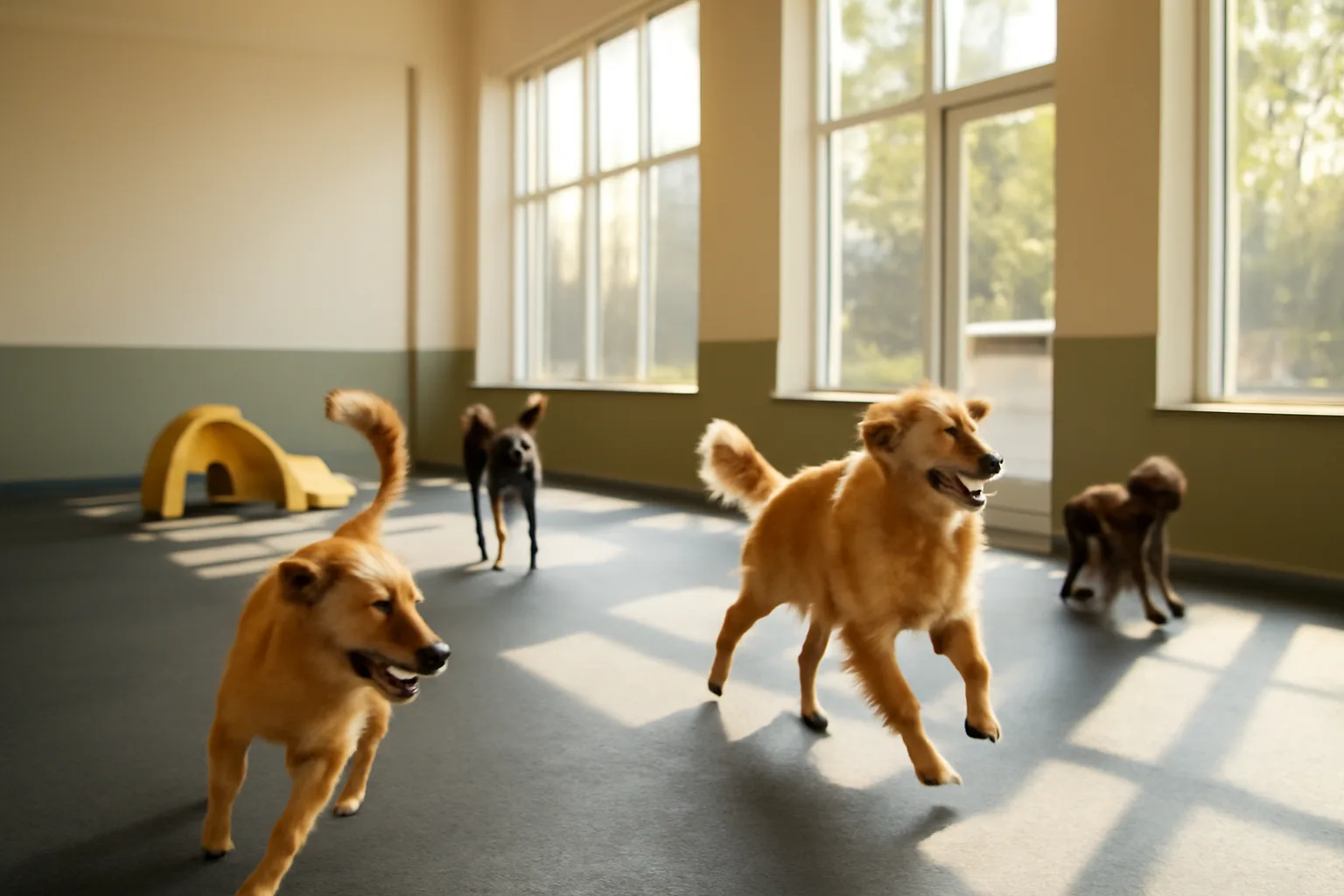
Dogtopia Highlands Ranch is a franchised daycare and boarding facility in Douglas County, Colorado. Boarding there runs in the same general range as most Denver-metro facilities, roughly $45 to $75+ per night depending on add-ons. This article uses it as a jumping-off point to explain dog licensing, breeder registration, and how to actually get papers for a dog, none of which a boarding facility issues.
What is Dogtopia Highlands Ranch and what does it offer?
Dogtopia is a national franchise chain of dog daycare and boarding facilities, and the Highlands Ranch location is one of several Colorado franchises operating under that brand in the Denver metro area. Like other Dogtopia locations, it typically offers open-play daycare, overnight boarding, spa services (baths, nail trims), and sometimes basic training add-ons. Franchise locations set their own prices within brand guidelines, so exact rates vary by location and by season. If you're comparing it to other options, it helps to know that Dogtopia is a corporate franchise model, not an independent kennel. That matters for licensing questions: the location still has to meet the same county zoning and state kennel/commercial animal facility rules as any independently owned dog kennels or pet boarding operation in Douglas County. The franchise name doesn't exempt it from local permitting. For readers researching this specific location because they're considering opening a similar business nearby, the more useful exercise is usually understanding the regulatory layer underneath any daycare/boarding brand, state licensing, county zoning, and facility standards, rather than the franchise branding itself. We cover the operator side of that in dogtopia and doggy day care.
How much does dog boarding cost?
Nationally, overnight dog boarding typically runs $25 to $85 per night depending on the region, the dog's size, and whether the facility is a basic kennel or a higher-end daycare-and-boarding combo like Dogtopia. Denver-metro pricing, including Douglas County, tends to sit in the $40 to $75 per night range for standard boarding, with add-ons (extra playtime, grooming, medication administration) pushing totals higher. There's no single national price registry for boarding rates. So any number you see, including the range above, is a market estimate based on typical published rates from boarding and daycare operators, not a government-set fee. If you want Dogtopia Highlands Ranch's actual current rate, you need to call the location or check their booking page directly, since franchise pricing changes and isn't standardized across locations. For context on how boarding pricing compares across facility types (home boarding, traditional kennels, franchise daycare centers), see dog boarding and dog hotels near me.
What does dog daycare typically cost compared to boarding?
Daycare (drop-off during the day, no overnight stay) usually runs cheaper than boarding, typically $20 to $40 per day at most metro-area facilities, with multi-day packages discounting the per-day rate further. Boarding, because it includes overnight staffing, food, and extra liability exposure, generally costs more per night than a single daycare day. Many daycare-and-boarding combo facilities, which is the Dogtopia model, bundle the two: a dog boards overnight and also gets daytime playgroup access, and the facility prices that as a single boarding rate rather than charging separately for both. That's one reason boarding quotes vary so much between a bare-bones kennel (dog stays in a run most of the day) and a play-based facility (dog gets supervised group play most of the day).
How do you register a dog?
"Registering a dog" usually means one of three different things, and people often mix them up: getting a local dog license (a legal requirement in most municipalities), registering the dog's breed pedigree with a kennel club like the American Kennel Club, or microchip registration. Each is a separate process with a separate agency or organization. Local dog licensing is typically handled by your county or city clerk, animal control agency, or health department, and is required by local ordinance, often tied to rabies vaccination proof. Douglas County and most Colorado municipalities require rabies vaccination and, in many cities, a pet license; requirements vary by city within the county, so check your specific municipality's animal control code rather than assuming a county-wide rule applies uniformly. Breed registration (AKC-style pedigree papers) is a private-organization process, not a government one, covered in the next section. Microchip registration means registering the chip's ID number with the manufacturer's database (or a universal registry) so a found dog can be traced back to you; this is done online through the chip company, not through a government office.
How to get a dog license (and how is it different from a kennel license)?
A dog license is a per-pet, per-year (or multi-year) tag issued by a city or county, usually costing $10 to $25 for spayed/neutered dogs and more for intact dogs, and it requires proof of current rabies vaccination. You apply through your local animal control office, county clerk, or, in some jurisdictions, online through the county's licensing portal. This is entirely different from a kennel license or commercial animal facility permit, which is what a business like a boarding facility, daycare, or breeding operation needs to legally operate. A kennel license authorizes housing multiple dogs (often defined as 3+ or 4+ dogs depending on the jurisdiction) for commercial purposes, and it's issued at the state and/or county level, often requiring a facility inspection, zoning approval, and proof of adequate space, ventilation, and sanitation. Colorado regulates commercial pet care and breeding facilities under the Pet Animal Care Facilities Act (PACFA), administered by the Colorado Department of Agriculture, which requires a state license for kennels, boarding facilities, groomers, and breeders operating above certain thresholds [1]. If you're opening a facility, you need both: the county zoning/business license process and, in Colorado, a PACFA license from the state Department of Agriculture, more than a per-pet city dog tag. If you're the one opening a facility rather than boarding a personal pet, this is the point where a generic "how to get a dog license" answer stops being useful, because you're actually navigating pet boarding and dog kennels licensing, which is state-level, facility-based, and inspection-driven.
How do you get papers for a dog?
"Papers" almost always means AKC (or another breed registry's) registration certificate, which documents a dog's pedigree and breed. You cannot get papers for a dog that wasn't bred from two already-registered parents of the same breed; papers document lineage, they don't certify health, temperament, or quality. To register a puppy with the AKC, the breeder registers the litter after the parents' registration numbers are confirmed, then individual puppy registration is completed, usually by the breeder initially and transferred to the buyer via an AKC registration application that comes with the puppy. If you bought a purebred puppy and didn't get registration paperwork at the time of sale, contact the breeder first; if the breeder is unresponsive or the litter was never registered, you generally cannot retroactively "get papers" without documented proof of the parents' registration, which the AKC requires. Mixed-breed dogs and dogs without documented purebred parentage cannot get traditional kennel club papers, full stop. Some owners confuse a vet record, microchip certificate, or bill of sale with "papers"; none of those are pedigree registration. If your goal is just proving ownership or vaccination history for boarding/daycare intake (which is what most facilities, including Dogtopia locations, actually require), a vet record and rabies certificate is what you need, not AKC papers.
How to become a dog breeder (and when do you cross into state/federal licensing)?
Becoming a hobby breeder with a litter or two a year generally doesn't trigger licensing, but scaling up crosses real legal thresholds fast, and this is where a lot of new breeders get caught off guard. At the federal level, the USDA's Animal Welfare Act requires a license from APHIS for certain commercial breeders. Under the regulations at 9 CFR Part 2, a person who maintains more than four breeding female dogs, cats, or small exotic or wild mammals, and sells any of their offspring sight unseen (born and raised somewhere the buyer cannot personally observe before purchase), must be licensed as a dealer or breeder. Breeders who sell only in person, letting buyers see the animal and its living conditions before purchase, are generally covered by the "retail pet store" exemption and don't need a USDA license regardless of volume [2]. The regulatory definitions and licensing categories (Class A breeder, Class B dealer, and so on) are spelled out in 9 CFR Part 2, Subpart A; if you're breeding at meaningful volume and selling any dogs without an in-person visit, assume you need to check your status with APHIS directly rather than guess. At the state level, Colorado's PACFA law separately requires breeders who have more than a set number of intact females (check current PACFA rules, since thresholds are periodically updated) to hold a state breeder license, with annual inspection and recordkeeping requirements [1]. States vary widely here: some have no breeder-specific threshold below USDA's, others (Colorado included) regulate at a lower dog count than the federal law does. Never assume state and federal thresholds match; they usually don't, and you may need a state license well before you'd need a USDA license, or vice versa. If you're planning to breed and sell across state lines, or via a website, budget time for both a state PACFA (or equivalent state agriculture department) application and a USDA APHIS license application, plus a facility inspection for each. This is exactly the kind of dual-layer compliance problem our $149 one-time Kennel License & Zoning Packet is built to walk operators through systematically; start at /license-packet-builder if you want a structured checklist rather than piecing it together from scattered agency pages.
What's the difference between a boarding facility license and a breeder license?
| Local dog license | Any pet owner | City/county clerk or animal control | |
|---|---|---|---|
| Kennel/boarding facility license | Boarding, daycare, grooming businesses housing multiple dogs | State agriculture dept. (e.g., Colorado PACFA) plus county zoning approval | |
| Breeder license (state) | Breeders above the state's intact-female threshold | State agriculture department | |
| USDA APHIS breeder license | Breeders selling sight-unseen above federal volume thresholds | USDA APHIS, under the Animal Welfare Act | A facility like Dogtopia Highlands Ranch operates under the boarding/daycare category, not the breeder category, since it doesn't sell puppies. If you're planning a facility that does both boarding and a small in-house breeding program, you likely need licenses in both columns, and your county zoning approval needs to reflect both uses, more than one. |
A boarding/daycare facility license (in Colorado, the PACFA "pet animal facility" license category) covers temporary care of other people's pets, while a breeder license covers producing and selling puppies. Both fall under PACFA in Colorado, but they're separate license categories with different inspection checklists, different fee schedules, and different recordkeeping rules [1]. |License type|Who needs it|Typical issuing agency|
What zoning and facility standards apply to a boarding/daycare business like Dogtopia?
Every boarding or daycare facility, franchise or independent, has to clear local zoning before it opens, and this is usually the slower, more unpredictable part of launching compared to the state license application. Zoning determines whether "kennel" or "commercial animal care facility" is a permitted, conditional, or prohibited use in a given commercial or industrial zone, and it's set by the county or municipal planning department, not the state. Douglas County, like most Colorado counties, defines animal-related commercial uses separately from residential keeping of pets in its zoning resolution, and commercial kennels typically require either a use-by-right zoning designation or a conditional use permit depending on the specific zone district. Contact the Douglas County Planning Division directly and ask for the current zoning resolution's animal-use definitions, since districts and definitions get amended periodically and the specific parcel matters more than a general county rule. Facility standards, separate from zoning, cover things like minimum square footage per dog, ventilation, drainage, noise mitigation, and sanitation, and in Colorado these are set out in PACFA rules administered by the Department of Agriculture [1]. Before signing a lease, confirm three things independently: that the zone district allows the use, that the specific suite/building meets PACFA's physical facility requirements, and that your county's noise ordinance doesn't conflict with an outdoor play yard. Skipping any one of these is the single most common reason facility buildouts stall for months after the lease is signed.
How do inspections work for kennels and breeding facilities?
Both PACFA-licensed facilities and USDA-licensed breeders get inspected, but by different agencies with different frequencies and different checklists. Colorado's PACFA program conducts inspections before initial licensing and periodically after, checking sanitation, animal housing, staffing ratios, and recordkeeping [1]. USDA APHIS separately inspects licensed breeders and dealers under the Animal Welfare Act. Inspection frequency and agency resourcing have been the subject of repeated scrutiny; a 2010 USDA Office of Inspector General audit of APHIS's Animal Care program found that the agency's enforcement process for chronic violators was weak, including inconsistent follow-up and penalties that didn't deter repeat offenders. As that audit put it, APHIS "needs to reassess how it agency-wide handles enforcement actions against violators of the Animal Welfare Act," a finding that pushed APHIS toward policy changes in subsequent years [3]. If you're licensed under both state and federal programs (common for breeders selling sight-unseen at volume), expect two separate inspection regimes, two sets of paperwork, and two agencies you're accountable to, not one combined inspection. Keep records (vaccination logs, cleaning schedules, incident reports) in a format that satisfies both, since duplicating recordkeeping systems is a common time sink for growing operators. For daycare/boarding-only operators like a Dogtopia franchise, there's no USDA layer at all, since USDA APHIS licensing applies to breeders and dealers, not to pet boarding or daycare businesses. Your inspection exposure is state (PACFA) and local (fire/health code, if applicable), full stop.
How do you register a dog with a kennel club if you're a breeder?
If you're breeding registered purebred dogs, you register the litter with the applicable kennel club (AKC being the largest in the US) after the litter is born, using the sire and dam's existing registration numbers. The AKC's litter registration process requires the breeder to submit an application along with the stud service or ownership documentation for both parents; individual puppies are then registered by the breeder or transferred to buyers using the paperwork included at sale. This process is entirely separate from state or federal licensing. You can be fully AKC-registered and still be operating illegally if you haven't gotten your state breeder license or, above threshold, your USDA APHIS license. Conversely, you can be fully state- and federally-licensed and choose not to register with any kennel club at all, if you're breeding for working, sport, or mixed-breed purposes where pedigree papers aren't the point. New breeders sometimes assume AKC registration functions like a government license; it doesn't. It's a private registry service with its own fee schedule, and it has no legal bearing on whether your kennel is operating lawfully under state or federal animal welfare law. Check the AKC's own registration pages directly for current fees before budgeting, since a private organization can change them without notice.
Frequently asked questions
How much does dog boarding cost?
Most U.S. boarding runs $25 to $85 per night depending on region and facility type. Denver-metro rates, including Douglas County, typically fall between $40 and $75 per night for standard boarding, with grooming or extra playtime add-ons pushing totals higher. There's no government price registry for this; it's set entirely by the market, so always confirm current rates directly with the specific facility.
How much is dog boarding at a franchise like Dogtopia?
Franchise pricing varies by location even within the same brand, since individual franchisees set rates. Expect Denver-metro Dogtopia locations, including Highlands Ranch, to fall in the general $45 to $75+ per night range for boarding, often bundled with daytime playgroup access. Call the specific location or check its booking page for a current quote.
How do you register a dog?
It depends what you mean. Local dog licensing happens through your city or county animal control office, usually requiring proof of rabies vaccination. Pedigree (breed) registration happens through a kennel club like the AKC. Microchip registration happens through the chip manufacturer's online database. These are three separate processes with three separate agencies or organizations.
How do you get a dog papers?
Papers mean pedigree registration (usually AKC), and you can only get them if both parents are already registered purebred dogs of the same breed. The breeder registers the litter after birth and transfers individual puppy registration to the buyer at sale. Mixed-breed dogs or dogs with undocumented parentage cannot get traditional kennel club papers after the fact.
How do you get papers for a dog you already own without documentation?
If the breeder never registered the litter or is unreachable, you generally cannot retroactively obtain AKC papers without documented proof the parents were registered purebreds. Some breed clubs offer limited alternative paths (like DNA-based parentage verification) in specific cases, but there's no universal workaround. Contact the breeder first; that's almost always the fastest path if papers exist at all.
How to become a dog breeder legally?
Start by checking your state's agriculture department rules (in Colorado, PACFA) for breeder license thresholds, usually based on number of intact breeding females. Separately check USDA APHIS thresholds under the Animal Welfare Act, which require a federal license if you keep more than 4 breeding females and sell puppies sight-unseen. Many small in-person-sale breeders fall under both thresholds and need no license, but verify rather than assume.
How to get a dog license?
Contact your city or county animal control office or clerk, bring proof of current rabies vaccination, and pay the local licensing fee, typically $10 to $25 annually for spayed/neutered dogs. This is a per-pet requirement for owners and is completely separate from a commercial kennel or breeding facility license, which is a state-level business permit.
What's the difference between a dog license and a kennel license?
A dog license is a small annual tag for an individual pet, issued locally, tied to rabies vaccination. A kennel license (called a PACFA license in Colorado) authorizes a business to house multiple dogs commercially for boarding, daycare, grooming, or breeding, and is issued by the state agriculture department after a facility inspection and typically requires county zoning approval too.
Does Dogtopia Highlands Ranch need a USDA license?
No. USDA APHIS licensing under the Animal Welfare Act applies to breeders and dealers selling animals, not to boarding or daycare facilities. A daycare/boarding business like Dogtopia needs state-level licensing (PACFA in Colorado) and local zoning approval, but has no USDA APHIS licensing requirement since it isn't selling animals.
How many dogs can you have before you need a breeder license?
It depends on the state. Colorado's PACFA rules set a specific intact-female threshold for requiring a state breeder license; check the current Colorado Department of Agriculture PACFA rules for the exact number, since thresholds get updated. Federally, USDA APHIS licensing under 9 CFR Part 2 kicks in above 4 breeding females if you also sell sight-unseen; in-person-only sellers are generally exempt regardless of count.
How do you get papers for a puppy from a breeder who won't provide them?
Ask in writing for the litter's AKC (or applicable registry) registration number and the sale contract terms; reputable breeders provide this at or before sale. If a breeder refuses or the litter was never registered, you likely cannot obtain papers after the fact, since registries require documented proof of registered parentage, more than a bill of sale.
Do you need a kennel license to open a dog daycare like Dogtopia?
Yes, in most states. A daycare housing dogs on-site during business hours typically counts as a commercial pet care facility under state law (PACFA in Colorado), requiring a state license, a facility inspection, and separate county zoning approval before opening, regardless of whether it's an independent business or a franchise location.
Sources
- Colorado Department of Agriculture, Pet Animal Care Facilities Act (PACFA) Program: Colorado licenses and inspects commercial pet care facilities and breeders under PACFA
- 9 CFR Part 2, Subpart A (Animal Welfare Act regulations, licensing): USDA APHIS licensing thresholds and exemptions for breeders selling sight-unseen versus in-person are defined in 9 CFR Part 2
- USDA Office of Inspector General, Audit Report 33002-4-SF: APHIS Animal Care Program Inspections of Problematic Dealers (2010): A federal audit found weaknesses in USDA APHIS enforcement and inspection follow-up for breeders with chronic violations
- Code of Federal Regulations (9 CFR Part 3): Federal facility standards (housing, space, sanitation) that apply to licensed animal boarding and breeding facilities
- Colorado Department of Agriculture: State statute (PACFA Act) establishing licensing requirements for pet animal facilities, including boarding kennels and breeders in Colorado