Last updated 2026-07-25
TL;DR
Day boarding for dogs (daytime-only care, no overnight stay) typically costs $20 to $50 per dog per session depending on region and add-ons. Operators need a state or local kennel/pet care license, often a zoning permit or conditional use permit, and must clear a USDA APHIS threshold only if selling dogs, not for boarding or daycare services themselves.
What is day boarding for dogs, exactly?
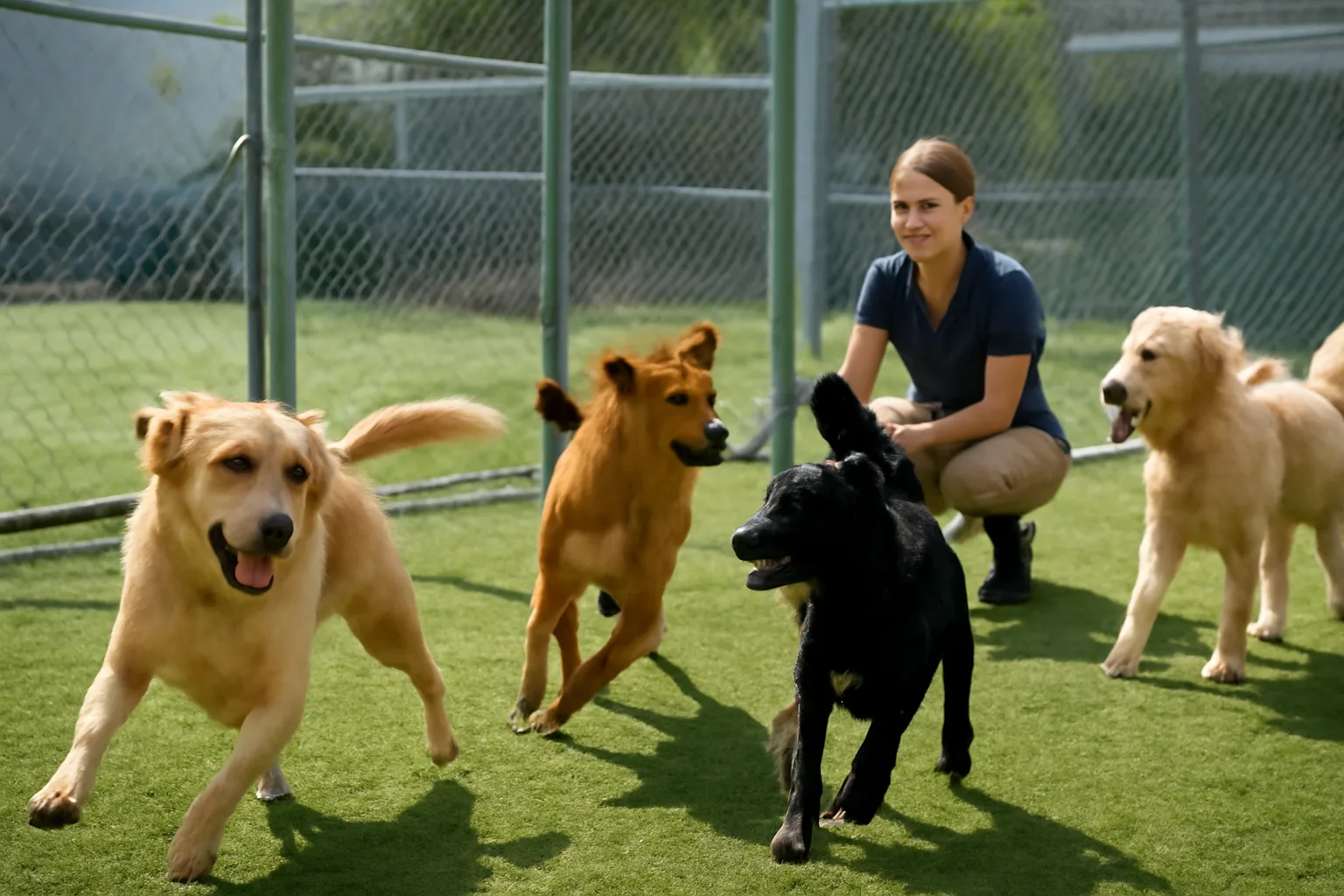
Day boarding is daytime-only supervised care for a dog, usually dropped off in the morning and picked up before closing, with no overnight stay. It sits between drop-in dog walking and full overnight boarding. Some facilities call this "doggy daycare" and some call it "day boarding" interchangeably, but a few operators draw a distinction: day boarding implies more individual attention or a boarding-style room setup (think a private suite with a cot), while daycare implies group play in an open room. For licensing purposes, most state and county rules don't care what you call it. If you're housing, feeding, or supervising someone else's dog for money, on your property, you're almost certainly running a "kennel" or "pet care facility" under your state's animal control or agriculture code, and that triggers licensing requirements whether the dog goes home at 6pm or stays till Tuesday. Check your state licensing rules before assuming daytime-only care is exempt. A handful of states and counties do carve out lighter rules for daytime-only operations versus overnight kennels, mostly because overnight facilities need sleeping quarters, fire/life-safety sign-off for occupants staying past business hours, and sometimes a caretaker on-site overnight. Day boarding usually skips those requirements. That's a real cost and permitting difference, more than semantics.
How much does dog boarding cost?
| Group daycare (open play) | $20 - $35 | |
|---|---|---|
| Day boarding with private suite | $30 - $50 | |
| Overnight boarding (standard) | $35 - $65 | |
| Overnight boarding (luxury/private suite) | $60 - $100+ | |
| Add-on: medication administration | $5 - $15 per dose | |
| Add-on: grooming bath | $20 - $50 | If you're pricing a new facility, look at three to five direct competitors within a 15-mile radius before setting rates, and factor in your actual cost per dog per day (staff-to-dog ratio, cleaning supplies, insurance) rather than just matching the market. A lot of new operators underprice in year one and have to raise rates on existing clients, which is an avoidable headache. |
Day boarding for dogs generally runs $20 to $50 per dog per day in the US, with most markets clustering around $25 to $40 for a standard daytime day. Overnight boarding costs more, typically $35 to $85 a night, because it includes evening and morning care, sometimes a private room, and after-hours staffing. Pricing swings hard by region and service tier. A daycare in a mid-size Midwest city might charge $22 a day for open-play group care. The same service in Manhattan or San Francisco can run $50 to $65. Add-ons push the number up fast: grooming bundles, medication administration (often $5 to $15 extra per dose), one-on-one play, or webcam access. Here's a rough national comparison. These are market averages, not quotes from any single company, and you should treat them as a planning range, not a rate card. | Service type | Typical daily cost |
How much is dog boarding compared to other pet care options?
Boarding (overnight) tends to cost 1.5x to 2x what day boarding or daycare costs per day, because you're paying for round-the-clock supervision instead of an 8 to 10 hour window. In-home pet sitting, where someone stays at the dog's own house, often costs more per night than kennel boarding in the same market, sometimes $40 to $75 a night, because you're paying for a dedicated sitter's time rather than shared facility staff. Drop-in dog walking is the cheapest option. Typically $15 to $25 for a 20 to 30 minute visit. But it's not a substitute for full-day supervision if a dog can't be left alone. For puppies, dogs with separation anxiety, or dogs recovering from surgery, day boarding or daycare is often the right call even though it costs more than a walk, because you're paying for continuous eyes on the dog rather than a single check-in. If you're comparing services for your own facility's competitive set, pet boarding and dog hotels near me are useful benchmarks for what higher-end overnight competitors charge, since your day boarding price should sit meaningfully below your own overnight rate.
What license do I need to operate a day boarding or daycare facility?
Nearly every state and most counties require some form of kennel, pet care facility, or animal boarding license before you can legally board or care for dogs that aren't yours, even if it's daytime-only. The exact name of the license and the issuing agency varies: some states license through the department of agriculture, some through a state veterinarian's office, and many just defer entirely to county or city animal control. There is no single federal license for boarding or daycare operators. USDA APHIS licensing under the Animal Welfare Act applies to specific commercial activities like breeding and selling dogs wholesale, exhibiting animals, or research, not to boarding kennels or daycares that only care for pets owned by the public [1]. If all you do is board and daycare dogs owned by their families, USDA licensing typically does not apply to you. What you will almost always need, at the state or local level:
- A business license from your city or county
- A kennel or pet care facility license (state or county level, names vary widely)
- A certificate of occupancy or zoning approval for the specific use (commercial animal care is a distinct use category in most zoning codes)
- Proof of rabies vaccination requirements for dogs on premises, per your state's public health code
- Fire and building code sign-off, especially if you have any overnight component Because requirements vary so much by state and even by county, don't assume the rules from one location apply somewhere else. Pull your specific state agriculture department page and your county zoning office page before you sign a lease. A kennel license and zoning packet built for your state and county can save you the research time of tracking down which agency handles what, though you'll still want to confirm current fees and forms directly with your local offices since those numbers change.
How do you register a dog for boarding or daycare intake?
Registering a dog for day boarding means collecting the paperwork and health records a facility needs before accepting the dog, not a government filing. Most facilities require: proof of rabies vaccination (required by state law in all 50 states for dogs, generally renewed every 1 or 3 years depending on vaccine type and state) [2], proof of distemper/parvo (DHPP) vaccination, and often a negative fecal test or proof of flea/tick prevention. Many daycares also require a Bordetella (kennel cough) vaccine, even though it's not state-mandated, because it reduces outbreak risk in group play settings. A temperament test or trial day before the dog is cleared for group play is standard practice at reputable daycares. This is a facility policy decision, not a licensing requirement, but insurers sometimes ask about your intake protocol when underwriting a policy. For your own operations, a simple intake form should capture: owner contact and emergency contact, vet name and phone number, vaccination records with expiration dates, behavioral notes, feeding instructions, and a signed liability waiver. Keep vaccination records on file and set an automated reminder system for renewals; a lapsed rabies certificate is one of the most common gaps inspectors and insurance auditors flag.
How do you get a dog license (the government kind)?
A dog license is a separate thing from a boarding license: it's a local government requirement for individual dog owners, usually issued by the county or city clerk or the county's animal control department, and it's usually not something a boarding facility handles for clients. Owners typically need current rabies vaccination proof and a small fee, often $10 to $25 a year for an intact dog and less for spayed/neutered dogs in counties that offer that discount. Requirements vary heavily by state and even by municipality. Some states, like Ohio, require dog licensing statewide through the county auditor's office, with fees set by county [3]. Other states leave dog licensing entirely up to individual cities or counties, so there's no single national answer. If a client asks you how to license their personal dog, the honest answer is "check your county clerk or animal control website," not something a boarding facility can process on their behalf. Some facilities do ask to see a current dog license tag at intake alongside vaccination records, mostly because it's a quick proxy for "this owner keeps paperwork current." It's not a substitute for the vaccination records themselves.
How do you get papers for a dog, and what does that actually mean?
"Getting papers" for a dog almost always means AKC registration or registration with another breed registry, which documents the dog's parentage and breed lineage. It has nothing to do with boarding, daycare, or kennel licensing. It's a private registry service, not a government requirement. To register a purebred puppy with the American Kennel Club, the breeder typically registers the litter first, then transfers individual registration to the buyer using a registration application that comes with the puppy at sale. If you bought a dog described as purebred but the seller has no registration paperwork, you generally cannot retroactively "get papers" for that dog unless you can document parentage through DNA testing and registry-specific pathways, which some registries allow under limited circumstances but many do not. If you're a breeder trying to register litters, that process runs through the AKC or another registry's litter registration system, not through any state or county office. It's worth knowing this distinction cold if you run a boarding or daycare facility, because clients sometimes ask front-desk staff this question assuming it's related to vaccination records or licensing, and it isn't.
How to become a dog breeder, and when do USDA rules kick in?
Becoming a dog breeder legally starts with your state and local rules, not a federal license, unless you cross specific USDA thresholds. Most states require a kennel license once you keep a certain number of breeding females or sell more than a set number of puppies per year; the exact numbers vary by state, so check your state department of agriculture's specific breeder licensing page rather than assuming a number. Federally, USDA APHIS requires a license under the Animal Welfare Act if you sell more than 25 dogs per year that were born and raised on your premises AND you sell them sight unseen (meaning the buyer doesn't personally observe the animal, its parents, or the home/premises before purchase, such as online or wholesale sales) [1]. Breeders who sell puppies only after the buyer has physically visited and inspected the dog and the premises are generally exempt from this specific threshold, per USDA's regulatory definition of a retail pet store. If you sell wholesale to pet stores, brokers, or research facilities, or you exceed the sight-unseen threshold, you need a USDA license regardless of your state's rules. The Animal Welfare Act regulations define a retail pet store, for purposes of this exemption, as a place where animals are sold at retail for personal use "and where the seller has direct face-to-face contact with the purchaser" [1]. Beyond the federal threshold, individual states often layer on their own breeder licensing rules with lower numeric triggers, so a breeder can be exempt federally but still need a state kennel license. Check both. They aren't the same requirement and don't substitute for each other.
What does a zoning hearing for a day boarding facility usually involve?
Most municipalities classify commercial dog boarding and daycare as a conditional use or special exception in residential-adjacent zones, meaning you need a public hearing before a zoning board even if the property is otherwise zoned commercial. Common conditions boards attach: outdoor play area setback from property lines (often 25 to 100 feet, varies by county), noise mitigation requirements, hours restrictions for outdoor play, and caps on the number of dogs on-site at once. Boards weigh noise complaints heavily, more than almost any other factor, because barking dogs are the number one neighbor objection at these hearings. Coming prepared with a written noise mitigation plan (sound-dampening fencing, limited outdoor hours, staff monitoring protocols) measurably improves outcomes compared to showing up without one, based on the pattern reported across county zoning board minutes in numerous jurisdictions. Bring photos or site plans showing setbacks and fencing, and if your county publishes prior board decisions for similar uses, read a few before your hearing. Check your specific county zoning office requirements early, ideally before you sign a lease, because a lease on a property that can't get zoning approval for animal care use is an expensive mistake. Some counties publish their conditional use checklist online; others require a pre-application meeting with planning staff to even find out what's needed.
What facility standards do inspectors check for day boarding?
Inspectors (state agriculture department, county animal control, or a licensing board depending on your state) generally check: enclosure size and construction per dog, sanitation and disease control protocols, ventilation and temperature control, staff-to-dog ratios during group play, and fire/life-safety compliance for the space. USDA's own facility standards for licensed animal facilities, while they technically apply to USDA-licensed operations rather than typical daycare/boarding businesses, are a useful baseline many state inspectors reference: primary enclosures must provide enough space for each dog to "turn about freely, to stand, sit, and lie in a comfortable, normal position, and to walk in a normal manner" [4]. Many state kennel codes borrow similar language even for non-USDA-licensed boarding facilities. Common inspection failure points, based on typical state kennel inspection checklists: inadequate separation between dogs of different households in group settings, poor drainage in wash-down areas leading to standing water, missing or expired vaccination records on file, and inadequate ventilation causing ammonia buildup. Fix these before an inspector shows up, not after a failed inspection. A re-inspection often costs an additional fee and delays your opening date by weeks. Review facility standards for your state's specific enclosure and ventilation requirements before you build out your space, since retrofitting after construction is far more expensive than designing to code the first time.
How much does it cost to get licensed and open a day boarding business?
Total licensing and permitting costs to open a legal day boarding or daycare business typically range from a few hundred dollars to several thousand, depending heavily on whether you need a zoning hearing (which can require paying for a site plan, a traffic study in some counties, or legal representation) versus a straightforward business license renewal in an already-commercial zone. Rough line items to budget for, understanding every jurisdiction differs:
- Business license: often $50 to $500 depending on city/county
- State or county kennel/pet care facility license: often $50 to $300 annually, some states scale by number of animals
- Zoning application/conditional use permit fee: often $200 to $2,000+, with public hearing notice costs sometimes added on top
- Building/fire inspection fees: variable, often $100 to $500
- Liability insurance: budget separately, typically $500 to $2,000+ a year for a small facility, more as you scale None of these numbers are universal. A rural county with no zoning hearing requirement might cost you under $500 total to get licensed. A dense suburban county requiring a full conditional use hearing with public notice, a traffic study, and legal review can run several thousand dollars before you ever open the doors. Get your specific state and county fee schedules directly from their.gov pages rather than budgeting off someone else's total, since fee schedules change and vary block by block in some cities.
Daycare vs. day boarding vs. overnight boarding: what's the licensing difference?
| Dogs on-site overnight | No | Yes | |
|---|---|---|---|
| Overnight staff/caretaker required | Usually not required | Often required by state/county code | |
| Fire/life-safety review | Standard commercial | Often stricter, since animals are unattended occupants | |
| Zoning classification | Commercial animal care use | Often same category, sometimes stricter conditions | |
| Typical licensing agency | State/county kennel or pet care license | Same, but often reviewed more heavily | If you plan to add overnight boarding later, it's worth designing your facility and applying for zoning approval that covers both from the start, rather than going back through a second hearing process once you're already operating daycare. Boards are sometimes more receptive to a phased build-out plan presented upfront than to a facility that shows up asking to expand its approved use a year later. Compare offerings across Dogtopia and other national doggy day care chains if you want a sense of how bigger operators structure their service tiers, though your own licensing path depends on your specific location, not theirs. |
The licensing difference between daycare, day boarding, and overnight boarding mostly comes down to whether animals stay on-site after business hours, which triggers additional fire/life-safety and staffing requirements in many jurisdictions. Daytime-only operations (dogs go home each night) generally face a lighter regulatory lift than overnight boarding in the same jurisdiction. | Factor | Daycare / Day boarding | Overnight boarding |
Frequently asked questions
How much does dog boarding cost per day?
Day boarding for dogs typically costs $20 to $50 per dog per day in the US, with most markets averaging $25 to $40. Overnight boarding runs higher, generally $35 to $85 a night. Exact pricing depends on your region, whether it's group daycare or a private suite, and add-ons like medication or grooming.
How to register a dog with a boarding or daycare facility?
Bring proof of current rabies vaccination, DHPP (distemper/parvo) vaccination records, and often a Bordetella vaccine, along with owner and emergency contact info and vet contact details. Most facilities require a signed liability waiver and many require a trial day or temperament evaluation before clearing a dog for group play.
How do you get a dog license?
A dog license is issued by your city or county clerk or animal control office, not by a boarding facility. You typically need proof of current rabies vaccination and a small annual fee, often $10 to $25, with lower fees for spayed/neutered dogs in many counties. Requirements and fees vary by state and county, so check your local government's website directly.
How do you get papers for a dog?
"Papers" usually means AKC or other breed registry registration, documenting a dog's lineage. If purchased from a registered litter, the breeder provides a registration application at time of sale. There's no government process for this; it's a private registry service, and dogs without documented parentage generally can't retroactively get full registry papers.
How can I get papers for my dog if the breeder didn't provide any?
If your breeder didn't provide registration paperwork, contact them first; sometimes it's a delay, not a refusal. Some registries offer limited pathways using DNA testing to establish parentage, but many require documentation from the original litter registration. Without breeder cooperation or documented lineage, full registry papers usually aren't obtainable.
How to become a dog breeder legally?
Check your state department of agriculture's breeder licensing rules first, since thresholds for required licenses vary by state. Federally, USDA APHIS licensing applies if you sell more than 25 dogs a year born on your premises and sell them sight unseen; breeders selling only to buyers who visit in person are generally exempt from that specific federal threshold.
Do I need a USDA license to run a dog boarding or daycare business?
No. USDA APHIS licensing under the Animal Welfare Act applies to specific commercial activities like wholesale breeding, selling animals sight unseen, exhibition, and research, not to boarding kennels or daycares caring for dogs owned by the public. Boarding and daycare licensing is handled at the state and county level instead.
What's the difference between day boarding and doggy daycare?
The terms are often used interchangeably, though some operators use "day boarding" for individual suite-style care and "daycare" for open group play. For licensing purposes, most jurisdictions treat them identically: both are daytime-only supervised care requiring the same kennel or pet care facility license as overnight boarding, just without overnight staffing requirements.
How much does it cost to license a day boarding facility?
Costs vary widely by state and county. Budget roughly $50 to $500 for a business license, $50 to $300 annually for a state or county kennel license, and $200 to $2,000+ for zoning or conditional use permits if a public hearing is required. Rural areas with simpler zoning often cost far less than dense suburban counties.
Does day boarding require a zoning permit?
In most municipalities, yes. Commercial dog care, including daytime-only boarding, is usually classified as a conditional use or special exception in zoning codes, especially in or near residential districts. You'll likely need a public hearing before a zoning board, even if the property is already zoned commercial.
Can I board dogs in my home without a license?
Almost never legally, if you're charging money and caring for dogs that aren't your own. Most states and counties require a kennel or pet care facility license regardless of whether the business operates from a commercial building or a private home, and home-based animal businesses often face additional zoning restrictions.
What vaccinations are required for dog daycare or day boarding?
Most facilities require proof of current rabies vaccination (mandated by state law), DHPP (distemper/parvo), and often Bordetella (kennel cough), even though Bordetella isn't state-mandated. Some also require a negative fecal test or flea/tick prevention proof. Exact requirements are set by each facility, not by government regulation, beyond the rabies mandate.
How many dogs can one staff member supervise during daycare?
There's no single national standard; ratios are typically set by individual state kennel codes or by industry best practice guidance from groups like the Pet Care Services Association, commonly cited in the range of 10 to 15 dogs per staff member during active group play, though this varies by state code and by dog temperament mix.
Sources
- USDA APHIS, Animal Welfare Act regulations, 9 CFR 2.1: USDA APHIS licensing applies to specific commercial breeding/selling activities, not boarding or daycare of pet-owned dogs
- CDC, Rabies vaccination requirements by state: All 50 states require rabies vaccination for dogs, typically renewed every 1 or 3 years
- Ohio Revised Code 955.01, Dog registration: Ohio requires statewide dog licensing through county auditors with county-set fees
- 9 CFR 3.6, Primary enclosures for dogs and cats: USDA space standard requiring dogs to turn about freely, stand, sit, lie comfortably, and walk normally in enclosures
- Electronic Code of Federal Regulations (eCFR): USDA licensees must allow inspectors access to facilities and records, which is part of the facility standards enforced under the Animal Welfare Act.
- Electronic Code of Federal Regulations (eCFR): Federal standards specify housing facility requirements, such as structural strength and space, that inspectors check for facilities handling dogs.
- Ohio Revised Code: Ohio law establishes licensing requirements for commercial dog breeders, which is relevant to when state breeder rules apply alongside USDA rules.
- U.S. Small Business Administration (SBA): Businesses, including pet care facilities, typically need to obtain local and state business licenses and permits before opening.